

 English
 Español
 عربى

1. Core Technology: High Volume, Low SpeedNatural Breezes: Unlike the “harsh” wind from small fans, HVLS fans use massive blades rotating at low speeds to create a large-scale, three-dimensional breez...
Content
Industrial facilities require dependable airflow to maintain comfortable working conditions, protect products, support ventilation, and improve operational efficiency. In warehouses, manufacturing plants, workshops, logistics centers, garages, commercial buildings, and other large spaces, ordinary portable fans often provide only localized cooling. Traditional high-volume low-speed ceiling fans may deliver broad airflow, but they are not always practical when overhead structures, cranes, racking, conveyors, low ceilings, or installation limitations prevent ceiling mounting.
The 79-inch freestanding energy-efficient HVLS industrial fan is designed to address these challenges. It combines a large-diameter fan assembly, a robust mobile support structure, a gearless direct-drive motor, industrial-grade blades, and quiet operation in one versatile airflow solution. Its freestanding configuration allows airflow to be positioned where it is needed without requiring permanent overhead installation.
With a maximum fan diameter of approximately 2 meters, the unit is engineered to move substantial volumes of air at relatively low operating speeds. This makes it suitable for cooling personnel, improving air circulation, dissipating fumes and odors, drying wet surfaces, and reducing stagnant air in large or obstructed areas. Depending on the selected model, the product provides maximum speeds from 200 RPM to 420 RPM, motor power from 0.35 kW to 0.65 kW, and a noise level below 40 dB under the stated specifications.
Manufactured by Shanghai Aipu Fans Co., Ltd., the fan reflects the company’s focus on industrial ventilation, energy-efficient motor technology, customized product solutions, and controlled manufacturing processes. The company has operated since 2006 and maintains an 8,000-square-meter production base equipped with automated machinery, machining, cutting, welding, and testing centers.
This article examines the product’s construction, technical performance, applications, advantages over conventional portable fans and fixed ceiling systems, manufacturing strengths, selection considerations, maintenance requirements, and frequently asked questions.
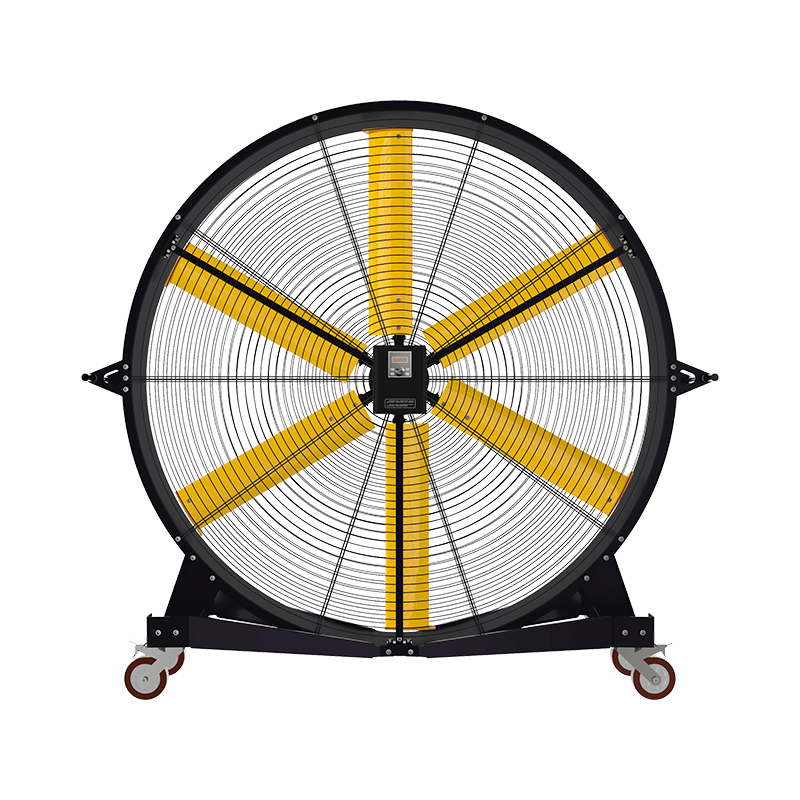
79-inch freestanding energy-efficient HVLS industrial fan
HVLS stands for high volume, low speed. HVLS fans are designed to move a large amount of air across a wide area rather than producing a narrow, high-velocity stream from a small blade diameter. The large blade span allows the fan to influence air across a broad zone, helping improve circulation in spaces where ordinary fans may not be sufficient.
A freestanding HVLS industrial fan uses this large-airflow principle without depending on ceiling suspension. Instead of being attached to a roof structure, the fan is supported by a purpose-built stand and frame. This arrangement provides flexibility for facilities that cannot support a ceiling-mounted fan or need airflow to be moved between work zones.
The 79-inch configuration is approximately 2 meters in diameter, making it substantially larger than common household or office fans. Its large blades are designed to move air efficiently at low or moderate speed. This design can help distribute airflow more evenly across a working area while reducing the need for multiple small fans.
The freestanding format is particularly useful in industrial environments with obstructions. Storage racks, overhead cranes, conveyors, machinery, lighting systems, ductwork, and low roof sections can make overhead airflow difficult to install or operate. A floor-supported fan can be placed at a suitable position and directed toward the required zone.
Because the fan is intended for industrial use, it is built with durability in mind. The impact-resistant frame is designed to withstand the demanding conditions associated with factories, warehouses, workshops, commercial spaces, and other high-traffic environments. The direct-drive motor eliminates belts and pulleys, reducing the number of mechanical wear components inside the drive system.
The most important advantage of the product is its large 79-inch blade diameter. Larger blades can influence a wider air zone than compact fans, allowing the product to support general circulation instead of only cooling a small area immediately in front of the fan.
Each blade is engineered to move a substantial volume of air without unnecessarily increasing the load on the motor. The blade geometry is intended to produce effective airflow at low operating speeds, which is consistent with the principles of HVLS fan design. In practical use, this may help reduce hot spots, stagnant air, and uneven ventilation in large spaces.
A large blade span can also reduce the number of separate fan units required for a given area. Rather than positioning many small fans throughout a facility, an operator may use fewer large-airflow units in strategic locations. The appropriate quantity and placement still depend on room layout, ceiling height, heat sources, ventilation requirements, and local safety conditions.
The freestanding structure is one of the product’s strongest advantages over ceiling-mounted fans. Installation does not require a dedicated overhead suspension point, roof reinforcement, or extensive structural modification. This can simplify deployment in rented buildings, temporary work areas, production floors, warehouses, and facilities with complicated roof structures.
The product can also address spaces where overhead airflow is blocked or unsuitable. For example, a warehouse may contain tall racks that interrupt air movement. A workshop may have cranes, ducts, or suspended equipment. A loading area may have a partially open structure or no usable ceiling. In such cases, a floor-supported fan can provide airflow from a more practical direction.
Freestanding equipment can also be useful when airflow needs change throughout the day. A facility may require stronger circulation near a production line during one shift and near a loading or drying area during another. The stand format provides greater positioning flexibility than a permanently fixed fan.
The product uses a gearless direct-drive motor system. In a traditional belt-driven fan, the motor transfers power through belts, pulleys, and related mechanical components. These parts may stretch, wear, slip, or require periodic adjustment and replacement.
A direct-drive configuration connects the motor more directly to the fan assembly. By removing belts and pulleys, the design reduces the number of parts exposed to mechanical friction and alignment problems. This can support lower maintenance requirements and more consistent operation over the service life of the product.
The direct-drive structure also helps create a cleaner and more compact transmission system. It eliminates belt noise and avoids the need for belt tension checks. For industrial operators, this may reduce routine service work and limit downtime associated with drive-component replacement.
Direct drive does not mean that maintenance is unnecessary. Bearings, electrical connections, controls, blades, protective structures, and the motor itself still require inspection. However, eliminating the belt system removes one common source of maintenance and operating variation found in conventional fan designs.
The product is designed to provide effective airflow while using relatively low motor power. Depending on the model, the listed power range is 0.35 kW to 0.65 kW. The ASF-20 configuration is listed with 0.65 kW, or 650 W, and a maximum speed of 200 RPM.
Low-speed, large-diameter airflow can be more efficient for broad circulation than relying solely on several small fans operating at high speed. A properly selected large fan can move air across a wider area with a motor sized for controlled industrial operation. This may help facilities manage energy consumption, particularly when the fan is used for long operating periods.
Energy performance depends on many factors, including operating speed, room dimensions, airflow resistance, fan placement, temperature, maintenance condition, and local electricity costs. The most effective approach is to select the correct model and operate it at the lowest speed that achieves the required air movement.
All listed models are specified at a noise level below 40 dB. This low-noise specification is valuable in working environments where excessive sound can interfere with communication, concentration, training, monitoring, or customer service.
The direct-drive motor contributes to quiet operation by avoiding the vibration and belt noise associated with some traditional mechanical drive systems. The large blades also allow the fan to generate airflow at lower rotational speeds than many small high-speed fans.
Actual sound levels may vary according to distance, floor reflections, surrounding equipment, installation conditions, operating speed, and the acoustic characteristics of the building. Nevertheless, the stated specification positions the product as a suitable option for facilities seeking industrial airflow without adding significant background noise.
The listed protection level is IP55. In general terms, an IP55 enclosure classification indicates protection against dust ingress sufficient to support normal industrial use and protection against water jets from limited directions. It should not be interpreted as protection for submersion or unrestricted exposure to severe weather.
The IP55 rating can be beneficial in workshops, warehouses, commercial facilities, garages, and other environments where airborne particles or incidental moisture may be present. Operators should still follow installation instructions and avoid using the equipment beyond its rated environmental conditions.
Industrial fans operate in environments where contact with equipment, carts, tools, or moving materials may occur. The product’s impact-resistant frame is designed to provide an additional level of protection against the physical demands of daily industrial use.
The frame helps protect the fan assembly and provides a stable support structure for operation. Its robust construction is intended to withstand the demanding conditions often found in factories and warehouses, where equipment may be exposed to vibration, movement, dust, and frequent handling.
Impact resistance should be viewed as a durability feature rather than permission for deliberate collision or improper handling. Safe clearance around the fan remains essential, and the unit should be positioned where vehicles, forklifts, and moving loads cannot strike it.
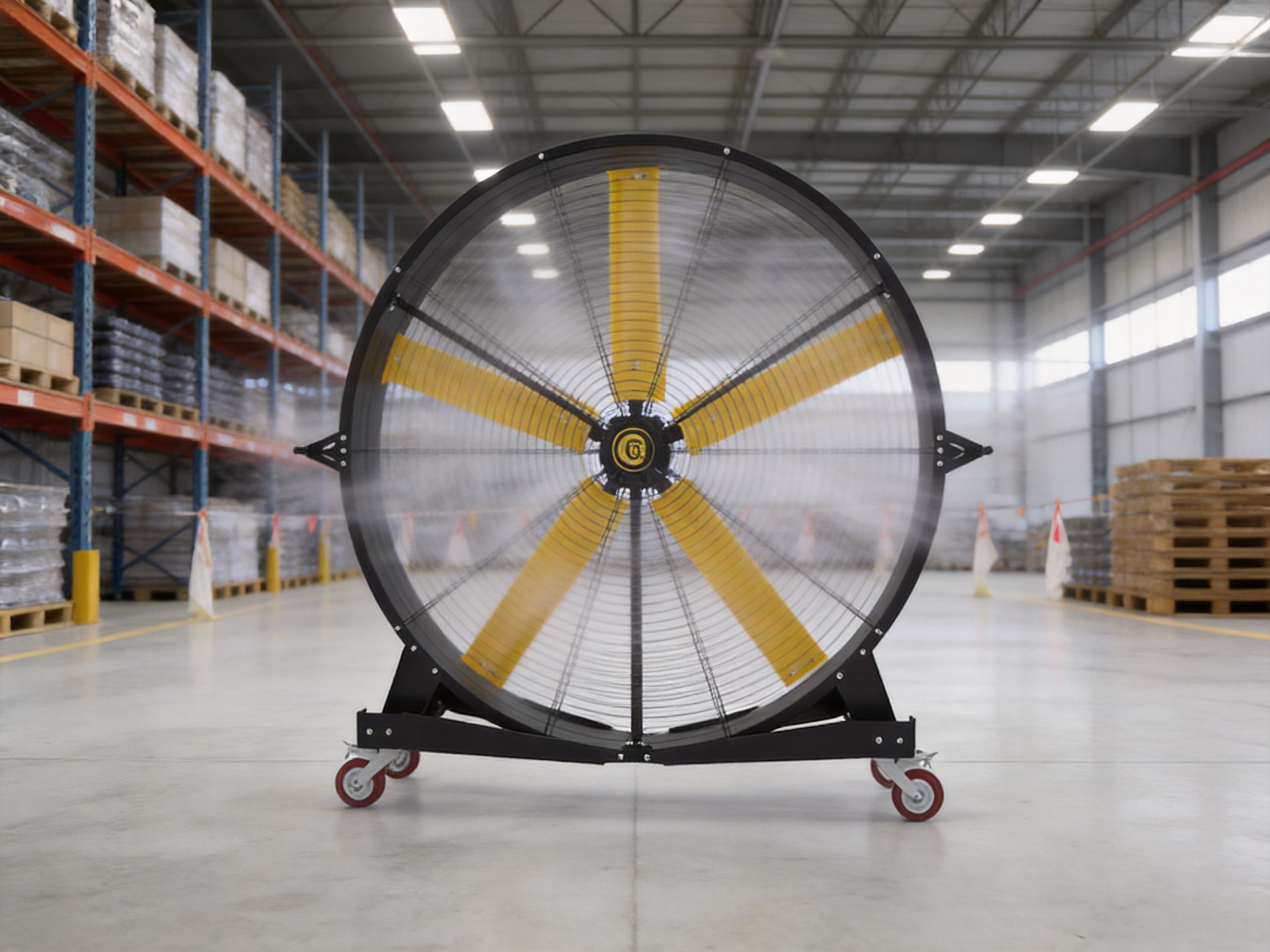
The product range includes several models with different dimensions, speeds, weights, and motor ratings. These options allow buyers to select a configuration based on required airflow, available floor space, mobility needs, and expected operating conditions.
| Model | Overall Size | Maximum Speed | Weight | Power | Noise Level | Protection Level |
|---|---|---|---|---|---|---|
| ASF-09 | 1000 × 640 × 1100 mm | 420 RPM | 65 kg | 0.35 kW | <40 dB | IP55 |
| ASF-12 | 1310 × 640 × 1400 mm | 380 RPM | 80 kg | 0.40 kW | <40 dB | IP55 |
| ASF-15 | 1610 × 720 × 1700 mm | 300 RPM | 92 kg | 0.55 kW | <40 dB | IP55 |
| ASF-20 | 2100 × 720 × 2240 mm | 200 RPM | 142 kg | 0.65 kW | <40 dB | IP55 |
The ASF-20 is the largest listed configuration and corresponds to the approximately 79-inch or 2-meter fan diameter. It has a listed overall dimension of 2100 × 720 × 2240 mm, a weight of 142 kg, a maximum speed of 200 RPM, and a rated power of 0.65 kW.
The smaller ASF-09, ASF-12, and ASF-15 versions provide alternatives for locations with limited space or lower airflow requirements. Their higher maximum rotational speeds reflect the relationship between fan diameter, blade speed, and the intended airflow range. A larger blade assembly generally does not need to rotate as quickly as a smaller one to influence a large air volume.
Before ordering, buyers should confirm whether the listed dimensions refer to the complete operating footprint, shipping dimensions, or a particular configuration. Floor clearance, access routes, door widths, aisle space, and safe operating zones should be checked in advance.
The fan blades are made from industrial-grade materials and are designed for reliable airflow in demanding environments. The product information identifies magnalium as the material. Magnalium is a lightweight aluminum-based alloy that can offer a useful combination of low weight, strength, and corrosion resistance when properly manufactured and finished.
Lower blade weight can reduce the load placed on the motor and support responsive operation. At the same time, the blade material must maintain sufficient rigidity to preserve its shape under rotation. Proper blade balance is also important because imbalance can create vibration, noise, and unnecessary stress on the motor and frame.
The available blade colors are listed as yellow, blue, silver, black, and red. Color selection can help coordinate the fan with facility branding, safety identification, equipment categories, or interior design requirements. Buyers should confirm available colors, minimum order quantities, and production lead times for customized orders.
The product information identifies five- or six-blade configurations. Blade count may influence airflow characteristics, visual appearance, motor loading, and operating performance. The most suitable configuration depends on the selected model and the intended application.
Customers should request the recommended blade configuration for their operating conditions rather than selecting solely on appearance. Factors such as space size, desired airflow intensity, operating speed, power supply, and duty cycle should be considered together.
The listed inverter is Kewo. An inverter or variable-frequency control system can allow operators to adjust the fan speed according to actual airflow needs. Variable-speed operation is useful because maximum speed is not always required throughout the day.
Adjustable speed can help improve comfort, control energy use, and adapt airflow to changing production conditions. For example, a facility may run the fan at a lower setting during mild weather and increase airflow during peak heat or when additional drying is required.
Speed adjustment should be performed within the manufacturer’s recommended operating range. Electrical installation, grounding, control-panel configuration, and protection settings should be completed by qualified personnel in accordance with applicable standards.
Small portable fans are useful for personal cooling, but they generally have a limited coverage area. Their smaller blades often produce a concentrated air stream that loses effectiveness quickly with distance. In a large warehouse or factory, many units may be necessary to influence the entire space.
The 79-inch freestanding HVLS industrial fan is designed for broad-area airflow. Its larger blade span allows it to move air over a wider zone, potentially reducing the number of units needed for general circulation. Its industrial frame and direct-drive motor are also more suitable for continuous commercial or industrial operation than many consumer-grade portable fans.
Another difference is durability. Household fans may not be designed for dust, extended operating hours, accidental contact, or industrial handling. The product’s IP55 protection level, impact-resistant frame, industrial-grade blades, and high-strength construction are intended for more demanding conditions.
Noise is another consideration. A large fan operating at low speed may create a more comfortable acoustic environment than multiple small fans operating at high speed. The stated noise level below 40 dB supports use in facilities where workers need to communicate clearly.
Finally, a single large airflow unit may simplify facility management. Instead of maintaining many small motors, power cords, guards, and switches, an operator may be able to manage fewer industrial units positioned according to the facility’s airflow plan.
Ceiling-mounted HVLS fans remain valuable in many large buildings, especially where high ceilings and suitable structural supports are available. However, they are not practical for every site. The freestanding product provides an alternative when ceiling installation is difficult, costly, or impossible.
Installation flexibility is the primary distinction. A freestanding fan does not require a roof beam, structural reinforcement, suspension rod, or permanent mounting point. This can reduce installation complexity and make the product suitable for leased buildings or temporary facilities.
Ceiling obstructions can also limit the effectiveness of overhead fans. Racks, mezzanines, cranes, lights, sprinklers, ducts, and machinery may interfere with airflow or create safety concerns. A floor-supported unit can be positioned below or around these obstructions to target a specific work zone.
Maintenance access is another advantage. A freestanding fan can generally be inspected from floor level without lifts or elevated work platforms, although suitable lockout and safety procedures are still required. Easier access may reduce service time and improve the likelihood that routine inspections are completed on schedule.
The product is not intended to replace every ceiling-mounted fan. In a very large unobstructed facility, overhead installation may provide more uniform whole-building circulation. The freestanding model is especially valuable where flexibility, targeted airflow, mobility, and installation simplicity are priorities.
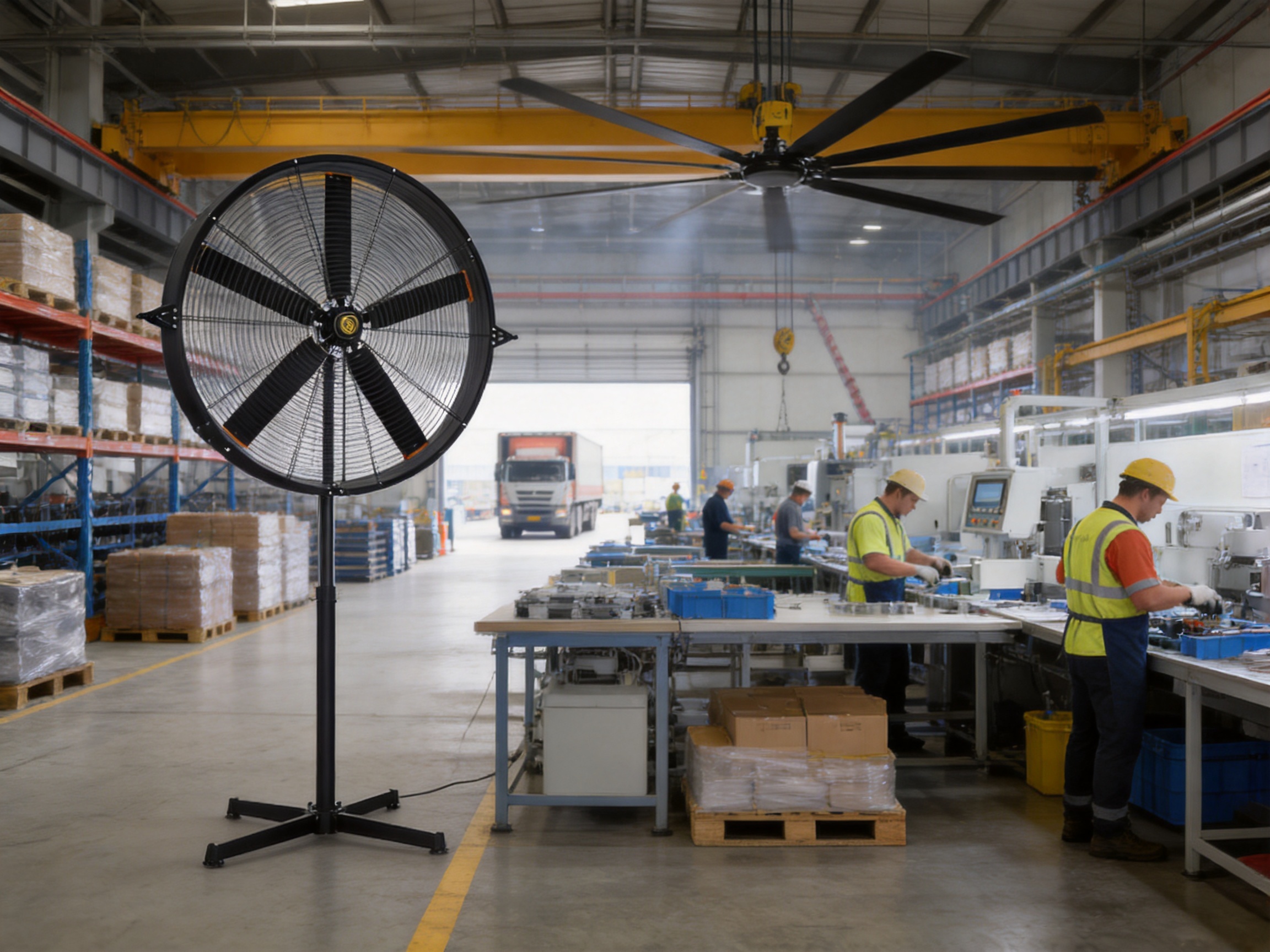
Warehouses often contain tall storage racks, loading areas, forklifts, packaging stations, and fluctuating occupancy. Airflow may be uneven, with some areas becoming warm or stagnant. A freestanding HVLS fan can be positioned near workstations, packing lines, dispatch areas, or aisles where personnel require improved circulation.
The fan can also help maintain more consistent air movement in facilities where ceiling-mounted equipment is obstructed by storage systems. Operators should maintain appropriate clearances from racks and moving vehicles and ensure that the fan does not interfere with fire protection equipment or emergency routes.
Manufacturing processes may generate heat, odors, fumes, or localized discomfort. Although a fan is not a substitute for a properly designed exhaust or ventilation system, it can support general air circulation and help disperse stagnant air within a work zone.
The direct-drive motor and industrial construction make the product suitable for long operating periods when properly selected and maintained. It can be deployed near assembly areas, processing stations, inspection zones, or other locations where overhead installation is unavailable.
Automotive workshops, repair garages, fabrication areas, and maintenance facilities often have low ceilings, suspended tools, service equipment, and irregular layouts. A freestanding fan can deliver air at floor level and help improve comfort during warm-weather work.
The IP55 protection level and impact-resistant design provide useful features for environments where dust, incidental moisture, and occasional contact with equipment may occur. The fan should not be placed where sparks, corrosive chemicals, flammable vapors, or explosive atmospheres exceed the equipment’s approved ratings.
High-volume airflow can accelerate the drying of floors, coatings, cleaned equipment, and other surfaces. The large blade assembly can move air across a broad area, reducing the need to position a small fan immediately beside every wet surface.
Drying performance depends on humidity, temperature, material type, surface area, and air exchange. The fan improves air movement but does not independently remove moisture from a building. For best results, it should be used with appropriate ventilation and moisture-control practices.
Improved circulation may help prevent odors and fumes from remaining concentrated in stagnant areas. The fan can support general air movement in commercial and industrial spaces, but it should not be treated as a dedicated extraction system.
Where hazardous fumes, dust, or gases are present, the facility must use ventilation equipment designed for the specific substance and hazard classification. The fan should only be used within its approved application range and must not be used to spread hazardous contaminants into occupied areas.
The product information identifies hotel and commercial use among its applications. In large service areas, workshops, open halls, back-of-house spaces, and temporary event zones, the fan can provide supplemental airflow without requiring permanent ceiling modifications.
Its low stated noise level may be beneficial in customer-facing or staff-facing environments where excessive sound would be undesirable. The frame color and blade color options may also allow buyers to select a configuration that fits the appearance of a commercial property.
The product is listed for outdoor applications, but outdoor deployment requires careful evaluation. The IP55 protection level supports resistance to dust and water jets within its rated conditions, but it does not mean the fan is suitable for unrestricted exposure to rain, flooding, salt spray, or severe weather.
Outdoor users should provide a stable, level surface and protect the unit from tipping, vehicle impact, unauthorized access, and extreme weather. Electrical connections must be protected according to local requirements, and the unit should be disconnected when conditions exceed its rated operating environment.
The performance of an industrial fan depends not only on its design but also on how consistently it is manufactured. Component quality, dimensional accuracy, welding quality, blade balance, motor assembly, electrical testing, and final inspection all affect reliability in service.
Shanghai Aipu Fans Co., Ltd. operates an 8,000-square-meter production base in China. The facility includes high-precision automated machinery, a machining center, a cutting center, a welding center, and a testing center. These capabilities support a more controlled production process than simple manual assembly alone.
Automated machinery can improve repeatability across production batches. Consistent processing is especially important for fan components because small dimensional differences can influence assembly accuracy, vibration, balance, and operating noise.
High-precision equipment also supports the manufacture of motor components, frames, blade structures, brackets, and other parts that require controlled tolerances. Repeatability makes it easier to maintain consistent quality across different models and customized orders.
A dedicated machining center allows the company to produce or finish components with controlled dimensions and accurate interfaces. Precise machining is important for shafts, mounts, motor connections, brackets, and other parts that must align correctly during assembly.
Accurate components help reduce unnecessary vibration and support smooth power transmission. They also make assembly and replacement more predictable during servicing.
The cutting center supports the preparation of metal and alloy components used in the fan structure. Controlled cutting improves dimensional accuracy and helps reduce material waste. It also contributes to consistency when producing multiple units with similar frame and blade requirements.
For customized OEM projects, controlled cutting can help accommodate different dimensions, colors, mounting arrangements, and application requirements, subject to technical review and production feasibility.
The welded frame is a critical structural component of a freestanding industrial fan. The welding center provides a dedicated area for producing the support structure and protective frame. Consistent welding can improve structural integrity, alignment, and long-term durability.
After welding, frames should be checked for dimensional accuracy, weld appearance, surface condition, and stability. These inspections help ensure that the fan remains properly supported during operation.
Industrial fans should be tested before shipment to verify key performance and safety characteristics. A testing center allows the manufacturer to examine motor operation, speed control, noise, vibration, electrical performance, and structural behavior.
Testing is especially important for large-diameter fans because blade balance and frame stability directly affect user experience and service life. A controlled testing process can identify abnormal noise, excessive vibration, electrical irregularities, or assembly problems before the product reaches the customer.
The stated CE certification also indicates that the product is designed to meet applicable European conformity requirements for the relevant configuration. Buyers should confirm the exact certification scope and documentation for the model, voltage, control system, and destination market.
Industrial customers often need more than a standard catalog product. They may require a specific blade color, power configuration, control method, frame arrangement, voltage, packaging format, or airflow solution for a particular facility.
The company provides customized OEM services and product solutions for industrial customers worldwide. Customization should begin with a technical review that considers the intended space, operating temperature, available electrical supply, environmental conditions, required airflow, floor surface, and installation limitations.
Blade colors are listed as yellow, blue, silver, black, and red. Other customization possibilities may be available depending on production conditions and order volume. Customers should confirm color availability, surface treatment, labeling, packaging, and lead time before placing an order.
OEM projects can also involve product labels, control-panel requirements, documentation, spare parts, export packaging, and inspection procedures. Clear communication at the quotation stage helps prevent misunderstandings later in the supply process.
The correct model should be selected according to the required airflow and physical conditions rather than fan size alone. The ASF-09 may be suitable for smaller areas or applications requiring a more compact footprint. The ASF-12 and ASF-15 provide intermediate options. The ASF-20 offers the largest listed dimensions and the broadest blade diameter.
Buyers should evaluate the following factors:
1. Room size and ceiling height: Larger rooms may require larger or multiple fans, while small spaces may be better served by a compact model.
2. Airflow objective: Determine whether the goal is personal cooling, general circulation, drying, odor dispersion, or supplemental ventilation.
3. Obstructions: Consider racks, machinery, cranes, partitions, vehicles, and pedestrian routes.
4. Floor conditions: Confirm that the floor is level, stable, and capable of supporting the selected unit.
5. Electrical supply: Verify voltage, frequency, phase, motor requirements, inverter compatibility, and local electrical regulations.
6. Operating environment: Review dust, moisture, temperature, corrosive substances, outdoor exposure, and possible hazardous atmospheres.
7. Mobility requirements: Decide whether the fan will remain in one position or be moved between work zones.
8. Maintenance access: Leave sufficient clearance for inspection, cleaning, and service.
9. Safety requirements: Prevent contact with vehicles, moving machinery, unauthorized users, and emergency pathways.
10. Quantity and placement: Determine whether one fan can support the required zone or whether multiple units are needed for consistent coverage.
A professional airflow assessment is recommended for large factories, complex warehouses, and spaces with heat or contaminant-control requirements. Product selection should not be based only on the maximum RPM or motor power.
The fan should be placed on a firm, level surface with sufficient clearance around the frame and blades. The area should remain free of loose objects, hanging materials, packaging, and obstacles that could contact the moving assembly.
Electrical installation should be completed by qualified personnel. The power supply, grounding, control system, protective devices, and inverter settings should comply with local regulations and the manufacturer’s instructions.
Before initial operation, inspect the frame, blade assembly, fasteners, power cable, control panel, and protective components. Confirm that all parts are securely installed and that the fan rotates freely without contact or abnormal resistance.
Start the fan at a low speed and observe its operation. Check for unusual vibration, noise, movement, or electrical odor. If any abnormal condition is detected, stop the fan and investigate before returning it to service.
Operators should avoid placing hands, tools, clothing, ladders, or other objects near the rotating blades. The fan should not be moved while operating unless the product is specifically designed for safe powered movement and the relevant instructions permit it.
When the fan is used outdoors or in semi-outdoor areas, ensure that the unit is protected from severe weather and that electrical connections remain appropriately protected. Disconnect the equipment during storms, flooding, or conditions outside its rated environment.
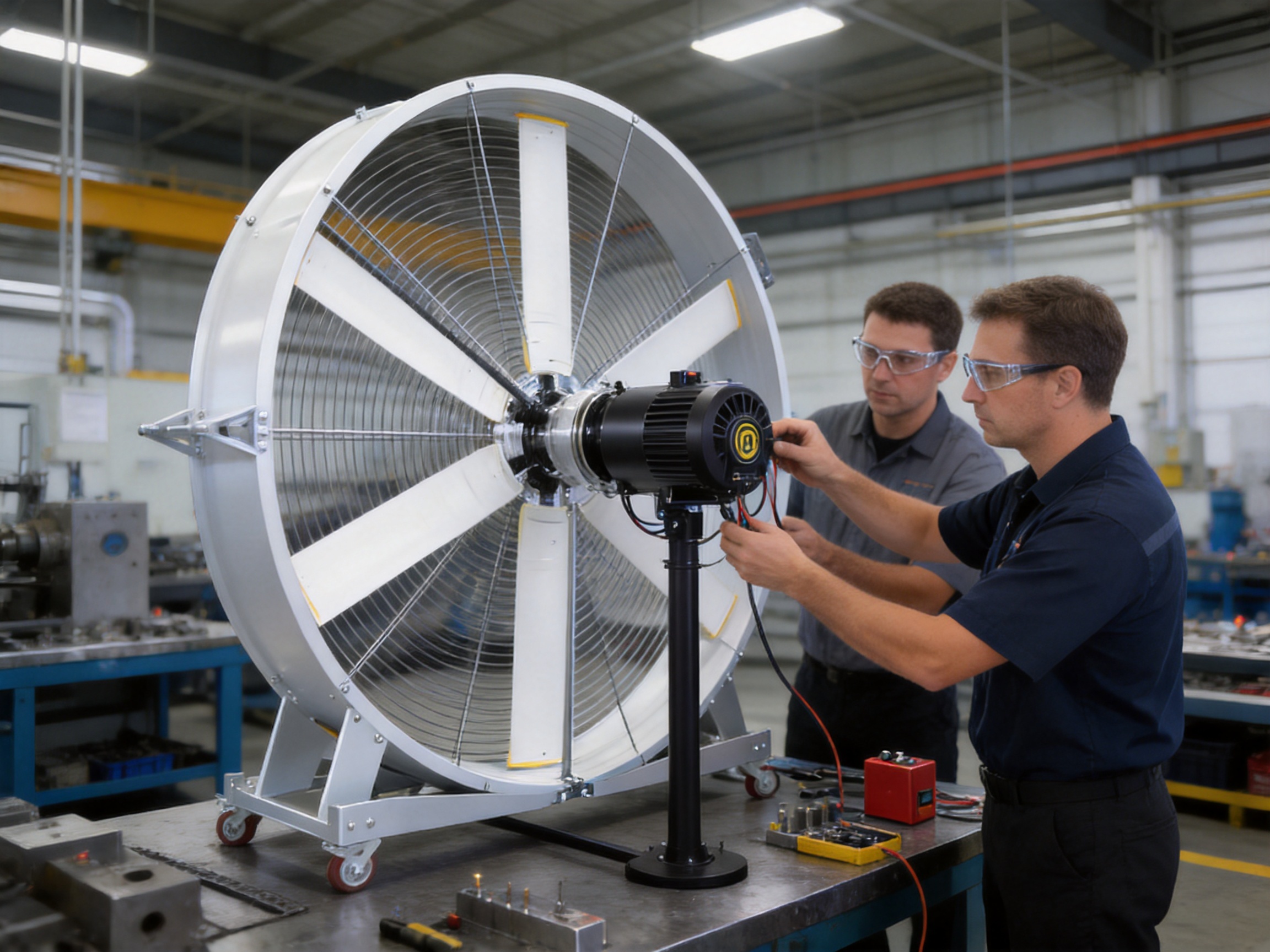
Routine maintenance helps preserve airflow, reduce noise, and extend service life. The fan should be inspected regularly according to operating hours, environmental conditions, and the manufacturer’s maintenance schedule.
Clean dust and debris from the frame, blades, motor housing, and protective areas. Accumulated deposits can affect balance, reduce airflow, increase motor load, and create a potential fire or hygiene concern in certain environments.
Inspect the blades for cracks, deformation, corrosion, loose fasteners, or surface damage. Even minor blade damage can affect balance and create vibration. Damaged components should be replaced with approved parts rather than repaired with improvised materials.
Check the frame and stand for looseness, corrosion, weld damage, or instability. Confirm that fasteners remain tight and that the unit sits securely on the floor.
Inspect cables, plugs, switches, and inverter connections for wear, heat damage, cuts, or loose terminals. Electrical inspection should be carried out by qualified personnel, especially when the fan operates in dusty, damp, or industrial conditions.
Listen for changes in operating sound. New rattling, grinding, humming, or excessive vibration may indicate a loose component, bearing issue, blade imbalance, electrical fault, or structural problem. Early attention can prevent more serious damage.
Always disconnect and isolate electrical power before cleaning, inspection, or service. Allow moving components to stop completely before approaching the fan assembly.
Industrial buyers generally require more than a visually attractive fan. They need dependable supply, repeatable performance, suitable documentation, service support, and the ability to adapt the product to real operating conditions.
A manufacturer with dedicated production and testing capabilities can provide greater control over these factors. The combination of automated machinery, machining, cutting, welding, and testing centers supports a structured approach to product development and production quality.
Experience also matters when a project involves multiple models, OEM labeling, export packaging, customized colors, or special operating requirements. A company established in 2006 has accumulated years of experience serving industrial ventilation customers and developing products for different markets.
The company’s focus on energy-efficient industrial fans, high-quality ceiling fans, and customized OEM services supports its role as a product supplier and technical solution provider. Its global sales experience can also help customers coordinate specifications, shipping requirements, and project communication.
The value of an industrial fan should be evaluated over its operating life rather than by purchase price alone. Important factors include motor power, expected operating hours, maintenance requirements, service accessibility, durability, noise, and the number of units required to cover the space.
The product’s direct-drive system can reduce belt-related maintenance and replacement costs. Its low stated motor-power range may support efficient operation when the fan is properly sized. Its freestanding design can also reduce the need for structural modifications and specialized overhead installation equipment.
Long-term value is maximized when the fan is correctly selected, installed, operated, and maintained. Running a fan at maximum speed when a lower setting is sufficient may increase energy use and wear. Conversely, selecting a fan that is too small for the space may require multiple units and provide less effective circulation.
Facility managers should consider total cost of ownership, including electricity, installation, maintenance, spare parts, downtime, and expected service life. A technical quotation should clearly identify the selected model, motor power, dimensions, control method, protection rating, certification, warranty, and delivery requirements.
HVLS means high volume, low speed. It describes fans designed to move a large volume of air across a broad area at relatively low rotational speeds compared with small high-speed fans.
The largest configuration, ASF-20, is listed with a fan diameter of approximately 2 meters or 7 feet, corresponding to about 79 inches.
Yes. The fan is designed for industrial and commercial applications, including warehouses. Its freestanding configuration can be useful where storage racks, cranes, conveyors, or structural limitations make ceiling-mounted fans impractical.
The product information lists outdoor use as an application. However, the IP55 rating does not mean unrestricted weatherproof operation. Outdoor users should protect the fan from severe weather, flooding, prolonged direct exposure, and conditions beyond the rated environment.
The listed noise level for all models is below 40 dB. Actual sound may vary according to operating speed, distance, building acoustics, surrounding equipment, and installation conditions.
No. The product uses a gearless direct-drive motor system. This eliminates belts and pulleys, reducing the number of mechanical transmission components that require adjustment or replacement.
The product information identifies magnalium as the blade material. The blades are designed for industrial airflow and are available in several listed colors, including yellow, blue, silver, black, and red.
The listed models range from 0.35 kW to 0.65 kW. The ASF-20 model is listed at 0.65 kW or 650 W. Actual energy consumption depends on operating speed, control settings, voltage, and operating time.
The listed protection level is IP55. This indicates a level of protection against dust and water jets within specified conditions, but it does not permit submersion or unrestricted exposure to severe weather.
The product information lists an inverter control system. This supports variable-speed operation when configured correctly. Speed should remain within the manufacturer’s recommended range, and electrical work should be completed by qualified personnel.
The product information lists a three-year warranty. Buyers should confirm the warranty terms, covered components, exclusions, service process, and conditions for the specific order and destination market.
Customized OEM services are available. Possible requirements may include blade color, labeling, packaging, electrical configuration, and other technical details. Customization should be confirmed with the manufacturer before ordering.
No. The fan can improve general air circulation and help move stagnant air, odors, or heat, but it is not automatically a substitute for a properly designed exhaust, filtration, or hazardous-fume control system.
Maintenance should include cleaning, blade inspection, frame inspection, fastener checks, electrical inspection, and monitoring for unusual vibration or noise. Power must be isolated before cleaning or service.
The 79-inch freestanding energy-efficient HVLS industrial fan provides a practical airflow solution for facilities that need broad air movement without permanent ceiling installation. Its large blade diameter, industrial-grade construction, direct-drive motor, low stated noise level, IP55 protection, and variable-speed capability make it suitable for a wide range of industrial and commercial environments.
Compared with small portable fans, it is designed to influence a larger area with fewer units and stronger industrial durability. Compared with ceiling-mounted HVLS fans, it offers greater flexibility where overhead structures, obstructions, rental conditions, or installation limitations prevent permanent suspension.
The ASF-20 model provides the approximately 79-inch configuration, while the ASF-09, ASF-12, and ASF-15 models offer smaller alternatives. Buyers can select a model based on airflow requirements, space limitations, motor power, operating speed, and mobility needs.
The product is supported by a manufacturing organization with an 8,000-square-meter production base, automated machinery, machining, cutting, welding, and testing centers. This production infrastructure, combined with experience dating back to 2006 and customized OEM capabilities, supports consistent manufacturing and industrial project support.
For the best result, the fan should be selected through a complete assessment of room dimensions, airflow goals, environmental conditions, electrical supply, safety clearances, and maintenance access. When properly specified and operated, the freestanding HVLS industrial fan can become a dependable component of an efficient industrial ventilation and comfort strategy.
1. Product specification sheet for ASF-series freestanding HVLS industrial fans.
2. Industrial fan application and operating information supplied by the manufacturer.
3. General principles of high-volume, low-speed fan design and air circulation.
4. IEC 60529, Degrees of Protection Provided by Enclosures, concerning IP protection classifications.
5. General industrial ventilation planning principles for warehouses, manufacturing facilities, workshops, and commercial spaces.
6. Manufacturer information regarding production facilities, OEM services, testing capabilities, and industrial fan manufacturing experience.
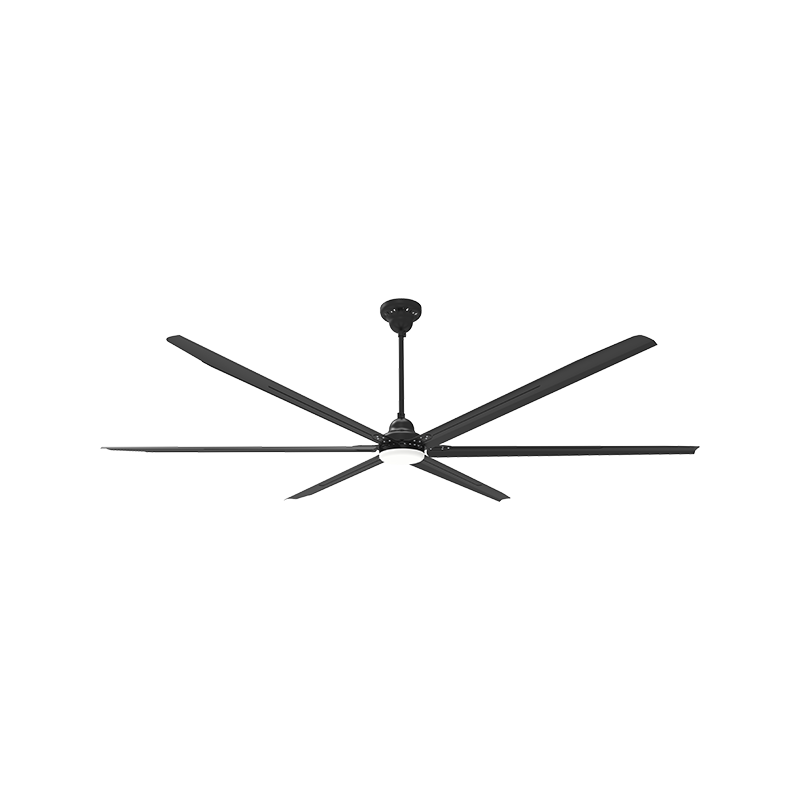
1. Core Technology: High Volume, Low SpeedNatural Breezes: Unlike the “harsh” wind from small fans, HVLS fans use massive blades rotating at low speeds to create a large-scale, three-dimensional breez...
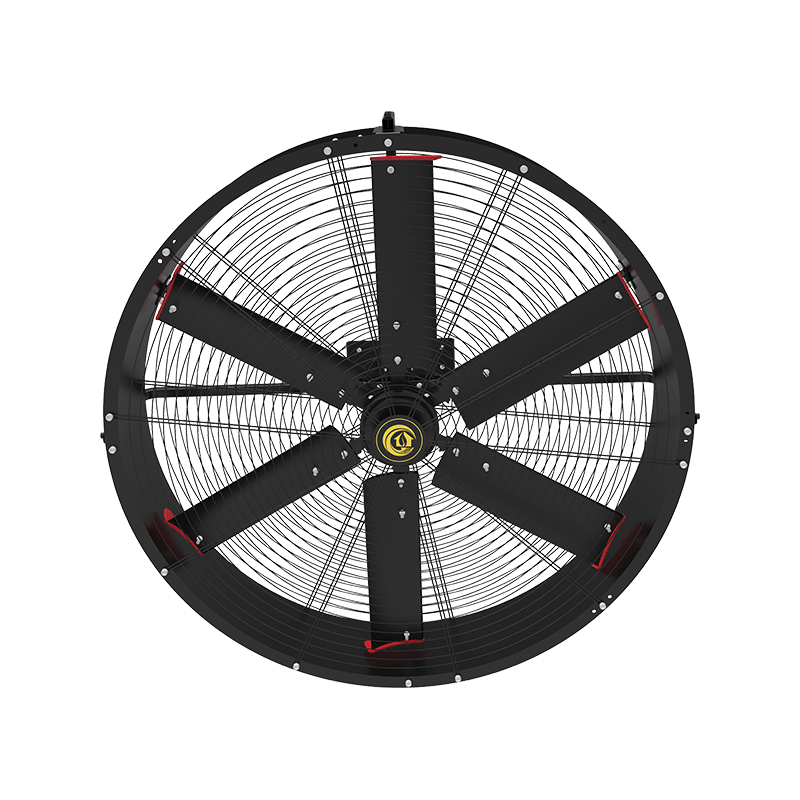
1. Extreme Airflow & Wide CoverageEquipped with massive 79-inch (2.0m) diameter aerospace-grade aluminum alloy blades. These precision-balanced blades generate a powerful, stable laminar airflow t...
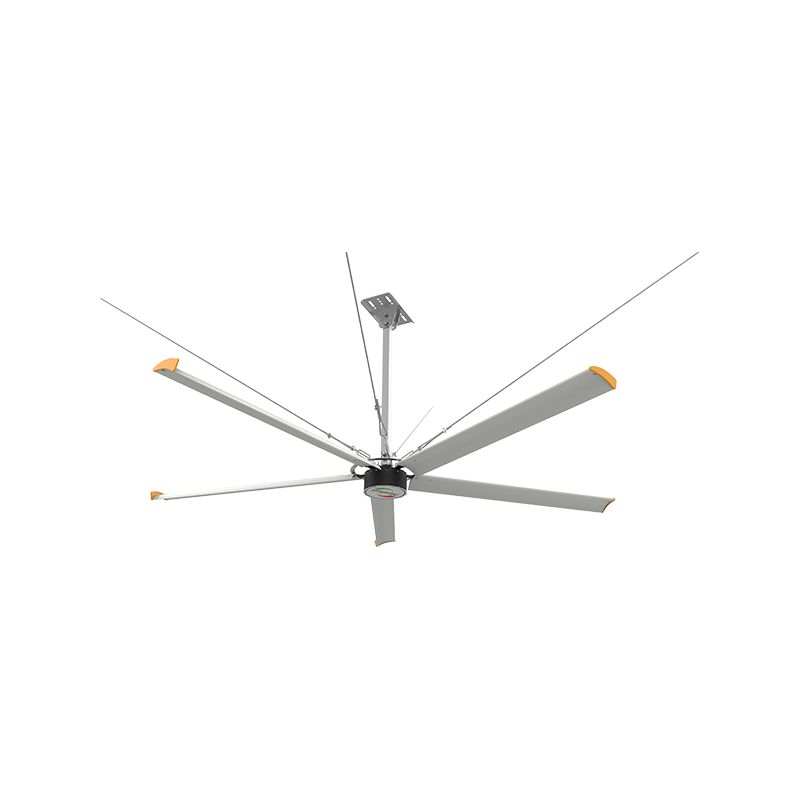
The industrial-grade aviation metal large-blade BLDC ceiling fan utilizes brushless DC motor (BLDC) technology, allowing it to provide powerful airflow with low power consumption. The ceiling fan rapi...
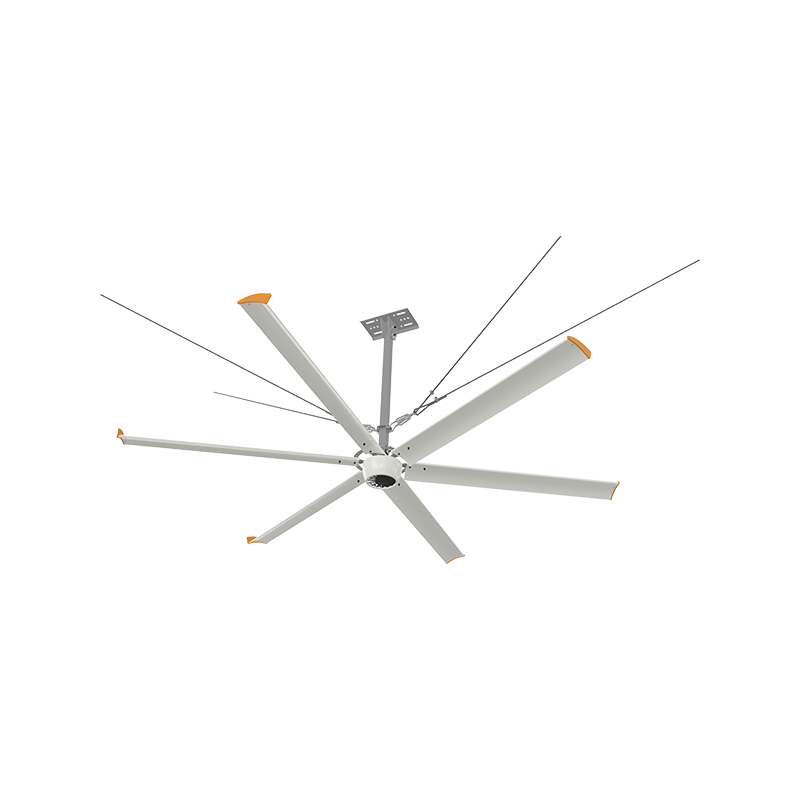
The 15-foot Even Airflow Industrial BLDC Ceiling Fan utilizes a high-efficiency BLDC motor and carefully designed blades. This ceiling fan operates with extremely low noise levels, making it suitable ...
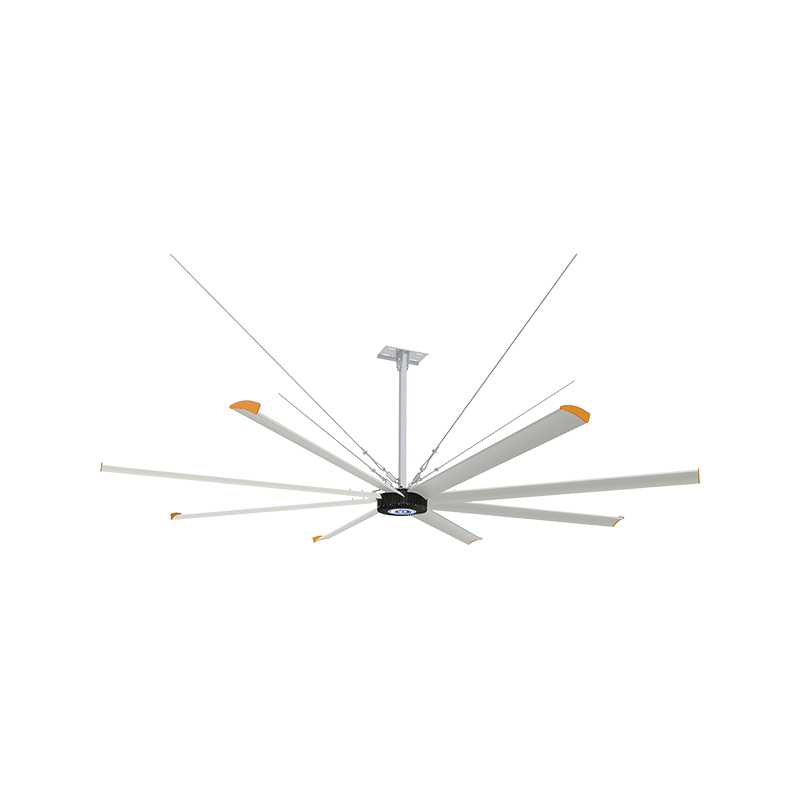
The 8-foot HVLS Large Industrial BLDC Ceiling Fan is equipped with a 0.3KW brushless DC motor, offering higher energy efficiency and lower noise levels. The lower power consumption design helps users ...
The 79-inch freestanding energy-efficient HVLS industrial fan features a robust construction designed to withstand the challenges of daily industrial use. Its impact-resistant frame ensures it can wit...
Shanghai Aipu Fans Co., Ltd., established in Shanghai in 2006, focuses on manufacturing industrial-grade high-quality ceiling fans, relying on industry-leading motor technology and advanced manufactu...
READ MOREBig Fans, Low Speed, Real Results: HVLS Industrial Fans Explained When a factory floor hits 34°C, small fans only move hot air around. Large-diameter HVLS ceiling fans do the opposite: they push a t...
READ MOREAt a distribution center in a hot climate, the worst heat gathers near the loading dock. The bay doors stay open through most of the shift, so any air that moves toward the dock gets pulled outside b...
READ MOREIndustrial Ventilation Planning The Right Industrial Ceiling Fan Size Starts With the Building A practical sizing guide to diameter, ceiling height, CFM, and fan layout for warehouses, plants, and di...
READ MORE Custom Large Industrial Fans Manufacturers