

 English
 Español
 عربى

The 15-foot Even Airflow Industrial BLDC Ceiling Fan utilizes a high-efficiency BLDC motor and carefully designed blades. This ceiling fan operates with extremely low noise levels, making it suitable ...
Content
Large industrial buildings require a different approach to ventilation than ordinary commercial rooms. Warehouses, manufacturing plants, logistics centers, workshops, sports facilities, agricultural buildings, and distribution hubs often have high ceilings, wide floor plans, heat-producing equipment, and continuously changing occupancy conditions. Conventional wall fans or small ceiling fans may create strong airflow near the equipment but fail to circulate air across the entire building. They can also require many units, complex wiring, frequent maintenance, and higher total energy consumption.
The 14-foot BLDC motor HVLS industrial aluminum alloy ceiling fan is designed to solve these challenges with one large, slow-moving, high-volume air circulation system. Its 4.2-meter diameter, six-blade aerodynamic configuration, brushless motor technology, and lightweight aluminum alloy construction enable it to move substantial volumes of air while operating at relatively low power. The product is intended for applications that need broad, comfortable, and consistent airflow rather than a narrow, high-speed blast.
This type of high-volume low-speed fan supports industrial ventilation by pushing air downward and outward across a large floor area. The resulting circulation can help reduce stagnant zones, improve worker comfort, distribute conditioned air more evenly, and support temperature equalization between different parts of a building. When properly selected and installed, it can provide a more practical alternative to deploying numerous smaller fans.
The product is manufactured by Shanghai Aipu Fans Co., Ltd., an industrial fan producer established in Shanghai in 2006. The company focuses on large industrial ceiling fans, motor technology, customized product solutions, and OEM and ODM services. Its manufacturing capabilities include an 8,000-square-meter production base, automated machinery, machining equipment, cutting and welding centers, and a dedicated testing center.
This article examines the product’s construction, motor system, aerodynamic performance, manufacturing strengths, installation flexibility, application value, maintenance requirements, and advantages compared with conventional industrial air-movement solutions.
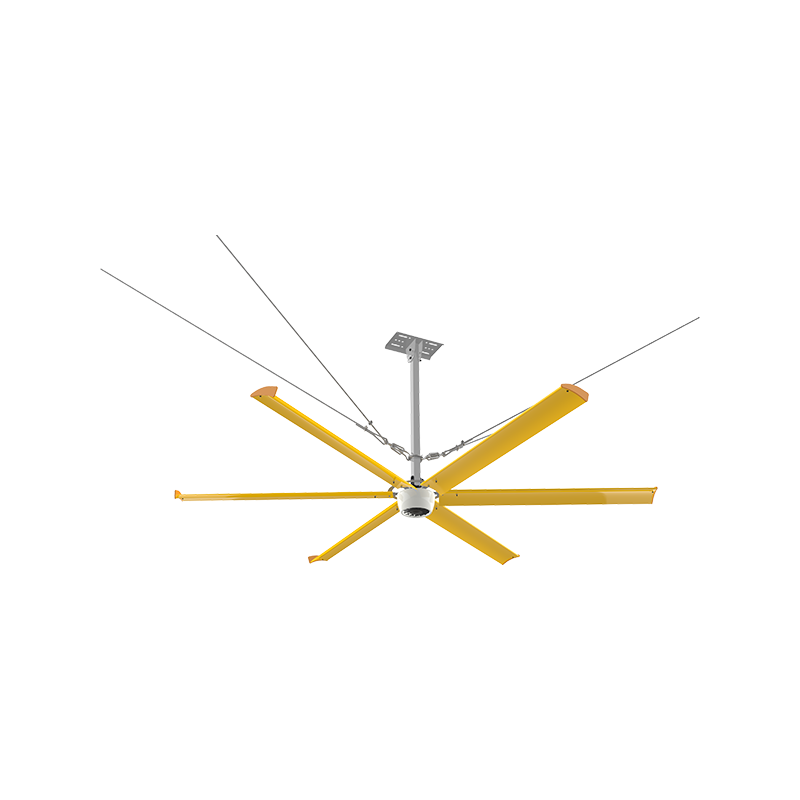
14-foot BLDC motor HVLS industrial aluminum alloy ceiling fan
The 14-foot BLDC motor HVLS industrial aluminum alloy ceiling fan has a nominal diameter of 14 feet, equivalent to approximately 4.2 meters. It uses six aluminum alloy blades and is powered by a permanent magnet synchronous motor, commonly described as a PMSM or BLDC motor in this product category. The motor is designed for efficient low-speed operation and controlled air delivery.
The standard product information identifies the fan as model ADF42 within a broader family of large industrial ceiling fans. The ADF42 configuration has a listed power rating of 0.75 kW, a maximum speed of approximately 74 revolutions per minute in the model comparison table, and an air volume of up to 5,800 cubic meters per minute. Additional product specifications identify a nominal operating range of 0 to 63 RPM, six blades, a 4.2-meter diameter, and a product weight of approximately 88 kilograms.
Actual operating speed and airflow may vary according to the controller configuration, installation height, building conditions, voltage, frequency, and selected operating mode. The published figures should therefore be used as reference values during preliminary selection, while final performance should be confirmed through a technical assessment of the building.
| Specification | Reference Value |
|---|---|
| Product type | 14-foot BLDC/PMSM HVLS industrial ceiling fan |
| Model family | ADF42 configuration |
| Fan diameter | 4.2 meters / 14 feet |
| Blade quantity | 6 pieces |
| Blade material | High-strength aluminum alloy |
| Rated motor power | Approximately 0.75 kW |
| Maximum listed speed | Approximately 74 RPM |
| Reference operating range | 0–63 RPM |
| Reference air volume | Up to 5,800 m³/min |
| Input options | 200–240 V or 380–480 V configurations |
| Available frequency | 50 Hz or 60 Hz |
| Approximate product weight | 88 kg |
| Control options | Standard controller, remote control, and optional Wi-Fi or APP control |
One of the key characteristics of the product is its balance between physical size and motor power. A 4.2-meter fan can cover a broad area, while the brushless permanent magnet motor is designed to deliver controlled torque without requiring the energy input associated with many conventional motor systems. This allows the fan to operate as a continuous air-circulation device rather than simply as a high-speed spot-cooling machine.
The six blades are manufactured from aluminum alloy, a material selected for its combination of low weight, strength, corrosion resistance, and suitability for large rotating structures. Each blade weighs approximately 3.5 kilograms according to the product description. Aluminum alloy has a density of roughly one-third that of steel, helping reduce the rotating mass and inertial load of the fan assembly.
Reducing blade weight is particularly important in a large ceiling fan. As diameter increases, the blade tips travel through a larger circular path and the rotating assembly must withstand continuous centrifugal and aerodynamic forces. Heavy blades require more starting torque, impose greater loads on the motor and support structure, and may increase energy consumption during acceleration and operation. Lightweight blades help the motor reach its selected speed efficiently while reducing the structural burden on the mounting system.
The aluminum alloy construction also supports more responsive speed control. When the controller changes the operating speed, a lighter rotating assembly can adjust more quickly than a heavier steel assembly. This characteristic is valuable in buildings where airflow needs vary throughout the day, such as warehouses with changing loading activity or workshops with variable heat generation.
Another important benefit is corrosion resistance. The product description states that the blade surface is anodized. Anodizing creates a protective oxide layer that improves surface durability and helps resist dust, moisture, and weak acidic or alkaline substances that may be present in industrial environments. This does not make the fan suitable for every corrosive atmosphere, but it provides an additional level of protection in normal industrial, commercial, and agricultural applications.
The blades are also easier to handle during transportation and installation than comparably sized steel blades. Lower component weight can simplify lifting procedures, reduce manual handling risk, and make assembly more manageable when the fan is installed under a high roof. Professional lifting equipment and qualified installation personnel remain necessary, but the material choice can make the overall process more efficient.
Traditional industrial fans may use heavier steel blades or thick stamped metal components. Steel can provide substantial mechanical strength, but its greater density can increase the load on the motor, gearbox, support structure, and bearings. Steel surfaces may also require careful coating maintenance in humid or chemically exposed environments.
Aluminum alloy provides a different performance balance. It combines adequate structural strength for the intended fan design with lower mass and good resistance to environmental exposure. The anodized finish supports long-term appearance and surface protection while reducing the likelihood that ordinary dust and moisture will rapidly degrade the blade surface.
For a large HVLS fan, material selection influences much more than appearance. It affects starting performance, energy consumption, installation requirements, vibration behavior, and long-term maintenance. The aluminum alloy blade design is therefore a functional engineering decision rather than simply a cosmetic feature.
The product uses six blades with an aerodynamic airfoil profile. The blade profile is described as having a smooth leading edge, a sharp trailing edge, and polished edges. These details are intended to reduce unnecessary air resistance and improve the efficiency of airflow generation.
When a blade rotates, its leading edge first meets the surrounding air. A smooth leading edge helps the air move over the surface with less abrupt separation. The trailing edge then guides the air away from the blade. Carefully formed edges can reduce turbulence and noise compared with poorly shaped or unfinished surfaces. In a large fan, even small aerodynamic improvements can influence total airflow because the effect is repeated across the entire blade length and throughout continuous operation.
The blade twist angle changes progressively from the root to the tip. This feature is important because the inner and outer sections of a rotating blade travel at different linear speeds. The tip moves much faster than the section near the hub. If the blade angle were identical from root to tip, different sections would operate at less efficient aerodynamic conditions. A variable twist helps each section contribute more effectively to air movement.
The result is a more balanced airflow distribution across the blade span. It can reduce the tendency for excessive turbulence near the tips and help avoid weak airflow areas beneath the fan. The design is intended to support long-distance air delivery of up to approximately 20 meters under suitable conditions, although actual reach depends on ceiling height, obstacles, indoor temperature, building geometry, and operating speed.
The six-blade arrangement provides a practical compromise between airflow generation, balance, noise control, and mechanical loading. A greater number of blades may increase the total blade area but can also add weight and resistance. A smaller number may reduce material use but may require different blade geometry or higher speed to achieve comparable airflow. The six-blade configuration is suitable for producing broad, steady circulation in industrial spaces.
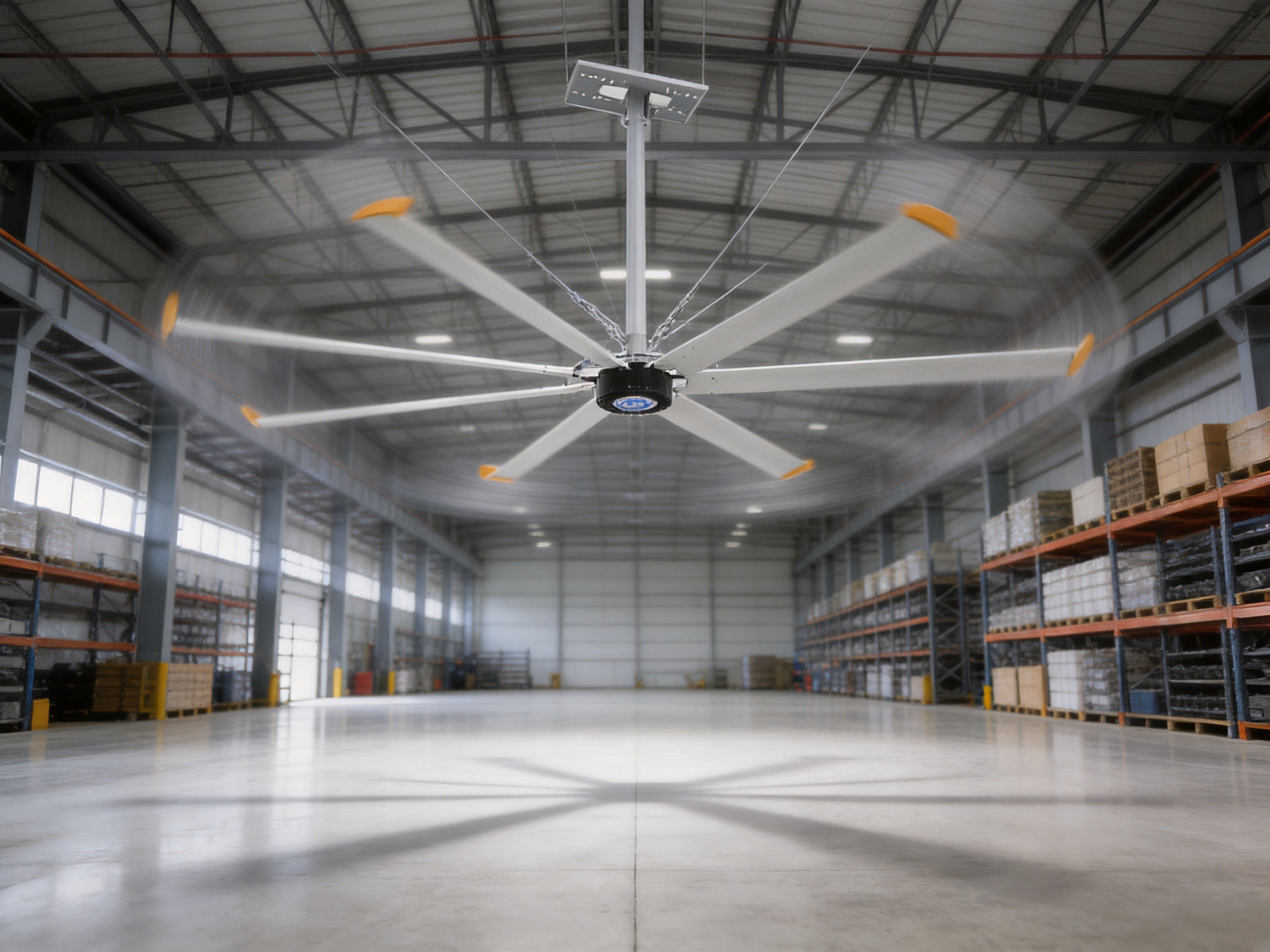
The fan is equipped with a brushless motor system based on permanent magnet synchronous motor technology. BLDC and PMSM motors both use permanent magnets and electronic commutation rather than traditional mechanical brushes. This design eliminates brush wear and supports accurate speed control through an electronic controller or inverter.
For an HVLS fan, brushless operation offers several practical advantages. First, there are fewer wear components inside the motor compared with brushed motor designs. This can reduce routine maintenance requirements and help support consistent operation over a long service period. Second, electronic control allows the fan to operate at different speeds according to the airflow demand. Third, the motor can maintain efficient torque production at the relatively low rotational speeds used by large-diameter fans.
Permanent magnet motors can also provide a favorable power-to-torque ratio. The permanent magnetic field contributes to torque production without requiring the same level of rotor excitation energy found in some other motor types. The result is a compact and efficient drive system suitable for continuous operation in large spaces.
The listed motor power for the ADF42 configuration is approximately 0.75 kW. Compared with the total airflow produced by a 4.2-meter fan, this represents an efficient approach to moving air over a wide floor area. The fan is not designed to create a concentrated jet like a small high-speed blower. Instead, it creates a large volume of slowly moving air that spreads outward and supports general circulation.
Electronic speed control allows the operator to match fan performance to current conditions. During mild weather, the fan may operate at a lower setting to maintain gentle circulation. During hot periods or when a building contains heat-producing equipment, the speed can be increased to strengthen air movement. This flexibility can reduce unnecessary power use compared with running a fixed-speed fan continuously.
Variable speed also helps improve comfort. Excessive air velocity may be uncomfortable for workers who remain in one area for long periods, while insufficient airflow can leave warm or stagnant zones. A controllable HVLS fan allows facility managers to find a suitable balance between air movement, energy use, and occupant requirements.
Remote control is available, and APP-based Wi-Fi control can also be accepted as an optional solution. These features can make it easier to operate multiple fans, adjust settings from a practical distance, or integrate fan operation into a broader facility management routine. The exact control functions depend on the selected electrical configuration and project requirements.
The reference airflow for the 14-foot configuration is up to 5,800 cubic meters per minute. This figure indicates the large quantity of air that the fan can circulate under its specified test or operating conditions. The actual air movement experienced at floor level depends on the distance between the fan and the floor, the fan’s speed, the presence of racking or machinery, and the arrangement of doors, walls, and other obstructions.
HVLS airflow normally follows a downward and outward pattern. Air is pushed toward the floor beneath the fan and then spreads horizontally. As the air moves across the floor, it can interact with surrounding air and create a wider circulation pattern. This is different from the narrow directional airflow produced by a small wall-mounted fan.
The broad circulation pattern can help reduce dead zones in large buildings. A dead zone is an area where air movement is weak, often located behind storage racks, between production lines, or far from conventional wall fans. Correct fan positioning and an appropriate operating speed are essential to achieve effective coverage.
The product information identifies a potential coverage capability of up to 1,800 square meters for the broader product range. Coverage should not be treated as a universal fixed value because every building is different. A high-ceiling warehouse with minimal obstacles may require fewer fans than a crowded workshop with partitions, machinery, and storage racks. Professional layout planning should consider the fan diameter, mounting height, airflow pattern, desired air velocity, and the placement of other ventilation equipment.
| Building Factor | Influence on Fan Selection and Performance |
|---|---|
| Ceiling height | Determines the distance available for airflow development and the appropriate mounting arrangement. |
| Floor area | Helps determine the number and spacing of fans required. |
| Racking and machinery | May interrupt airflow and require adjusted fan locations. |
| Heat sources | Influence the required airflow intensity and operating schedule. |
| Occupancy level | Determines comfort requirements and acceptable air velocity. |
| Doors and openings | Can introduce cross-drafts or allow conditioned air to escape. |
| Existing HVAC equipment | May complement or interfere with HVLS airflow patterns. |
| Roof structure | Determines the appropriate support and installation method. |
The main energy advantage of an HVLS ceiling fan comes from moving a large amount of air with a relatively low-power motor. Instead of using numerous small fans at different locations, one large fan can support a broad circulation pattern. The total energy benefit depends on the number of conventional fans replaced, the operating schedule, local electricity prices, and the building’s ventilation requirements.
The lightweight aluminum blades reduce the inertial load that the motor must accelerate. The aerodynamic blade profile reduces unnecessary resistance, while the brushless permanent magnet motor supports efficient torque production. Together, these features help the fan deliver useful airflow without relying on high rotational speed.
Energy efficiency is also connected to control. A fan does not need to operate at maximum speed at all times. With variable-speed operation, facility managers can reduce output during cooler periods, increase circulation during peak heat, and coordinate operation with heating or cooling systems. This demand-based strategy may reduce unnecessary electricity consumption and improve the overall effectiveness of the building’s ventilation plan.
In facilities with air conditioning, HVLS circulation can help distribute cooled air more evenly. In facilities with heating systems, it can help mix warmer air that accumulates near the ceiling with cooler air at occupant level. This destratification effect may improve comfort and reduce the tendency for conditioned air to remain unused near the roof.
HVLS fans do not replace all forms of mechanical ventilation. They primarily circulate existing air. Buildings requiring pollutant extraction, fresh-air exchange, smoke control, or precise humidity management may need separate ventilation equipment. The strongest results often come from combining HVLS circulation with an appropriately designed HVAC or industrial ventilation system.
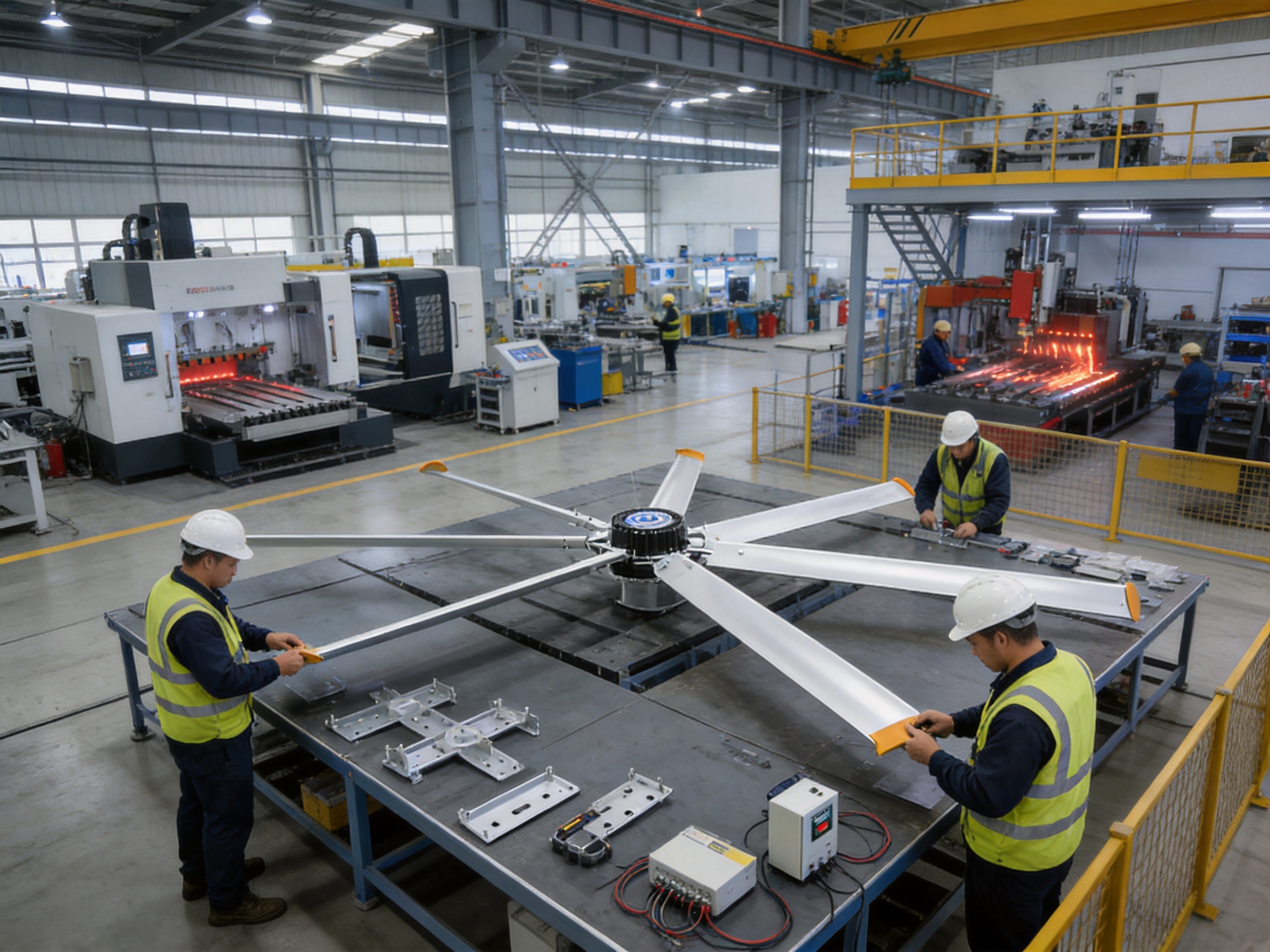
The performance of a large industrial ceiling fan depends not only on its design but also on the consistency of its manufacturing process. Blade balance, motor alignment, structural accuracy, fastener quality, electrical control, and final testing all influence reliability and operating comfort. Shanghai Aipu Fans Co., Ltd. supports production through an 8,000-square-meter manufacturing base in Shanghai.
The facility is equipped with high-precision automated machinery and specialized production centers. These include a machining center, cutting center, welding center, and testing center. Each area contributes to a different stage of product quality.
Machining equipment supports the production of accurate motor components, hubs, mounting parts, shafts, and structural interfaces. Dimensional accuracy is important because misalignment can contribute to vibration, uneven loading, or premature wear. Consistent machining helps ensure that components fit correctly during assembly and remain stable during long-term operation.
Automated cutting equipment helps produce repeatable blade and structural components. Consistent cutting dimensions improve the uniformity of the blade set and reduce variation between individual products. This is especially important for a six-blade fan because even small dimensional differences can influence balance and airflow behavior.
The welding center supports the manufacture of mounting structures, brackets, frames, and other metal components. Weld quality affects the mechanical integrity of the fan support system. Proper welding procedures, inspection, and finishing help ensure that the structure can withstand the dynamic loads generated during operation.
A dedicated testing center allows the company to evaluate products before shipment. Testing may include electrical checks, motor operation, speed control, vibration observation, airflow assessment, and general assembly inspection. The purpose of final testing is to identify manufacturing irregularities before the product reaches the installation site.
Industrial customers often require more than a visually attractive product. They need predictable performance, stable operation, reasonable maintenance requirements, and technical support throughout the project. A structured manufacturing process helps establish repeatability, which is particularly valuable for customers ordering multiple fans for one facility or for a larger OEM program.
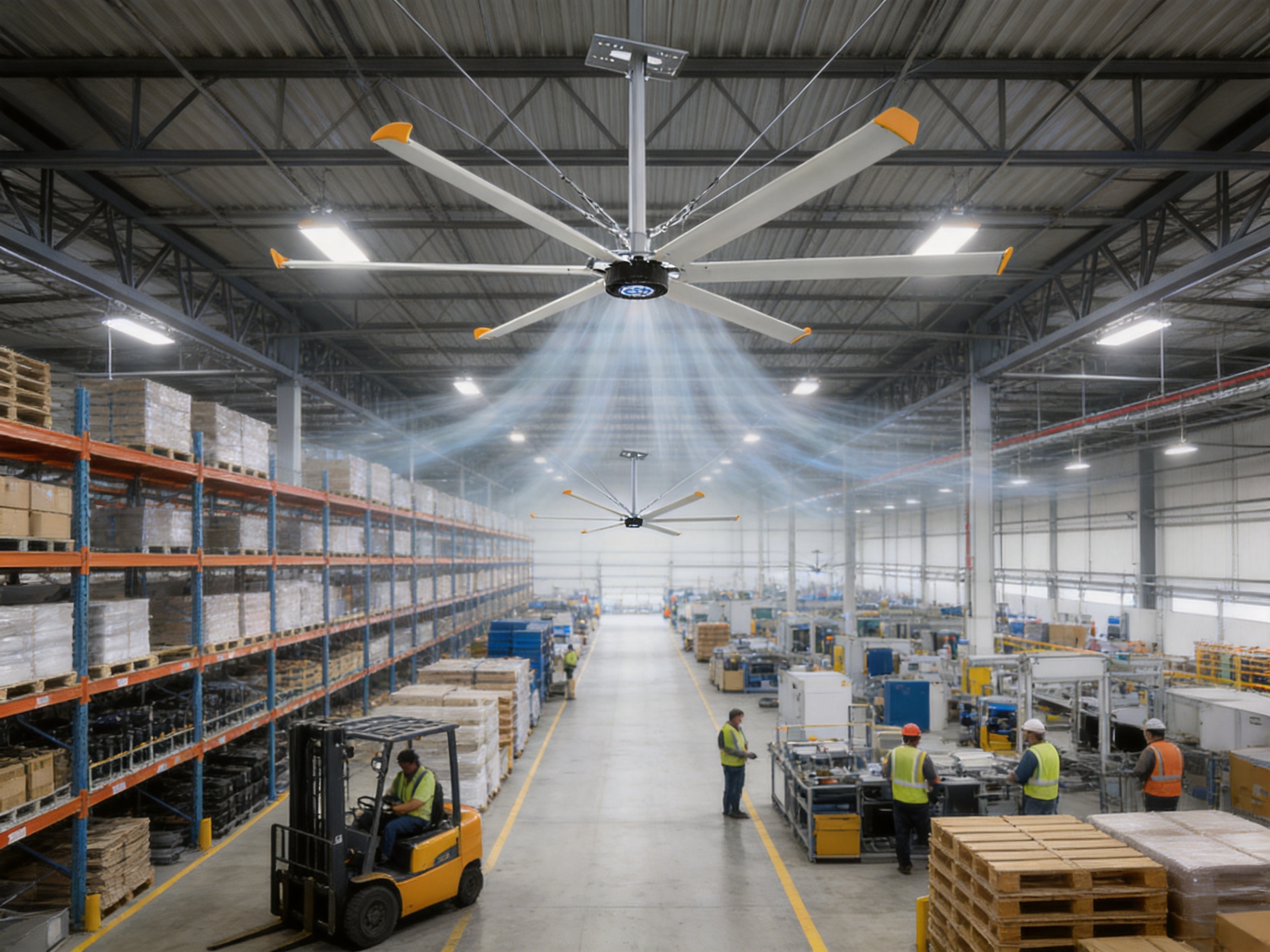
The fan is designed for use with various roof and building structures, including steel structures, round steel supports, and concrete structures. This flexibility is important because industrial buildings differ widely in their roof design, beam arrangement, ceiling height, and available attachment points.
Before installation, the building structure should be assessed by qualified personnel. The support point must be capable of carrying the static weight of the fan and the dynamic loads created during rotation. The installation design should also account for vibration, safety clearances, emergency access, electrical routing, and the presence of sprinklers, lighting, cranes, ductwork, and other ceiling equipment.
Correct mounting height is essential. If the fan is installed too high, airflow may disperse before reaching the occupied zone. If it is installed too low, clearance and safety concerns may arise. The suitable height depends on the fan diameter, building dimensions, floor use, equipment arrangement, and applicable local safety standards.
Installation should be completed by trained technicians familiar with industrial ceiling fans and electrical systems. The motor, blades, support assembly, controller, and safety components must be installed according to the approved technical instructions. After installation, the fan should be inspected for alignment, fastener tightness, blade balance, rotation clearance, control response, and abnormal sound or vibration.
The 14-foot fan is suitable for a wide range of large indoor environments where broad air circulation is required.
Warehouses often have high roofs and large open floor areas. Storage racks can create stagnant zones, while loading doors may introduce temperature differences. An HVLS fan can help circulate air through open areas and support a more consistent environment for workers and stored goods. Fan placement should be coordinated with rack aisles, forklift routes, sprinklers, and lighting systems.
Production equipment can generate heat, and workers may spend long periods near machinery. Large-area airflow can improve perceived comfort without creating an excessively narrow or disruptive air stream. The fan can be used in assembly areas, processing halls, fabrication shops, and general production spaces.
Workshops may contain welding stations, engines, compressors, or other heat-producing equipment. The fan can support general circulation and reduce stagnant air, but it should not be considered a substitute for source capture or exhaust ventilation where fumes, dust, or hazardous gases are present.
Large barns, equipment storage buildings, and agricultural processing areas can benefit from broad air movement. Aluminum alloy and anodized surfaces may be helpful in environments with dust and moisture, although the suitability of the fan depends on the specific atmospheric conditions and cleaning chemicals present.
Indoor sports centers, training halls, exhibition spaces, and event venues often require quiet and unobtrusive air circulation. A large ceiling fan can move air across a broad area while maintaining a lower rotational speed than small high-speed fans.
Retail distribution centers, vehicle service facilities, showrooms, and large commercial halls can use HVLS fans to support occupant comfort and temperature mixing. Optional remote or APP control can be useful where facility managers need to adjust multiple units according to occupancy and weather conditions.
The most important advantage of this product is its ability to combine large-area airflow with a compact power requirement. A conventional small fan may produce strong airflow close to its blades but cover a relatively limited area. To ventilate a large building, many such fans may be required. This can increase the number of electrical connections, mounting points, control devices, and maintenance tasks.
The 14-foot HVLS fan uses its large diameter to influence a much wider air volume. Its airflow is intended to be broad and continuous rather than concentrated in one direction. This can create a more uniform indoor environment and reduce the need for multiple independent fans.
The brushless PMSM drive provides another advantage over older brushed or less controllable motor systems. It reduces brush maintenance, supports variable-speed operation, and is well suited to continuous low-speed work. The aluminum alloy blades further reduce rotating mass compared with heavy steel alternatives.
The product also offers application flexibility. It can be configured for different electrical systems, including 200–240 V and 380–480 V input ranges, depending on the order and controller design. Voltage, frequency, and control requirements should be confirmed before production and installation.
Compared with simple fixed-speed fans, the product offers greater control. Remote control and optional Wi-Fi or APP operation can help facility managers change airflow without accessing the fan directly. This is particularly useful in high-ceiling buildings where manual adjustment would be impractical.
| Comparison Point | 14-Foot HVLS Fan | Small Conventional Fan |
|---|---|---|
| Air distribution | Broad, downward, and outward circulation | More localized directional airflow |
| Typical operating speed | Low speed with variable control | Often higher speed with fewer control options |
| Coverage approach | One large unit can influence a wide area | Multiple units may be needed for large spaces |
| Motor technology | Brushless permanent magnet motor | May use induction or brushed motor technology |
| Blade construction | Lightweight anodized aluminum alloy | May use plastic, steel, or other materials |
| Control options | Variable speed, remote, and optional APP control | Often limited to local or stepped control |
| Maintenance profile | Fewer brush-related wear concerns | Depends on motor and blade design |
Safety is a central consideration when installing any large rotating machine overhead. The fan support system must be engineered for the building and installed with all required safety components. Blade clearance, mounting strength, electrical protection, and emergency shutoff procedures should be reviewed before commissioning.
Routine maintenance should include visual inspection of blades, fasteners, support structures, electrical connections, and control equipment. The operator should monitor for unusual noise, vibration, delayed starting, speed instability, or changes in airflow. Any abnormal condition should be investigated before continued operation.
Dust accumulation can affect blade balance and airflow. In dusty industrial environments, the blades and surrounding structure should be cleaned according to a safe maintenance schedule. Power should be isolated before personnel work on or near the fan. Cleaning methods should be compatible with the anodized aluminum surface and should not use chemicals that could damage the protective finish.
Fasteners and mounting components should be checked periodically, especially during the first operating period after installation. Vibration can reveal a loose connection, blade imbalance, structural movement, or another mechanical issue. Preventive inspection is generally more effective than waiting for a visible failure.
The supplied product information states a three-year warranty for the motor and inverter and up to ten years for other accessories in the general application description. Another specification lists a three-year warranty. Warranty coverage should therefore be confirmed in the purchase contract, including the exact duration for the motor, inverter, blades, support components, controller, and other accessories.
With appropriate installation, operation, inspection, and environmental protection, the product is intended for long-term industrial service. Actual service life depends on operating hours, atmospheric conditions, maintenance quality, electrical stability, and whether the fan is used within its specified application range.
Industrial projects often require more than a standard catalog product. Building dimensions, roof structures, voltage systems, control platforms, branding requirements, and installation conditions may differ from one customer to another. The manufacturer provides OEM and ODM support for customers seeking customized solutions.
Customization may include electrical input configuration, control methods, color or finishing requirements, mounting arrangements, product labeling, packaging, documentation, and project-specific accessories. The technical feasibility of each request should be reviewed before production because modifications can affect motor performance, balance, structural loading, or certification requirements.
OEM and ODM cooperation can be valuable for distributors, engineering contractors, ventilation solution providers, and industrial equipment brands. A manufacturing partner with machining, cutting, welding, assembly, and testing capabilities can support both standard orders and more specialized product programs.
Shanghai Aipu Fans Co., Ltd. has experience supplying industrial-grade ceiling fans to domestic and international customers. Its manufacturing base and technical resources support product development, repeat production, quality control, and project communication. Customers can request technical information related to dimensions, power, airflow, mounting, controls, packaging, lead time, warranty, and installation requirements.
Although the 14-foot configuration is suitable for many medium and large spaces, the correct fan selection should be based on the full building profile rather than floor area alone. The first step is to identify the building’s length, width, height, roof construction, and occupancy pattern.
The second step is to identify heat sources, process equipment, doors, windows, storage racks, partitions, and existing ventilation systems. These factors influence airflow distribution and may affect the recommended fan spacing. Facilities with dense equipment layouts may need a different arrangement from open warehouses of the same floor area.
The third step is to clarify the intended purpose. The fan may be used primarily for worker comfort, temperature destratification, general circulation, support for air conditioning, or a combination of these objectives. Each purpose may require a different speed range and operating schedule.
The electrical system should also be confirmed. The product information includes 200–240 V and 380–480 V input options, with 50 Hz and 60 Hz frequency availability. The customer should provide the site voltage, frequency, phase requirements, controller preferences, and applicable electrical standards before the order is finalized.
Finally, the customer should confirm the installation structure and service conditions. A qualified technical team can then recommend fan quantity, layout, mounting height, support method, controls, and maintenance access.
The fan has a nominal diameter of 4.2 meters, which is approximately 14 feet. This size is intended for broad air circulation in large indoor spaces such as warehouses, workshops, production facilities, and commercial halls.
The fan uses a brushless permanent magnet motor system, described as BLDC or PMSM technology. It uses electronic commutation instead of mechanical brushes and is designed for efficient, controllable low-speed operation.
The standard 14-foot configuration uses six aluminum alloy blades. The blades have an aerodynamic profile, polished edges, and a variable twist angle designed to support balanced airflow.
The reference specification for the ADF42 configuration lists approximately 0.75 kW. The final motor and controller configuration should be confirmed according to the required voltage, frequency, operating speed, and project conditions.
The listed reference air volume is up to approximately 5,800 cubic meters per minute. Actual airflow depends on speed, installation height, building layout, obstacles, and other environmental conditions.
Yes. The brushless motor and electronic controller support variable-speed operation. The reference product information identifies an operating range of 0 to 63 RPM, while the model comparison table lists a maximum speed of approximately 74 RPM. Final operating limits should be confirmed for the selected configuration.
Remote control is available, and APP-based Wi-Fi control can also be accepted as an optional function. The selected control method should be specified during the quotation and technical confirmation process.
The product is described as suitable for steel structures, round steel supports, concrete structures, and other appropriate roof systems. A qualified installer must inspect the building and design a safe support arrangement before installation.
The product is primarily intended for large indoor industrial and commercial spaces. The anodized aluminum blades provide resistance to dust, moisture, and weak chemical exposure, but outdoor installation or highly corrosive environments require separate technical confirmation and appropriate protection.
No. The fan circulates existing air and can support comfort and temperature distribution. It does not replace systems designed for fresh-air intake, fume extraction, dust collection, smoke control, or hazardous gas removal.
Maintenance generally includes inspecting blades, fasteners, support structures, electrical connections, and controls; cleaning accumulated dust; and monitoring for unusual noise or vibration. Maintenance must be performed with the power isolated and by appropriately trained personnel.
The supplied product materials state three years for the motor and inverter and up to ten years for other accessories in one description, while another specification lists a three-year warranty. The exact warranty terms should be confirmed in the commercial contract before purchase.
Yes. OEM and ODM support is available. Customers can discuss branding, packaging, electrical configuration, controls, mounting arrangements, documentation, and other project-specific requirements with the manufacturer.
The 14-foot BLDC motor HVLS industrial aluminum alloy ceiling fan is engineered for large-area air circulation where conventional small fans may be insufficient. Its principal strengths include a 4.2-meter diameter, six lightweight aluminum alloy blades, an aerodynamic airfoil profile, a variable twist angle, brushless permanent magnet motor technology, and controllable low-speed operation.
The product’s aluminum alloy construction reduces rotating mass while providing strength and corrosion resistance. The anodized finish supports durability in ordinary industrial environments, and the blade geometry is designed to reduce resistance, improve airflow distribution, and limit stagnant zones. The PMSM or BLDC motor provides efficient torque production, speed adjustment, and reduced brush-related maintenance.
Manufacturing capability is another important part of the product offering. An 8,000-square-meter production base, automated machinery, precision machining, cutting, welding, and testing centers provide a foundation for consistent production and customized industrial solutions. OEM and ODM services further expand the product’s suitability for distributors, contractors, facility developers, and international industrial customers.
For the best result, the fan should be selected and installed according to the building’s dimensions, roof structure, electrical system, airflow requirements, and safety conditions. When correctly applied, it can support worker comfort, temperature equalization, energy-conscious air circulation, and more efficient ventilation management in warehouses, factories, workshops, agricultural buildings, sports facilities, and commercial spaces.
1. Product specification sheet for the 14-foot BLDC/PMSM HVLS industrial ceiling fan, model ADF42.
2. Manufacturer-provided technical information on aluminum alloy blade construction, anodized surface treatment, and aerodynamic blade design.
3. Manufacturer-provided information on BLDC and permanent magnet synchronous motor systems, variable-speed control, and optional remote or APP control.
4. Manufacturer-provided company profile and production capability summary for Shanghai Aipu Fans Co., Ltd.
5. General industrial ventilation principles concerning high-volume low-speed air circulation, building airflow distribution, and temperature destratification.
6. General engineering guidance for rotating equipment installation, structural support inspection, electrical safety, and preventive maintenance.
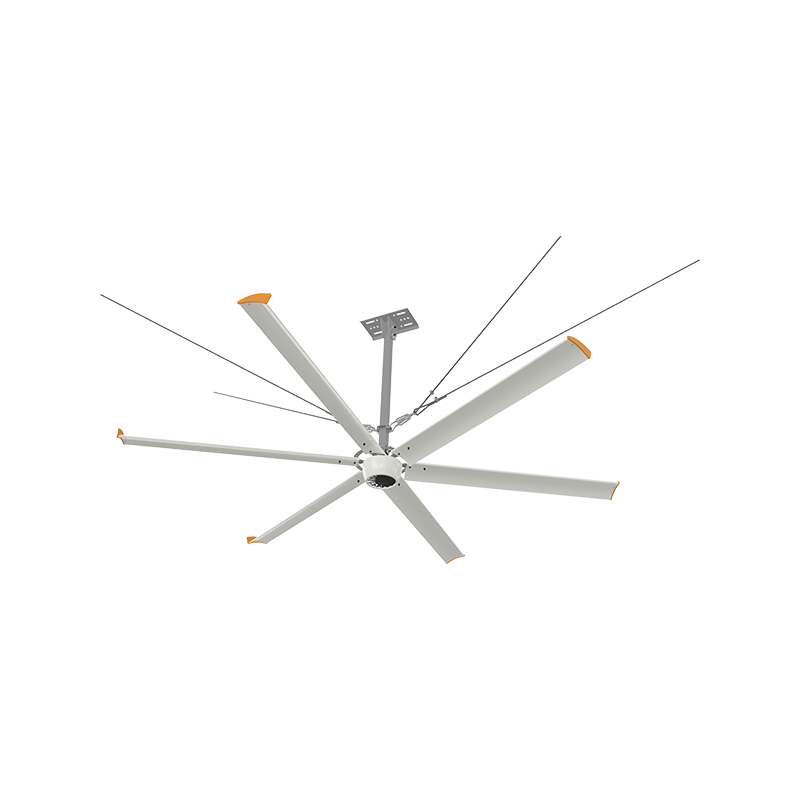
The 15-foot Even Airflow Industrial BLDC Ceiling Fan utilizes a high-efficiency BLDC motor and carefully designed blades. This ceiling fan operates with extremely low noise levels, making it suitable ...
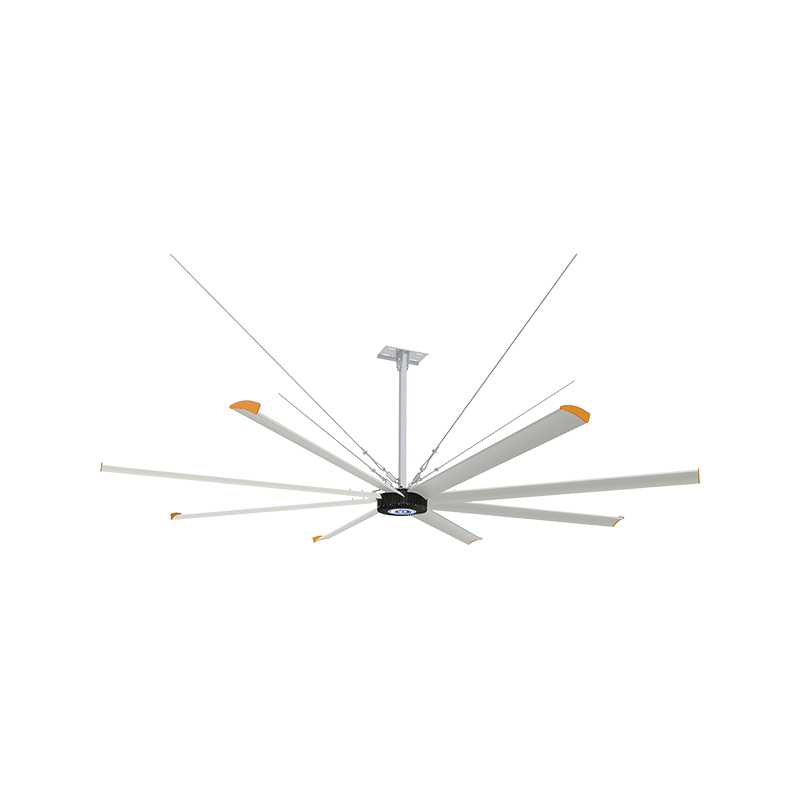
The 8-foot HVLS Large Industrial BLDC Ceiling Fan is equipped with a 0.3KW brushless DC motor, offering higher energy efficiency and lower noise levels. The lower power consumption design helps users ...
The blades of the 14-foot BLDC motor HVLS industrial aluminum alloy ceiling fan are made of high-strength aluminum alloy, offering advantages such as light weight (each blade weighs approximately 3.5k...
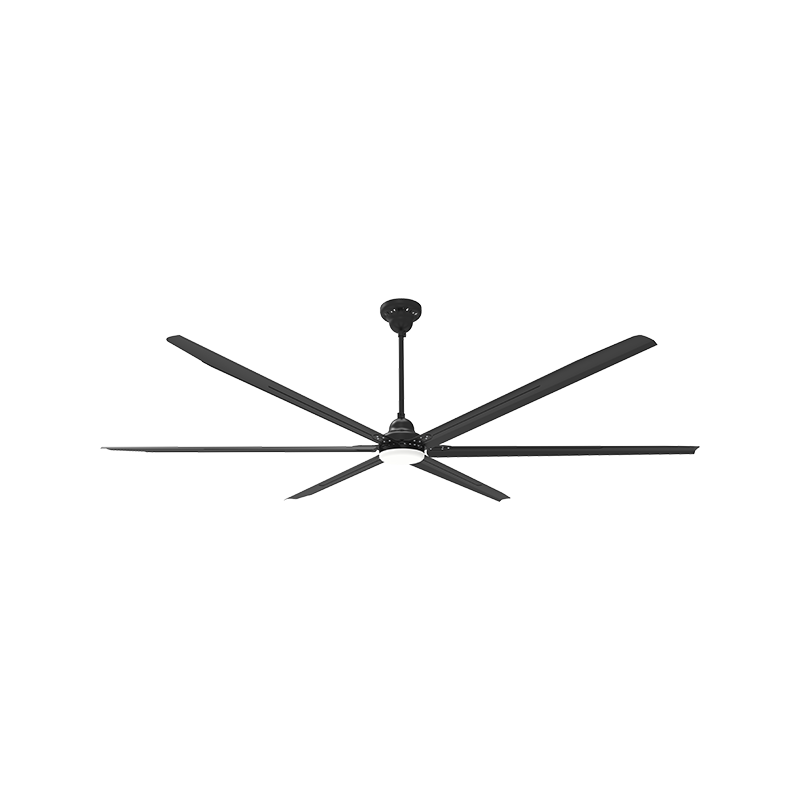
1. Core Technology: High Volume, Low SpeedNatural Breezes: Unlike the “harsh” wind from small fans, HVLS fans use massive blades rotating at low speeds to create a large-scale, three-dimensional breez...
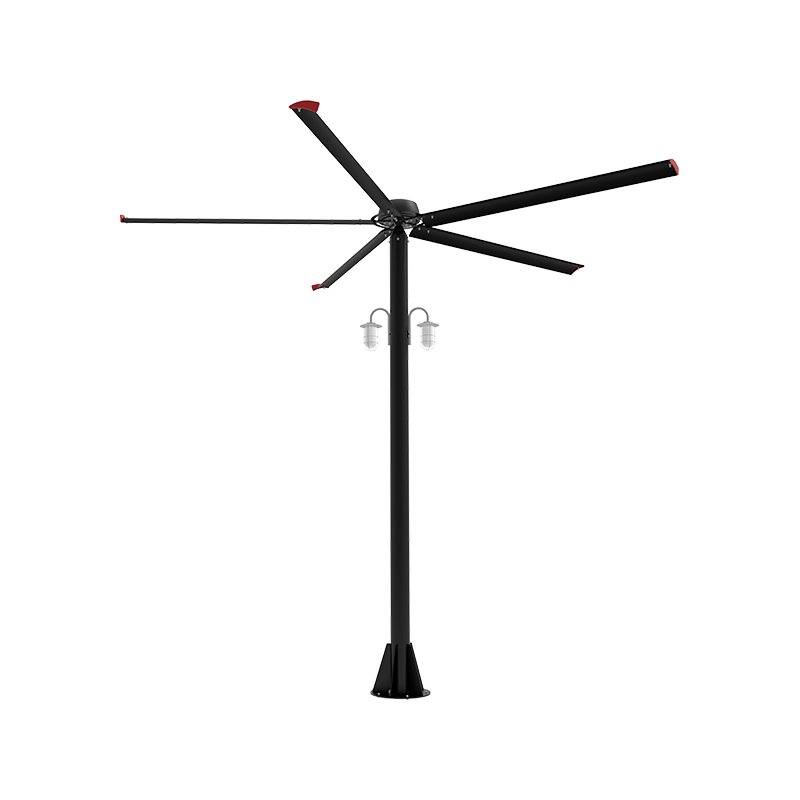
The large vertical HVLS floor-standing ventilation fan offers a variety of color options, allowing users to choose the most suitable color based on different environments and decoration needs. This c...
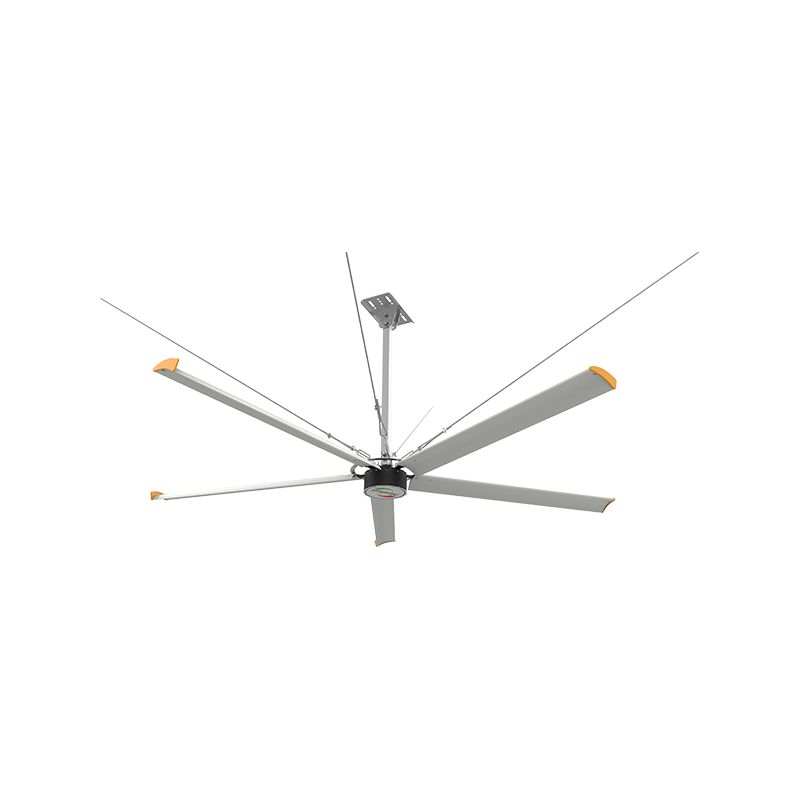
The industrial-grade aviation metal large-blade BLDC ceiling fan utilizes brushless DC motor (BLDC) technology, allowing it to provide powerful airflow with low power consumption. The ceiling fan rapi...
A 6,800 m² factory floor used to be ventilated by roughly 300 small wall and pedestal fans. Six large ceiling fans now cover the same area, and in the manufacturer's own comparison that change cuts m...
READ MORECommercial HVLS Fans: The Quiet Engineering Behind Large-Space Airflow A practical guide to selecting high-volume, low-speed ceiling fans for warehouses, factories, and commercial halls — with the ef...
READ MOREShanghai Aipu Fans Co., Ltd., established in Shanghai in 2006, focuses on manufacturing industrial-grade high-quality ceiling fans, relying on industry-leading motor technology and advanced manufactu...
READ MOREBig Fans, Low Speed, Real Results: HVLS Industrial Fans Explained When a factory floor hits 34°C, small fans only move hot air around. Large-diameter HVLS ceiling fans do the opposite: they push a t...
READ MORE Custom Large Industrial Fans Manufacturers