

 English
 Español
 عربى

1. Extreme Airflow & Wide CoverageEquipped with massive 79-inch (2.0m) diameter aerospace-grade aluminum alloy blades. These precision-balanced blades generate a powerful, stable laminar airflow t...
Content
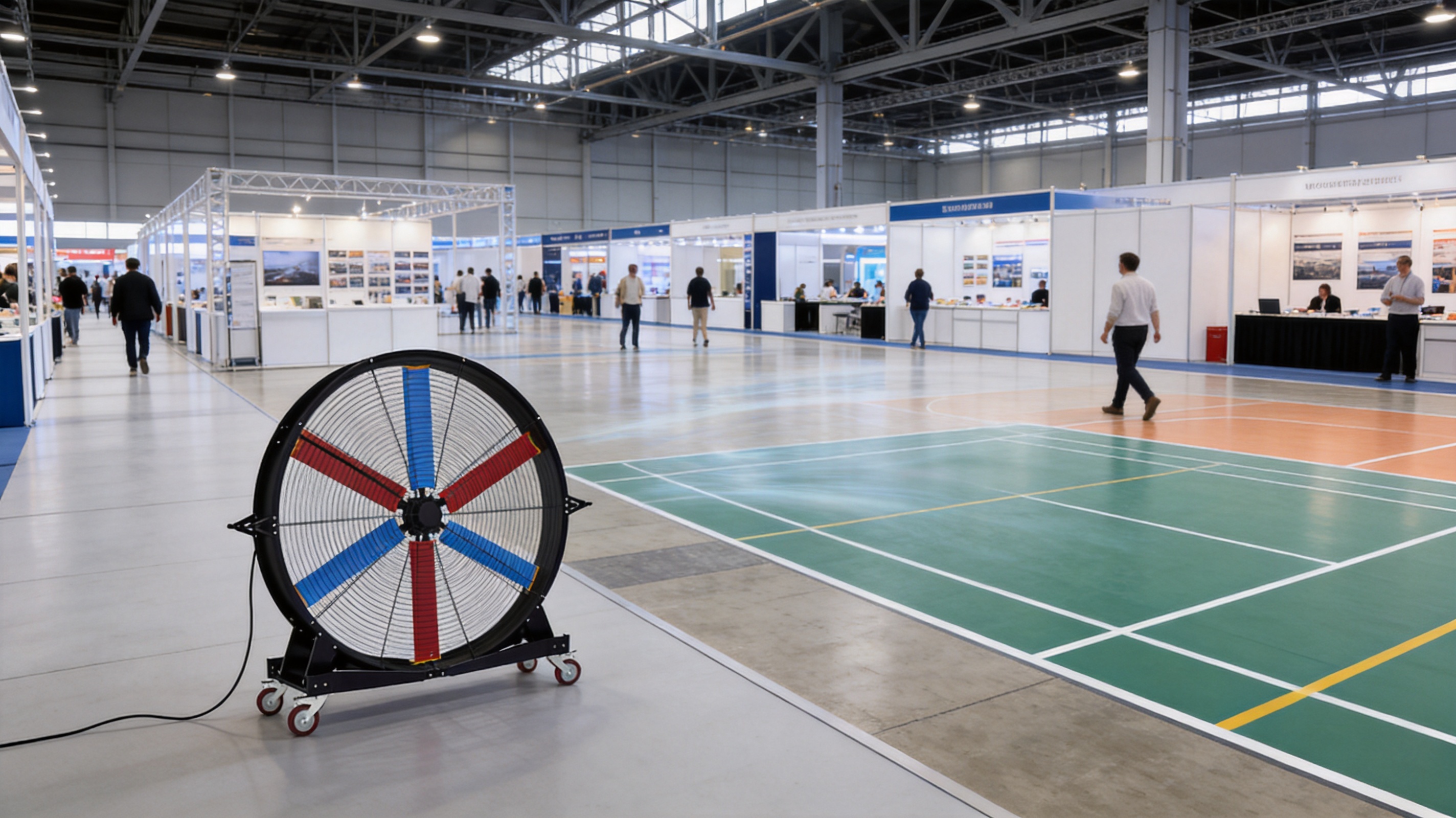
Large indoor spaces often require a different approach to ventilation than ordinary rooms. A conventional high-speed fan may create a powerful stream of air close to the blades, but its airflow can weaken rapidly across a large facility. It may also produce uncomfortable drafts, localized hot spots, excessive noise, and uneven temperature distribution. The 2-meter 4-wheel movable large floor-standing HVLS fan is designed to address these challenges through a combination of large blades, low-speed operation, wide-area air circulation, and flexible floor mobility.
This type of high-volume, low-speed fan moves a substantial quantity of air across a broad area instead of concentrating airflow into a narrow, high-pressure jet. Its slow rotational movement creates a more comfortable breeze effect while encouraging air exchange throughout warehouses, workshops, sports facilities, agricultural buildings, retail spaces, exhibition halls, and other large commercial or industrial environments.
The floor-standing configuration provides an important advantage over permanently installed ventilation equipment. Because the fan is mounted on a four-wheel base, operators can relocate it to different working areas as production layouts, storage arrangements, events, or seasonal ventilation needs change. The equipment can therefore support multiple zones without requiring additional ceiling construction or permanent installation work.
Manufactured by Shanghai Aipu Fans Co., Ltd., the product is part of a wider industrial ventilation portfolio that includes HVLS fans, PMSM ceiling fans, stand fans, pedestal fans, wall-mounted fans, and commercial ceiling fans. The company combines industrial motor technology, automated manufacturing equipment, precision machining, welding, testing, and OEM product development to supply ventilation solutions for customers in different markets.
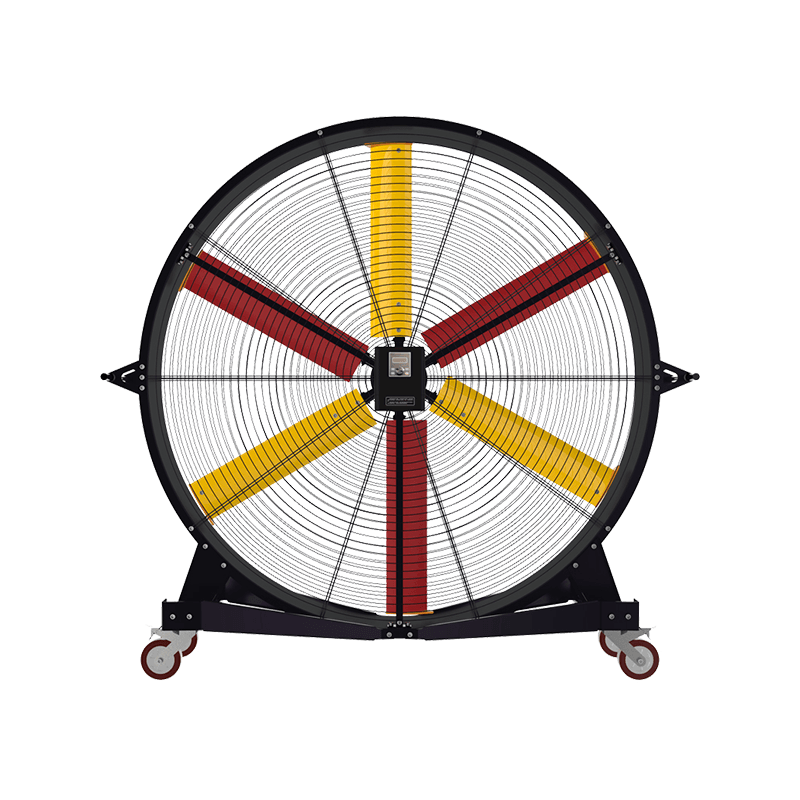
2-meter 4-wheel movable large floor standing HVLS fan
HVLS stands for “high volume, low speed.” The term describes a fan that moves a large volume of air while rotating more slowly than many conventional high-speed fans. Instead of relying primarily on intense air velocity at a short distance, an HVLS fan uses large blades and carefully controlled rotation to create broad air movement.
The 2-meter model has a fan diameter of approximately 2 meters, or about 7 feet. Its large blade span allows the fan to influence a wider area than a compact portable fan. As the blades rotate, they push air outward and forward, helping mix air layers and reduce differences between warmer and cooler zones within a building.
The product is floor-standing rather than ceiling-mounted. This configuration makes the fan suitable for locations where ceiling installation is impractical, where the ceiling is too high, or where the user needs to change the airflow position regularly. Four wheels support movement across suitable floors, while the heavy base and industrial structure help maintain stability during operation.
Although the product is described as a movable floor-standing fan, it is designed for demanding commercial and industrial applications rather than casual residential use. Its large size, industrial-grade construction, IP55 protection level, and motor power range make it appropriate for facilities that require reliable circulation over extended periods.
The operating principle is based on air displacement rather than simply increasing rotational speed. A larger blade can interact with more air during each rotation. When the blade profile and motor control are properly matched, the fan can move considerable air at a lower rotational speed.
Low-speed airflow is often more comfortable in occupied spaces because it avoids the harsh, concentrated blast associated with smaller, faster fans. The air movement is distributed across a larger area, producing a gentle breeze effect. This can improve perceived comfort for workers, visitors, athletes, customers, and livestock without creating an excessively turbulent environment.
Air stratification is another issue addressed by large-area air movement. In many buildings, warm air rises toward the upper part of the structure while cooler air remains closer to the floor. This can create temperature differences between working levels. By encouraging vertical and horizontal air mixing, a large HVLS fan helps distribute air more evenly throughout the available space.
The fan does not necessarily lower the actual temperature in the same way as an air-conditioning system. Instead, it improves air circulation, enhances the evaporation of perspiration, reduces stagnant zones, and helps occupants feel more comfortable. When combined with cooling or heating equipment, improved air mixing can also help distribute conditioned air more effectively.
The product range includes several sizes and configurations. The principal model associated with the 2-meter product is ASF-20, while the series also includes smaller models for facilities with different space and airflow requirements.
Model |
Approximate Size |
Maximum Speed |
Weight |
Power |
Noise Level |
Protection Level |
ASF-09 |
1000 × 640 × 1100 mm |
420 RPM |
65 kg |
0.35 kW |
Below 40 dB |
IP55 |
ASF-12 |
1310 × 640 × 1400 mm |
380 RPM |
80 kg |
0.40 kW |
Below 40 dB |
IP55 |
ASF-15 |
1610 × 720 × 1700 mm |
300 RPM |
92 kg |
0.55 kW |
Below 40 dB |
IP55 |
ASF-20 |
2100 × 720 × 2240 mm |
200 RPM |
142 kg |
0.65 kW |
Below 40 dB |
The supplied product information also identifies the main 2-meter configuration with a listed dimension of approximately 1985 mm × 720 mm × 2100 mm, a rated power of 650 W, a fan speed of approximately 230 RPM, and a wind range of 0 to 26 meters. Dimensions and operating speed may vary according to the selected configuration, blade arrangement, control settings, and production specifications. Buyers should confirm final technical data before ordering.
The ASF-20 model has a listed power rating of 0.65 kW, making it suitable for large-area circulation while maintaining a relatively moderate electrical load for an industrial fan of this size. The listed noise level for the series is below 40 dB, supporting use in facilities where excessive sound could affect communication, concentration, customer comfort, or workplace productivity.
A conventional portable fan generally produces a concentrated air stream in front of a relatively small blade assembly. The airflow may feel strong at close range but may not reach distant workers, equipment, storage racks, or other zones effectively. The 2-meter HVLS fan uses a much larger blade span to move air across a broader area.
This wide coverage is especially valuable in buildings with open floor plans. Instead of purchasing and positioning many small fans, a facility may use large-area air movement to support more consistent circulation. The final number of fans required depends on building shape, ceiling height, obstacles, heat sources, occupancy, and ventilation objectives, but the larger format can simplify airflow planning.
High-speed fans may produce strong local drafts while leaving other parts of a room relatively stagnant. Large HVLS blades are designed to move air more gradually and evenly. This helps reduce the contrast between areas directly in front of the fan and areas farther away.
More even airflow can improve the comfort of employees working across a production floor. It can also help prevent temperature differences between aisles, workstations, loading zones, and storage areas. In sports facilities and public spaces, balanced circulation can make the environment feel more consistent for people moving throughout the building.
The product series has a listed noise level below 40 dB. Actual sound performance depends on the installation environment, floor condition, operating speed, maintenance, and nearby equipment. Nevertheless, low-speed operation generally provides a quieter experience than many small, high-speed fans running at maximum output.
Lower noise is useful in commercial and industrial spaces where workers need to communicate, customers expect a comfortable atmosphere, or operators monitor machinery. It may also support better conditions in exhibition halls, indoor sports venues, retail areas, and hotel facilities.
The four-wheel structure allows operators to move the fan between different zones. This is a major distinction from permanently mounted ceiling fans. A movable unit can be assigned to a packing station during one shift, a loading area during another shift, and a maintenance or assembly zone when production conditions change.
Mobility can also reduce the need to install multiple fixed units for temporary or seasonal use. Event organizers may reposition the fan as exhibition layouts change. Warehouses can move it when storage racks are rearranged. Workshops can direct it toward a heat-producing operation when required.
Ceiling-mounted HVLS fans can be effective, but installation may require structural assessment, lifting equipment, electrical work, and permanent attachment points. Some facilities have low ceilings, suspended ceilings, limited structural capacity, or rental restrictions that make permanent mounting unsuitable.
A floor-standing unit avoids many of these limitations. It can be placed on the floor without modifying the building structure. This can shorten deployment time and make the product practical for leased facilities, temporary workspaces, manufacturing expansions, and locations where ceiling access is difficult.
The series is specified with an IP55 protection level. The first digit indicates protection against dust ingress at a level appropriate for many industrial environments, while the second digit indicates protection against water jets from various directions. IP ratings do not mean that equipment can be submerged or exposed to every outdoor condition, so users should still follow installation and cleaning instructions.
IP55 protection can provide an important advantage over ordinary household fans when the operating environment contains dust, moisture, or routine cleaning activities. The suitability of the unit should be evaluated according to the specific facility, including the presence of corrosive chemicals, combustible dust, high-pressure washing, or hazardous-area requirements.
The approximately 2-meter fan diameter provides the foundation for high-volume air movement. The large rotating assembly is intended to influence a substantial volume of indoor air. The blade arrangement may be configured with five or six blades, depending on the selected product specification.
Blade balance is important for smooth operation. An industrial fan with an unbalanced blade assembly may generate vibration, noise, and unnecessary stress on bearings and structural components. Precision manufacturing and inspection help ensure that the rotating parts operate consistently within their intended performance range.
The listed material is magnalium, an aluminum-magnesium alloy commonly valued for its low weight, corrosion resistance, and strength-to-weight characteristics. Using a lightweight metal alloy for fan components can help reduce the load on the drive system while supporting a strong and durable blade structure.
Material selection is particularly important for large rotating components. Excessive weight can increase energy consumption and mechanical stress. A suitable alloy can help the fan achieve a practical balance between structural integrity, responsive operation, and long-term serviceability.
The four-wheel base supports the product’s movable design. Because the ASF-20 weighs approximately 142 kg according to the series table, a robust base is necessary to support transportation and stable operation. The floor surface should be reasonably level, clean, and capable of supporting the equipment load.
Operators should move the fan carefully and secure it appropriately before operation. The wheels are intended to support positioning, not uncontrolled movement during rotation. Facility operators should follow the manufacturer’s guidance concerning wheel locks, braking arrangements, safe clearances, and relocation procedures.
The product is equipped with an inverter identified in the supplied specifications as Kewo. Variable-speed control allows operators to adjust airflow according to occupancy, season, production activity, and comfort requirements. Lower settings may be suitable for quiet work areas or mild conditions, while higher settings may be used for heat-producing processes or larger circulation demands.
Variable-speed operation can also support more efficient energy management. Rather than operating continuously at maximum speed, users can select an appropriate level for actual conditions. This may reduce unnecessary electricity consumption and help maintain a more comfortable environment.
Warehouses often have large open areas, high ceilings, loading doors, storage racks, and changing occupancy patterns. These conditions can create stagnant zones and uneven temperatures. A movable HVLS fan can be directed toward packing stations, receiving areas, loading docks, or aisles where air circulation is most needed.
Improved circulation may help reduce hot spots around equipment and support more consistent working conditions. It can also help distribute conditioned air throughout an open facility. In areas containing temperature-sensitive products, the fan should be used as part of a complete environmental control plan rather than as a substitute for required refrigeration or humidity management.
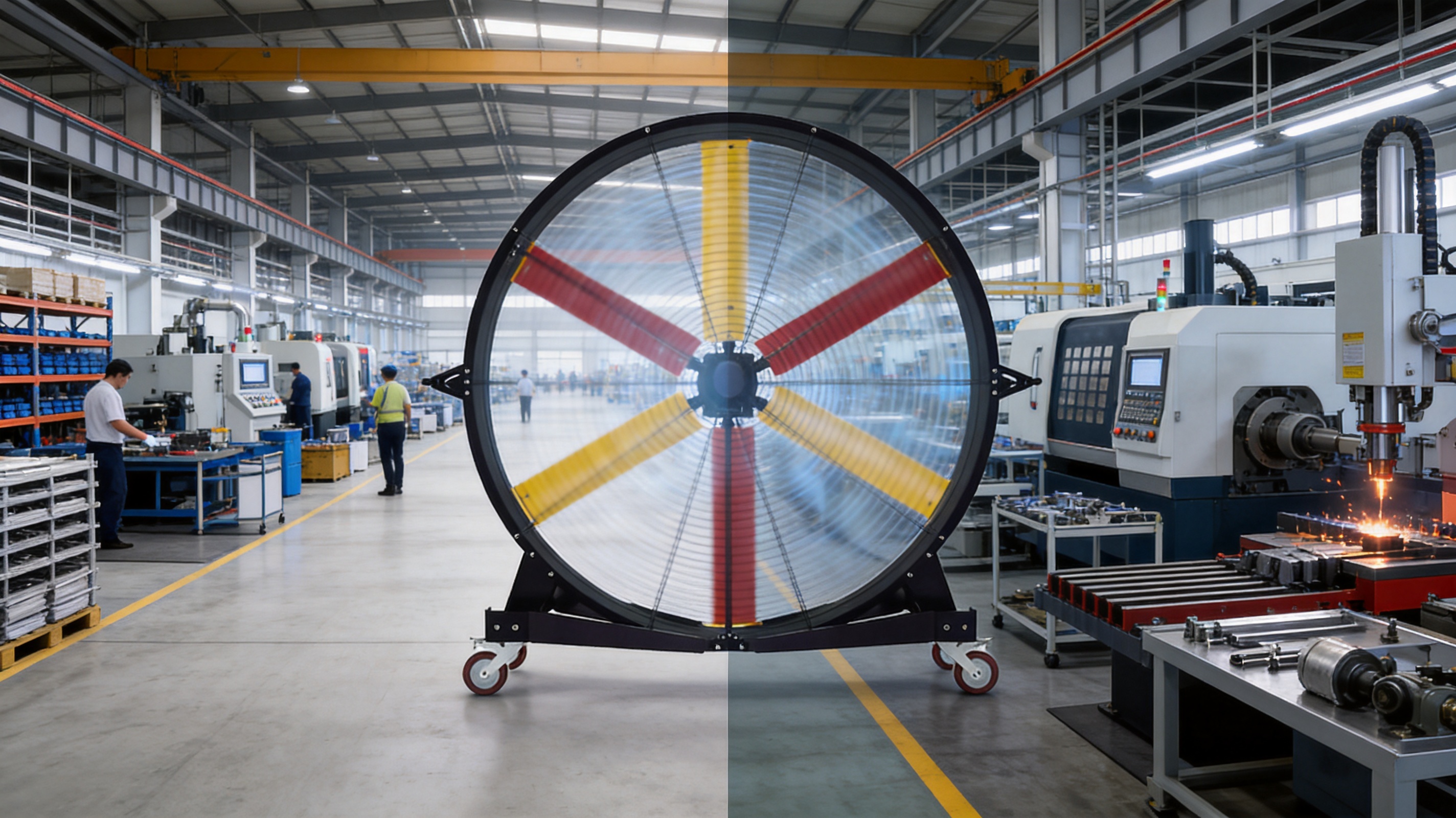
Manufacturing operations may generate heat from machinery, welding, molding, processing, lighting, or compressed-air systems. Employees may work across large floor areas with different thermal conditions. The 2-meter fan can provide broad air movement without occupying ceiling space or requiring a permanent mounting position.
Its mobility is useful when production lines are changed or when airflow needs to be focused on a particular work cell. The relatively low noise specification can also help maintain a more manageable acoustic environment, although the total sound level of the facility will depend on all operating machinery.
Automotive repair facilities often have wide bays, large doors, vehicle lifts, and heat-generating tools. A portable industrial fan can help circulate air around technicians and work areas. Because the unit can be moved, it may be positioned near a service bay during hot weather and relocated when vehicles or equipment occupy the working path.
Users should consider exhaust fumes, flammable vapors, and hazardous-area classifications before operating any electrical fan in an automotive environment. The product should not be treated as explosion-proof unless the specific model has been separately certified for that purpose.
Sports facilities require air circulation that supports comfort without creating distracting or excessively strong drafts. A large, slow-moving fan can help mix air throughout a court, training space, or spectator area. Its movable structure may allow the airflow direction to be adjusted for tournaments, practice sessions, or special events.
Placement must be planned carefully to maintain safe clearance from athletes, spectators, equipment, doors, and emergency routes. The fan should be positioned on a stable surface and operated only by trained personnel.
Livestock barns and agricultural buildings can benefit from broad air circulation because animals may be distributed across a large area. Moving air can help reduce stagnant conditions and support a more comfortable environment during warm periods. The fan may also be useful in certain crop-processing or storage areas.
Agricultural users should evaluate humidity, dust, ammonia, corrosive gases, wash-down practices, and electrical safety. The IP55 rating provides a level of protection, but it does not eliminate the need for regular cleaning, inspection, and appropriate environmental controls.
Large retail stores, hotel service areas, and commercial facilities may need temporary air circulation during renovations, seasonal peaks, equipment failures, or special events. A movable fan can supplement installed ventilation without requiring major building modifications.
In customer-facing spaces, appearance, sound, cable management, and pedestrian safety are important. The blade color can be selected from yellow, blue, silver, black, or red options according to the available product configuration. Operators should ensure that the fan does not obstruct aisles, entrances, displays, fire exits, or accessibility routes.
Exhibition halls frequently change their internal layout. Booths, temporary walls, lighting systems, displays, and visitor traffic can all affect airflow. A floor-standing HVLS fan can be repositioned as the layout develops, offering practical circulation support without permanent construction.
Exhibition operators should take account of visitor safety and visual presentation. The fan should be placed where its large footprint does not interfere with visitor movement or sensitive displays. Airflow should also be evaluated for lightweight materials, hanging exhibits, paper products, and dust-sensitive objects.
Food processing environments may require careful management of temperature, humidity, and air movement. A large fan can help reduce stagnant areas and support general circulation, but airflow patterns must be compatible with sanitation, hygiene, and contamination-control procedures.
The fan should be included in the facility’s cleaning and maintenance program. Operators should prevent dirt accumulation on blades and protective components, and they should confirm that the selected configuration meets the site’s food-safety requirements. Air movement should not be used to replace dedicated hygienic ventilation systems where such systems are required.
Shanghai Aipu Fans Co., Ltd. was established in Shanghai, China, in 2006. The company specializes in industrial-grade ceiling fans and broader ventilation products for industrial customers worldwide. Its experience in fan development supports the production of large air-movement equipment for warehouses, plants, commercial buildings, and other demanding environments.
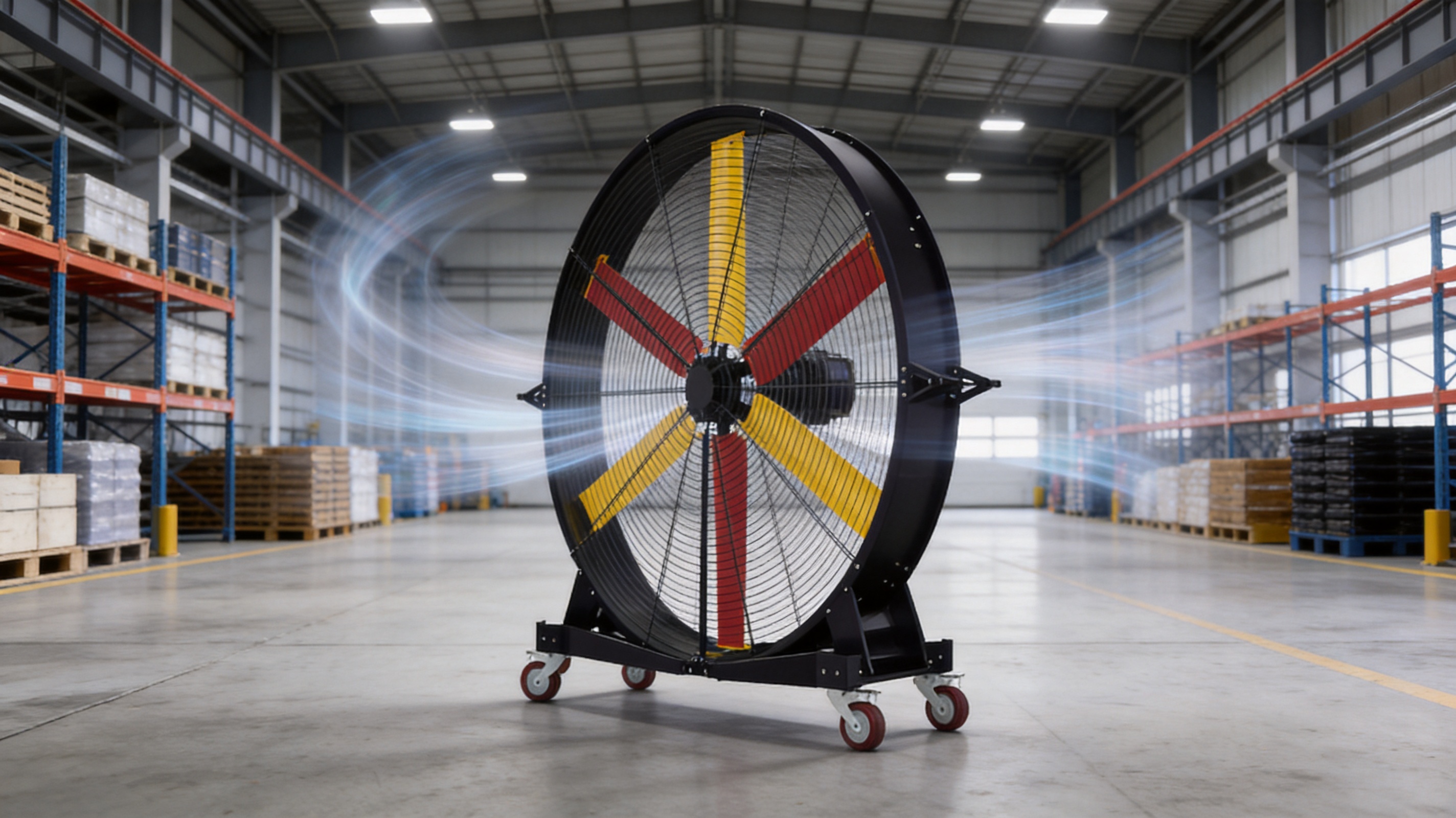
The company operates an approximately 8,000-square-meter production base. The facility includes high-precision automated machinery, a machining center, a cutting center, a welding center, and a testing center. These capabilities are important because a large industrial fan requires more than simple assembly. The motor, blades, frame, wheels, controls, fasteners, and electrical components must operate as a coordinated system.
Automated production equipment can improve repeatability across batches. Consistent cutting, forming, drilling, and component preparation help reduce dimensional variation. This is particularly useful for fan assemblies because even small differences in blade geometry or mounting position can influence balance and vibration.
Precision machinery also supports more efficient production planning. When customers require different sizes, colors, blade counts, or electrical configurations, a capable production line can adapt more readily than a purely manual workshop. Manufacturing consistency is valuable for distributors and OEM customers that need repeatable products for multiple projects.
The machining center provides controlled processing for components that require accurate dimensions and connection points. Proper machining helps ensure that shafts, mounts, brackets, housings, and other mechanical parts fit together correctly.
Accurate mechanical interfaces can reduce assembly problems and help improve serviceability. They also support consistent alignment of rotating parts, which is important for reducing vibration and extending the operating life of bearings and drive components.
The cutting center supports the preparation of metal and other structural materials. Controlled cutting improves the consistency of frames, supports, and blade-related parts. It can also help reduce material waste and improve production efficiency.
For large mobile equipment, frame geometry must be carefully controlled. A square, stable frame helps distribute the product’s weight and reduces unnecessary stress during movement. The cutting and fabrication process therefore contributes directly to the usability of the finished fan.
Welding quality affects the strength and durability of the base, brackets, guards, and structural supports. A dedicated welding center allows the company to manage welding procedures, fixtures, and inspection more systematically.
Strong, consistent welds are particularly important for equipment weighing more than one hundred kilograms. The frame must withstand movement, stopping, vibration, and normal industrial handling. Appropriate welding inspection helps support safe and reliable operation.
Testing is an essential step in the manufacture of industrial fans. A testing center can be used to examine operational performance, electrical behavior, sound, vibration, speed control, and general assembly quality. The exact tests applied may vary according to the product model and market requirements.
Testing helps identify problems before shipment. It can also support quality records, product improvement, and customer confidence. For OEM and international customers, a structured testing process is especially important because the equipment may be installed far from the factory and expected to operate in demanding conditions.
The product information identifies CE certification for the available configuration. Certification requirements can vary by destination market, voltage, electrical system, and product version. Buyers should confirm that the exact model and electrical configuration meet the standards applicable to the intended country or region.
The listed warranty period is three years. A warranty can provide valuable support for industrial customers, especially when equipment is used regularly and forms part of a facility’s ventilation strategy. Warranty conditions generally depend on correct installation, proper operation, routine maintenance, and the use of suitable electrical supplies.
Industrial customers may also benefit from OEM customization. Potential customization areas can include blade color, control arrangements, electrical specifications, product labeling, packaging, and project-specific configurations. The feasibility of each option should be confirmed during technical discussions before production.
The company’s product range covers several categories, including HVLS fans, PMSM ceiling fans, Airmove stand fans, Airpole pedestal fans, industrial wall-mounted fans, and commercial ceiling fans. This broader portfolio allows customers to combine different ventilation formats in one project. For example, a warehouse may use large HVLS equipment for general circulation and wall-mounted units for localized workstations.
A movable fan does not require permanent ceiling installation, but careful positioning is still necessary. The unit should be placed on a stable and reasonably level floor with adequate space around the rotating assembly. It should not be positioned where people can reach the blades or where nearby objects could enter the rotating area.
The fan should be kept away from emergency exits, fire equipment, narrow walkways, vehicle routes, unstable stacks, and locations where water may accumulate. Power cables should be routed to avoid trip hazards, crushing, abrasion, and contact with hot surfaces.
Before operation, the operator should inspect the wheels, frame, blade assembly, guards, fasteners, electrical connections, and control system. If the fan has been moved, it should be stabilized before being switched on. Abnormal vibration, scraping, unusual noise, burning smells, or irregular speed should be treated as reasons to stop the equipment and investigate.
Airflow planning should consider the location of heat sources, doors, windows, exhaust systems, partitions, racks, and occupied workstations. The best position is not always the location closest to the people who want airflow. In some cases, placing the fan to support circulation across the entire space produces better results than directing it narrowly at one workstation.
Regular maintenance supports safe and efficient operation. Dust and dirt can accumulate on blades, guards, motor housings, and control components, especially in warehouses, workshops, agricultural buildings, and manufacturing plants. Accumulated material can affect balance, increase resistance, and reduce airflow performance.
The fan should be switched off and isolated from its power source before cleaning or maintenance. Operators should use cleaning methods compatible with the materials and protection level. High-pressure water should not be directed at electrical components unless the equipment and procedure are specifically approved for that purpose.
Fasteners and structural connections should be inspected periodically. Vibration can gradually loosen components if the fan operates continuously in a demanding environment. Wheels, brakes, and the base should also be checked because mobility is a central feature of the product.
Electrical inspections should be performed by qualified personnel. The power supply, inverter, wiring, grounding, control panel, and protective devices should be checked according to applicable regulations. Any damaged cable, cracked enclosure, exposed conductor, or overheating sign should be corrected before continued use.
Maintenance records can help facility managers identify recurring issues and plan service intervals. Records may include cleaning dates, operating hours, inspection results, repairs, replacement parts, and abnormal performance observations.
The 0.65 kW power rating of the ASF-20 provides a reference point for evaluating operating cost. Actual energy consumption depends on the selected speed, operating hours, control method, voltage, and load conditions. Variable-speed operation can allow users to avoid running the fan harder than necessary.
Large-area air movement may also support the performance of existing heating and cooling systems by reducing temperature stratification. When air is mixed more evenly, conditioned air may be distributed more effectively. However, the fan is not a replacement for a properly designed HVAC system, mechanical exhaust system, or process ventilation system.
Comfort depends on more than air speed. Humidity, clothing, workload, radiant heat, air temperature, and individual sensitivity all influence how people experience a space. A facility should select fan settings that improve circulation without creating discomfort or disturbing sensitive operations.
The product’s low-speed design provides a useful balance between air movement and comfort. It avoids relying solely on very high rotational speed, which can increase noise and produce an overly forceful draft. This makes the fan appropriate for environments where people remain in the airflow for long periods.
The 2-meter size offers a practical middle ground between compact portable fans and very large permanent ceiling systems. It is large enough to produce broad airflow for industrial spaces while remaining suitable for floor-level relocation with appropriate handling procedures.
Its movable format is beneficial for businesses that have changing layouts. Manufacturing lines may be reconfigured, warehouses may add or remove racks, and event halls may change arrangements from one week to the next. A mobile fan can follow the operational need rather than remaining fixed in one location.
The product can also support phased facility development. A company may begin with a small number of movable units while evaluating airflow requirements. As operations expand, additional equipment or complementary ceiling and wall-mounted products can be integrated into the overall ventilation plan.
For rental properties, temporary workshops, seasonal agricultural operations, and event venues, avoiding permanent structural modifications can be an important financial and logistical advantage. The fan can be deployed where needed without the construction time associated with ceiling-mounted alternatives.
Fan Type |
Primary Airflow Character |
Mobility |
Typical Strength |
Potential Limitation |
2-meter floor-standing HVLS fan |
High-volume, broad, low-speed circulation |
High |
Wide coverage and flexible positioning |
Requires floor space and safe clearance |
Small portable fan |
Localized, higher-velocity airflow |
High |
Low initial cost and easy handling |
Limited coverage in large spaces |
Ceiling-mounted HVLS fan |
Broad overhead air circulation |
Low after installation |
Efficient use of floor space |
Requires suitable structure and installation |
Wall-mounted fan |
Directional airflow from a fixed position |
Low after installation |
Useful for localized zones |
Less flexible after mounting |
Pedestal fan |
Medium-area directional airflow |
Moderate to high |
Adjustable height and direction |
Generally smaller coverage than an HVLS unit |
This comparison shows why the floor-standing HVLS format occupies a distinct position. It combines the broad airflow principle of large industrial ventilation equipment with the flexibility of portable equipment. It is not intended to replace every other fan type, but it can provide a strong solution where both coverage and mobility are priorities.
Before purchasing, buyers should assess the floor area, ceiling height, heat sources, occupancy, existing HVAC systems, environmental conditions, and expected operating schedule. The 2-meter model may be appropriate for many large spaces, but final fan quantity and placement should be determined through a site-specific evaluation.
Electrical requirements should be confirmed early. Buyers should provide the destination country, voltage, frequency, phase requirements, plug or connection preferences, and any control-system requirements. Correct electrical matching helps prevent delays and supports safe commissioning.
Buyers should also clarify the final dimensions and weight of the selected configuration. The supplied specifications include different dimensional figures for the ASF-20 in the series table and product information. This may reflect different measurement methods, blade configurations, or production versions. Confirming the final drawing before shipment is recommended, particularly when the fan must pass through doors, elevators, loading bays, or narrow aisles.
Questions about blade count, blade material, blade color, inverter configuration, wheel locking, protective guards, packaging, warranty terms, spare parts, and after-sales service should be addressed in the quotation stage. A complete technical discussion reduces the possibility of misunderstanding between the buyer and manufacturer.
Shanghai Aipu Fans Co., Ltd. supplies industrial ventilation products to domestic and international customers. Its manufacturing base, production equipment, testing resources, and experience in fan development support projects that require more than a standard off-the-shelf product.
The company focuses on industrial-grade, energy-conscious ventilation products and customized OEM services. Customers can discuss product solutions according to building size, operating environment, target airflow, installation method, appearance requirements, and control preferences.
Its location in Shanghai provides access to a developed manufacturing and logistics network. International buyers can work with the company to coordinate product specifications, documentation, packaging, shipping, and market-specific requirements. The company’s product portfolio also makes it possible to source multiple fan categories from one supplier.
Technical communication remains important for every industrial fan project. Product drawings, electrical data, operating instructions, maintenance guidance, packaging details, and certification documents should be reviewed before order confirmation. This process is especially important for customers installing equipment in facilities with strict safety or environmental requirements.
HVLS means high volume, low speed. An HVLS fan moves a large quantity of air while rotating more slowly than many conventional high-speed fans. The objective is broad, comfortable air circulation rather than a narrow, forceful air stream.
The main product has a listed fan diameter of approximately 2 meters, or about 7 feet. The final dimension may vary slightly according to the selected configuration and measurement method.
No. This product is a floor-standing model supported by a four-wheel base. It does not require permanent ceiling installation, although it still requires suitable floor space, electrical access, and safe clearance around the rotating assembly.
The fan should be switched off and stabilized before relocation. Operators should follow the manufacturer’s safety instructions and avoid moving a large rotating unit through occupied areas or across unsuitable floors.
The series has a listed noise level below 40 dB. Actual sound may vary according to operating speed, floor condition, maintenance, surrounding machinery, and building acoustics.
The listed protection level is IP55. This indicates protection against dust ingress at a specified level and protection against water jets. It does not mean that the fan is suitable for immersion, high-pressure washing, hazardous gases, or every outdoor condition.
The ASF-20 model is listed with a power rating of 0.65 kW, equivalent to 650 W. Actual electrical consumption depends on speed, operating conditions, control settings, and electrical supply.
The product information lists approximately 200 RPM in the main series table for ASF-20 and approximately 230 RPM in another product specification. The final speed may depend on the configuration and control setting, so buyers should confirm the approved technical datasheet for their order.
The listed material is magnalium, an aluminum-magnesium alloy known for a useful balance of light weight, strength, and corrosion resistance. Specific components may use different materials according to their function and design.
The product information lists five or six blades. The exact blade count should be confirmed according to the selected model and quotation.
The supplied application information includes outdoor use, but suitability depends on weather exposure, electrical installation, ground condition, drainage, wind, temperature, and local safety requirements. The IP55 rating alone does not guarantee suitability for every outdoor environment.
No. The fan improves air movement and perceived comfort but does not remove heat in the same way as an air-conditioning system. It can complement HVAC equipment by helping distribute conditioned air more evenly.
Potential applications include warehouses, manufacturing plants, automotive repair shops, gymnasiums, indoor sports arenas, agricultural barns, retail spaces, exhibition halls, food processing facilities, hotels, garages, and other large commercial or industrial buildings.
The supplied specifications list a three-year warranty. Warranty coverage and conditions should be confirmed in the sales agreement, including requirements for installation, operation, maintenance, and authorized service.
The company provides OEM services and may support customization of selected product features. Possible options may include color, electrical configuration, controls, labels, packaging, and project-specific arrangements. Availability should be confirmed before production.
The 2-meter 4-wheel movable large floor-standing HVLS fan is designed for facilities that need broad, comfortable, and flexible air circulation. Its large blade span, low-speed operating principle, variable-speed control, industrial construction, and mobile four-wheel base distinguish it from smaller conventional fans and permanently installed ventilation equipment.
The product can help address uneven temperatures, stagnant air, localized hot spots, and changing airflow requirements in warehouses, factories, sports venues, agricultural buildings, retail spaces, exhibition halls, garages, and other large environments. Its listed power rating of 0.65 kW, noise level below 40 dB, IP55 protection level, industrial materials, and available blade configurations provide a practical foundation for demanding applications.
Its advantages are supported by the manufacturer’s production capabilities. Shanghai Aipu Fans Co., Ltd. operates an approximately 8,000-square-meter production base with automated machinery, machining, cutting, welding, and testing facilities. The company’s experience since 2006, broad fan portfolio, OEM capabilities, CE certification information, and listed three-year warranty make it a potential partner for industrial ventilation projects.
Successful use depends on selecting the correct configuration, confirming final technical details, positioning the fan safely, maintaining the equipment, and integrating it with the facility’s overall ventilation strategy. When these factors are carefully considered, a movable HVLS fan can provide a versatile and efficient way to improve air circulation across large working and commercial spaces.
1. Shanghai Aipu Fans Co., Ltd., Product Information for the 2-Meter 4-Wheel Movable Large Floor-Standing HVLS Fan.
2. Shanghai Aipu Fans Co., Ltd., ASF Series Technical Specifications and Application Information.
3. International Electrotechnical Commission, Degrees of Protection Provided by Enclosures, IP Code Classification.
4. International Organization for Standardization, Acoustics and Sound Pressure Measurement Principles.
5. General industrial ventilation and thermal comfort engineering principles concerning high-volume, low-speed air movement.
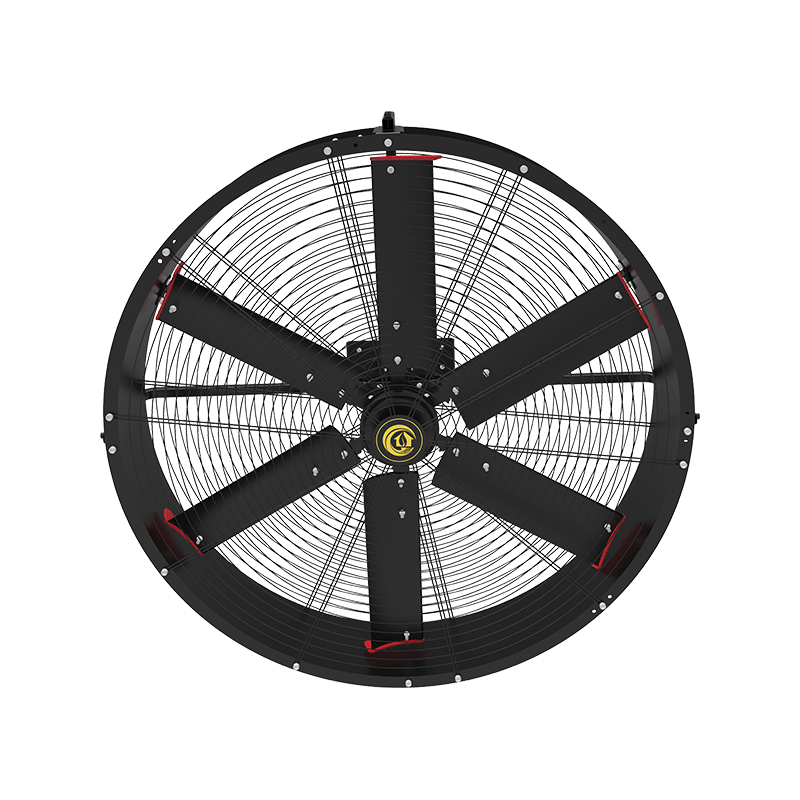
1. Extreme Airflow & Wide CoverageEquipped with massive 79-inch (2.0m) diameter aerospace-grade aluminum alloy blades. These precision-balanced blades generate a powerful, stable laminar airflow t...
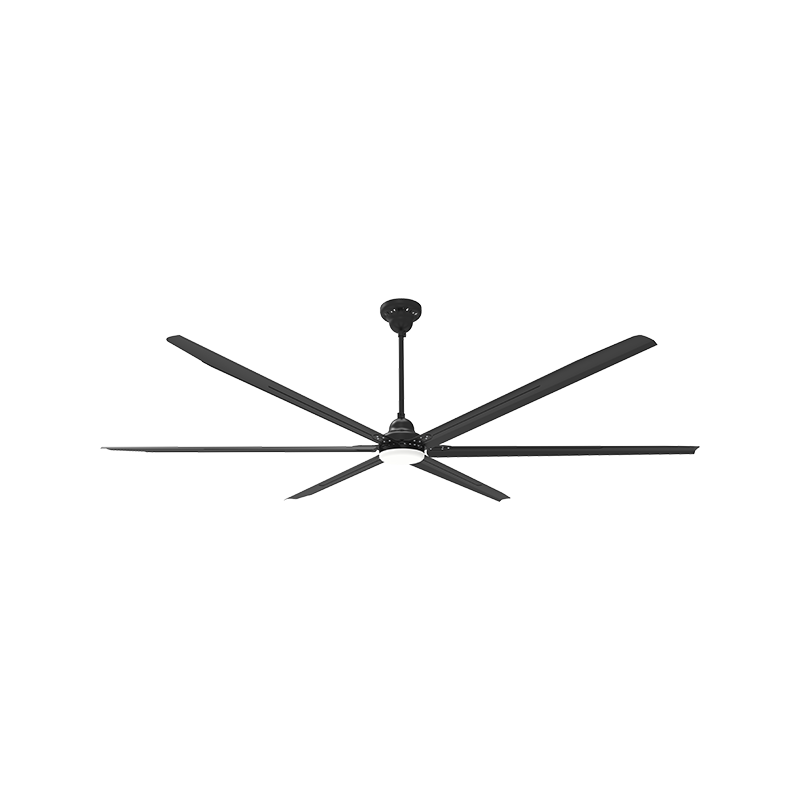
1. Core Technology: High Volume, Low SpeedNatural Breezes: Unlike the “harsh” wind from small fans, HVLS fans use massive blades rotating at low speeds to create a large-scale, three-dimensional breez...
The 2-meter 4-wheel movable large floor-standing HVLS fan utilizes larger blades and a lower rotational speed, enabling it to generate a large volume of airflow while maintaining low noise levels. The...
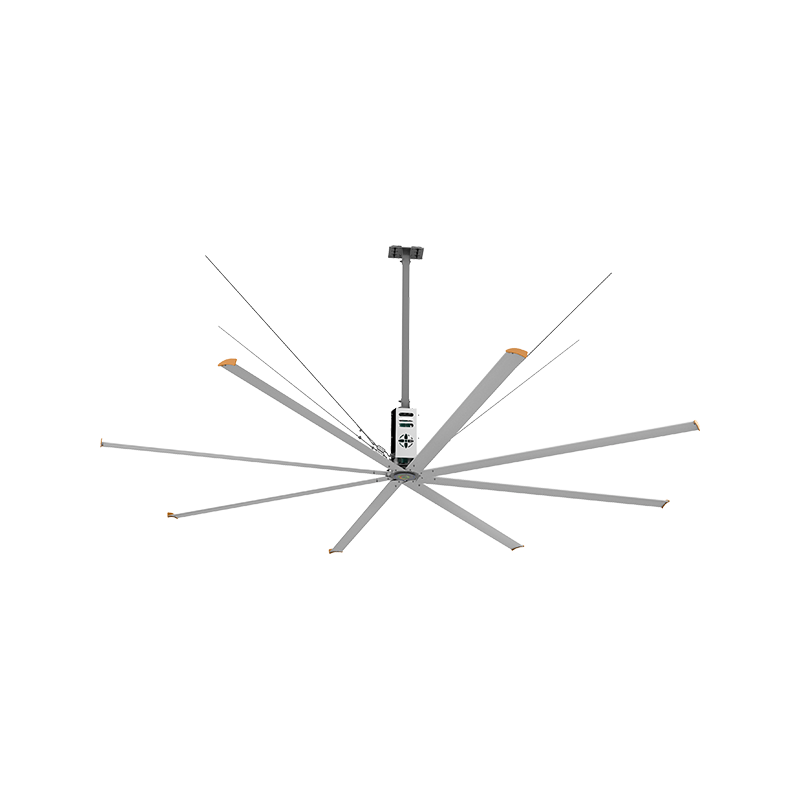
The 24-foot aluminum alloy blade HVLS ceiling fan has a motor power of 1.5 kilowatts, providing sufficient power while maintaining high energy efficiency. This ceiling fan supports multiple voltage sp...
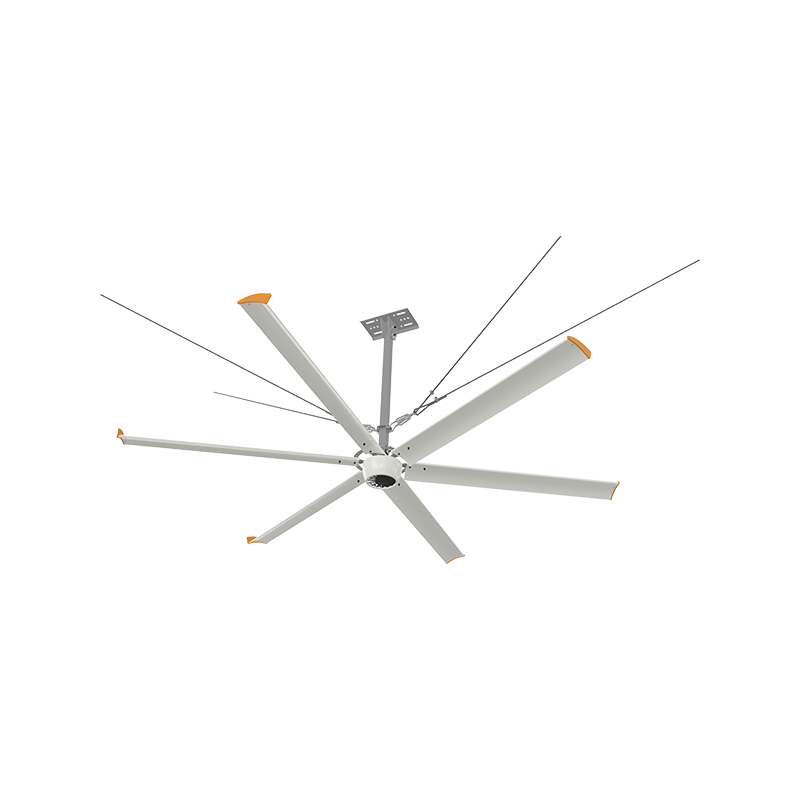
The 15-foot Even Airflow Industrial BLDC Ceiling Fan utilizes a high-efficiency BLDC motor and carefully designed blades. This ceiling fan operates with extremely low noise levels, making it suitable ...
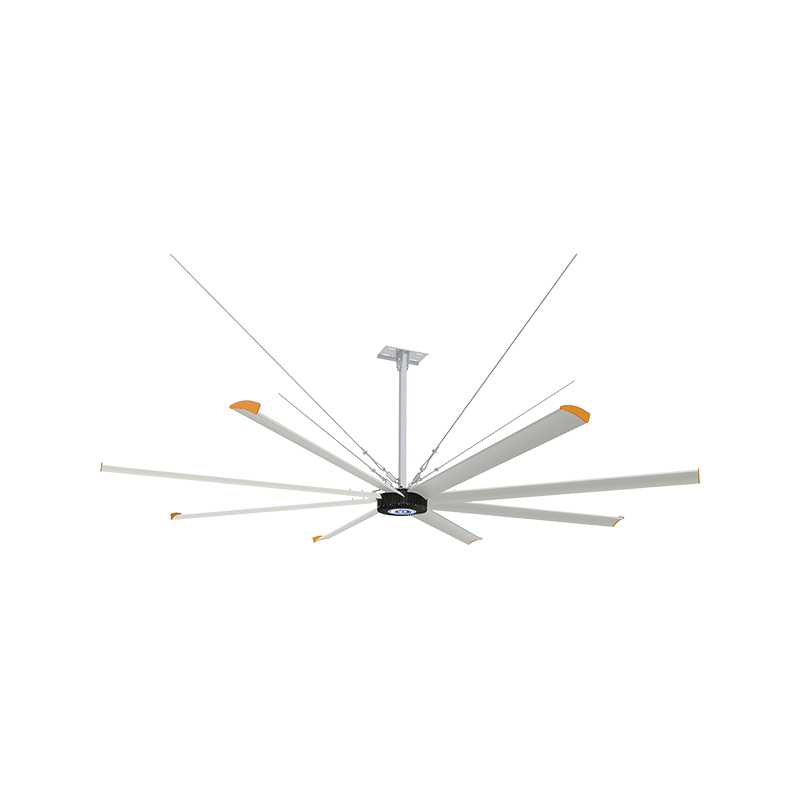
The 8-foot HVLS Large Industrial BLDC Ceiling Fan is equipped with a 0.3KW brushless DC motor, offering higher energy efficiency and lower noise levels. The lower power consumption design helps users ...
A 6,800 m² factory floor used to be ventilated by roughly 300 small wall and pedestal fans. Six large ceiling fans now cover the same area, and in the manufacturer's own comparison that change cuts m...
READ MORESpecifying industrial air movement The HVLS Ceiling Fan Isn’t a Big Ceiling Fan. Sizing, motor selection, and mounting height have to work together before a large industrial space can feel genuinely...
READ MOREDealership Ventilation Planning Car Showroom Fan Installation: Comfort That Sells Tall glass facades, high ceilings, and polished floors make a showroom one of the hardest retail spaces to keep comfo...
READ MOREStanding on the floor of a 6,000-square-metre factory on a hot July afternoon, you quickly notice the problem: small ceiling fans running at full speed create noisy air pockets near the floor, while ...
READ MORE Custom Large Industrial Fans Manufacturers