

 English
 Español
 عربى

The 8-foot HVLS Large Industrial BLDC Ceiling Fan is equipped with a 0.3KW brushless DC motor, offering higher energy efficiency and lower noise levels. The lower power consumption design helps users ...
Content
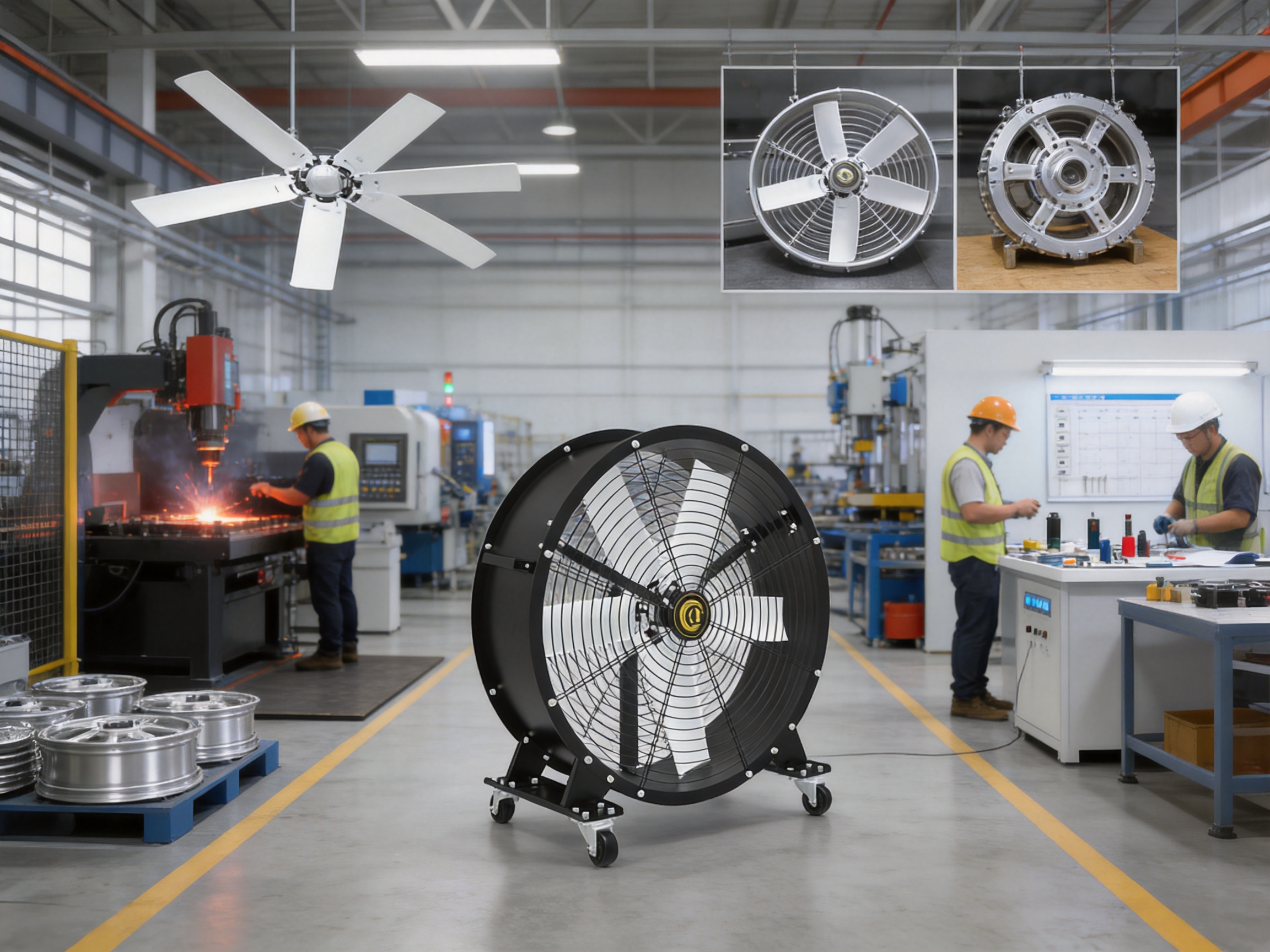
Large indoor and semi-outdoor spaces require a different approach to air movement than ordinary rooms. Warehouses, manufacturing plants, agricultural barns, exhibition halls, gymnasiums, garages, retail spaces, and repair facilities often have high ceilings, wide floor areas, changing occupancy levels, and equipment that produces heat. In these environments, a small portable fan may create a narrow stream of air without improving overall circulation, while a permanently installed ceiling fan may not be practical when the layout or operating requirements change.
The 79-inch new mobile HVLS fan is designed to address these challenges with a combination of large-volume airflow, mobile construction, variable-frequency control, low energy consumption, and durable materials. Its design uses magnetic aluminum alloy, also described as magnalium, to provide a strong and lightweight structure. The reduced weight makes the unit easier to transport, position, and install compared with many permanently mounted industrial ventilation systems.
As a mobile high-volume, low-speed fan, this product can support air movement in locations where fixed ceiling installation is difficult or where ventilation needs change from one area to another. It is suitable for industrial, commercial, agricultural, sports, automotive, and household applications. Its adjustable operating range allows users to select a suitable airflow level for a particular space rather than operating continuously at one fixed speed.
The product range includes several models, from the compact ASF-09 to the larger ASF-20. Depending on the selected model, maximum speed, dimensions, rated power, weight, and airflow reach vary. This range gives buyers the flexibility to select a unit according to the size of the facility, available floor space, required air movement, and mobility requirements.
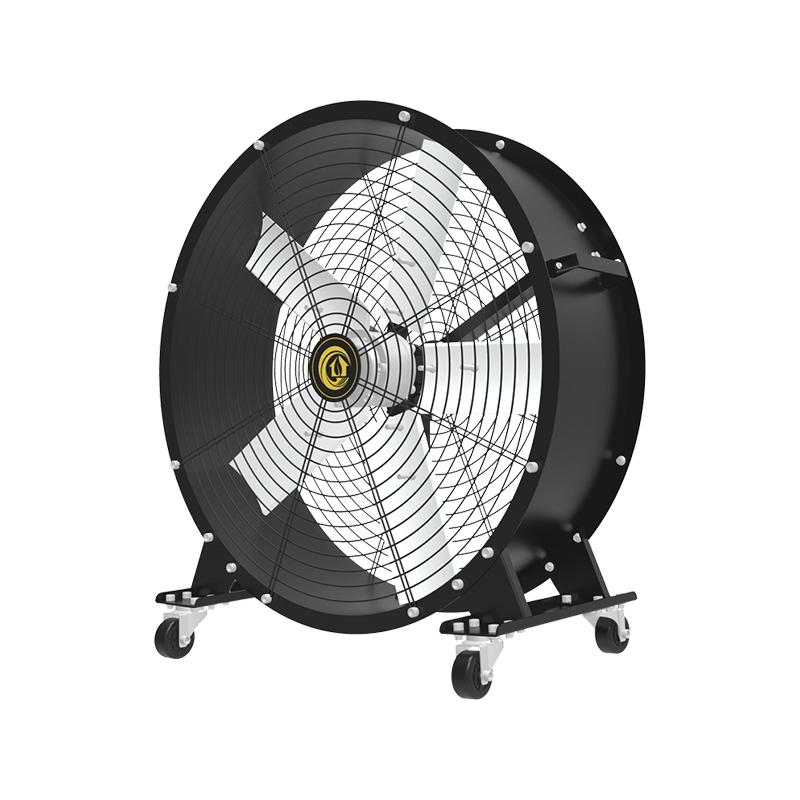
79-inch new mobile HVLS fan
HVLS means high volume, low speed. Unlike a conventional high-speed fan that produces a concentrated jet of air, an HVLS fan is designed to move a broad volume of air across a wide area. The resulting circulation can help reduce stagnant air, distribute temperature more evenly, and improve perceived comfort for people and working animals.
A mobile HVLS fan uses the same basic air-movement principle as a large industrial fan but places the fan assembly on a movable support rather than attaching it permanently to a ceiling structure. This arrangement is valuable when the fan must be used in multiple work zones, when the roof cannot support a suspended fan, or when a facility frequently changes its internal layout.
The 79-inch new mobile HVLS fan combines a large-diameter fan assembly with a wheeled or movable structure. The available information identifies a 2-meter or approximately 7-foot fan diameter for the ASF-20 configuration, while the product title describes the product as a 79-inch mobile HVLS fan. Buyers should confirm the exact fan diameter and configuration before ordering, especially when comparing the different ASF models.
High-volume airflow does not mean that the fan must consume excessive power. The product uses a high-efficiency motor and advanced variable-frequency control technology. These systems regulate motor operation according to the selected speed, enabling users to reduce power use when maximum airflow is unnecessary.
This combination of broad airflow, adjustable speed, mobile operation, and energy-conscious motor control distinguishes the product from basic pedestal fans and many fixed ventilation solutions.
One of the most important advantages is mobility. A fixed ceiling fan can be effective in a permanently arranged facility, but its airflow pattern is tied to one installation point. Moving equipment, changing production lines, seasonal storage arrangements, or temporary events may leave some areas inadequately ventilated.
The mobile design allows operators to reposition the fan according to actual conditions. It can be directed toward a loading zone during receiving operations, moved near a workstation during a hot production period, positioned beside exercise equipment in a sports facility, or used in a garage when repair work generates heat and odors. This flexibility can reduce the need to purchase and install multiple fixed fans.
Mobility is also useful for facilities with seasonal requirements. A warehouse may require stronger circulation during summer, while an agricultural barn may need airflow in different sections depending on livestock placement. Retail stores and exhibition halls may rearrange displays regularly. A mobile unit can adapt to these changes without requiring new structural work.
The fan design uses magnetic aluminum alloy material, also referred to in the product information as magnalium. This material choice is intended to balance durability and weight. Aluminum-based alloy construction can offer a useful combination of corrosion resistance, strength, and reduced mass when compared with heavier traditional metal structures.
A lighter fan is easier to transport and position. It can also simplify handling during installation, maintenance, or relocation. At the same time, the alloy structure is intended to withstand the demands of industrial and commercial environments. The material is suitable for a product that may be used in warehouses, garages, workshops, agricultural buildings, and other locations where equipment must operate reliably over an extended period.
The material also contributes to the product’s modern appearance. Buyers can select blade colors including yellow, blue, silver, black, and red, depending on the required visual style or facility color scheme. In commercial applications, appearance may be important when fans are installed in customer-facing spaces such as retail areas, hotels, exhibition venues, and sports facilities.
The product is equipped with a high-efficiency motor and advanced variable-frequency control technology. A variable-frequency system controls motor speed by adjusting the frequency supplied to the motor. This provides more precise regulation than a simple on-off switch or a limited number of fixed speed settings.
In practical use, the operator can select a lower speed when moderate circulation is sufficient and increase the speed when the space becomes warmer or more crowded. This helps avoid running the fan continuously at full output. The result can be a more efficient operating pattern and a better match between energy use and ventilation demand.
The information supplied for the product lists power ratings from 0.35 kW to 0.65 kW across the ASF-09, ASF-12, ASF-15, and ASF-20 models. These ratings are relatively modest for equipment intended to move air through large spaces. Actual energy consumption will depend on the selected speed, operating time, electrical conditions, and site requirements, so users should evaluate the complete operating profile when calculating energy savings.
Variable-frequency operation can also make the airflow more comfortable. Instead of switching abruptly between still air and a strong blast, the user can select an intermediate setting. This is particularly helpful in retail environments, gyms, offices connected to industrial areas, garages, and facilities where people remain near the fan for long periods.
The product supports a broad range of wind speeds, identified in the specifications as 0 to 26 meters of wind range for the applicable configuration. The detailed model table lists maximum speeds from 200 RPM to 420 RPM. Lower fan speeds are associated with the larger models, while smaller models can operate at higher rotational speeds.
These figures demonstrate an important principle of HVLS design: rotational speed alone does not determine the usefulness of the fan. A larger fan moving at a lower speed can distribute air across a broad area while maintaining comfortable operation. A smaller fan may turn faster to achieve its intended airflow performance.
The five- or six-blade configuration helps support broad air movement. The final number of blades may depend on the selected configuration, so purchasers should confirm the blade arrangement during the quotation process. The combination of blade diameter, blade count, motor output, and speed control determines the final airflow pattern.
The listed noise level is below 40 dB for all models in the main specification table. Low noise is valuable in facilities where communication, concentration, customer comfort, or animal welfare matters.
In a gymnasium, lower operating noise allows users to hear instructions and music more clearly. In a retail or hotel environment, it helps preserve a comfortable atmosphere. In a workshop or production facility, quieter ventilation can reduce the cumulative noise burden on workers. In agricultural applications, reduced noise may create a more suitable environment for livestock.
Actual perceived sound can be affected by installation conditions, floor surfaces, surrounding equipment, airflow obstructions, and the selected operating speed. Nevertheless, the stated noise rating indicates that quiet performance is a design priority.
The product information lists IP55 protection. An IP55 enclosure rating generally indicates protection against dust ingress at a level that does not interfere with operation and protection against water jets from different directions. It is not a declaration that the fan is waterproof or suitable for submersion.
This level of protection can be useful in industrial, agricultural, garage, warehouse, and commercial conditions where dust or incidental moisture may be present. Operators should still follow the installation and maintenance instructions, avoid direct exposure beyond the equipment’s design limits, and ensure that electrical connections are protected appropriately.
The mobile HVLS fan is available in multiple model sizes. The following table summarizes the supplied specifications. Because product configurations may be adjusted for specific projects, buyers should verify the final dimensions, rated speed, blade arrangement, controls, and electrical requirements before purchase.
| Model | Approximate Dimensions | Maximum Speed | Weight | Power | Noise Level | Protection |
|---|---|---|---|---|---|---|
| ASF-09 | 1000 × 640 × 1100 mm | 420 RPM | 65 kg | 0.35 kW | Below 40 dB | IP55 |
| ASF-12 | 1310 × 640 × 1400 mm | 380 RPM | 80 kg | 0.40 kW | Below 40 dB | IP55 |
| ASF-15 | 1610 × 720 × 1700 mm | 300 RPM | 92 kg | 0.55 kW | Below 40 dB | IP55 |
| ASF-20 | 1985 × 720 × 2100 mm | 200 RPM | 115 kg | 0.65 kW | Below 40 dB | IP55 |
The ASF-09 is the lightest listed model and may be appropriate where mobility and compact dimensions are the main priorities. The ASF-12 provides a larger configuration while remaining relatively easy to handle. The ASF-15 offers increased size and a lower maximum speed for broader air movement. The ASF-20 is the largest model in the listed range and is identified in the detailed product information with a 2-meter or 7-foot fan diameter, 650 W power rating, and a stated fan speed of 220 RPM in one configuration.
The difference between the main model table and the detailed ASF-20 information should be confirmed with the supplier. The main table lists a maximum speed of 200 RPM for ASF-20, while the additional specification lists 220 RPM. Similarly, dimensions may vary depending on whether the measurement refers to the fan body, complete mobile frame, or a particular configuration.
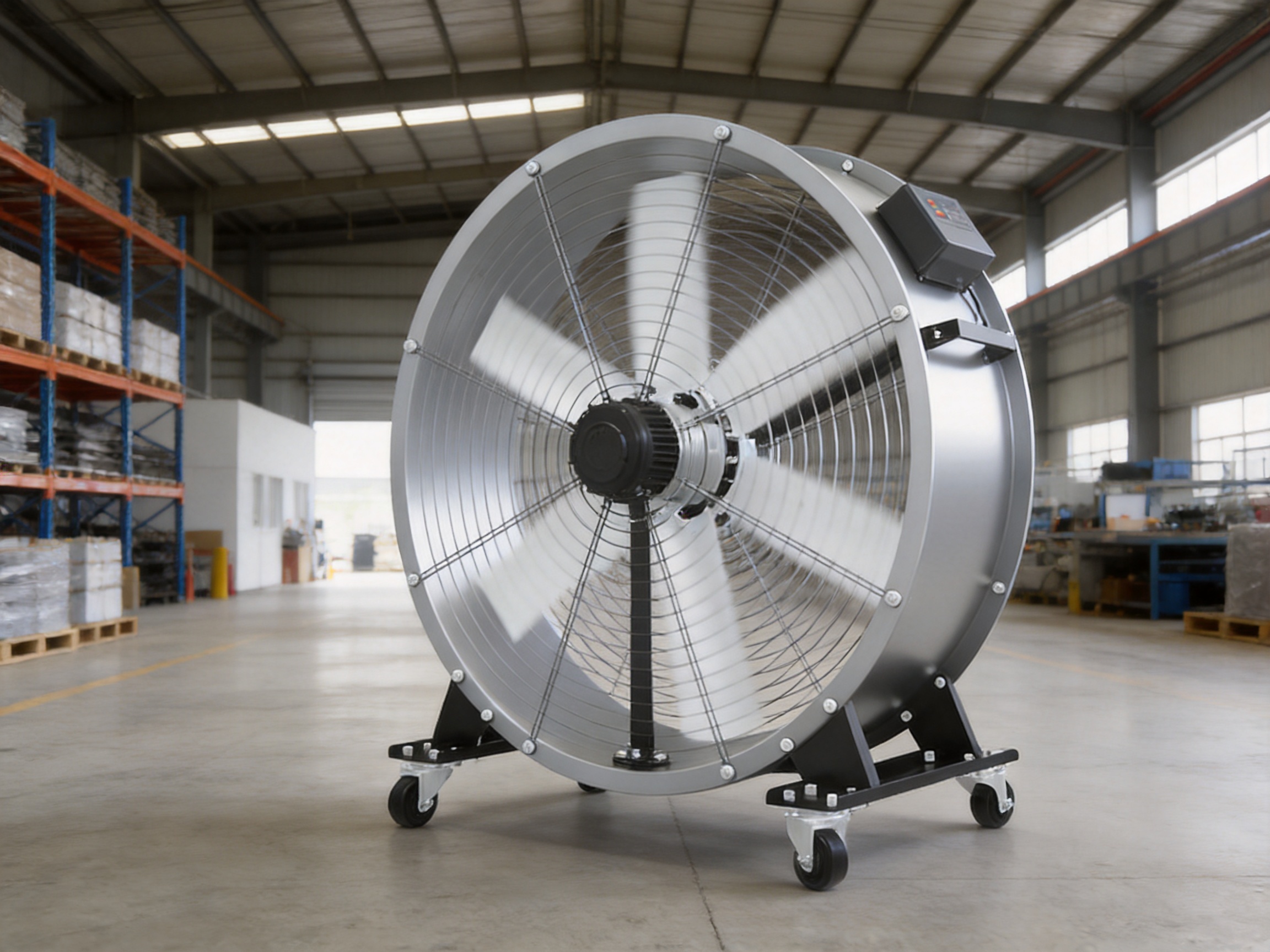
Ordinary pedestal fans are usually intended for localized personal cooling. They may be useful beside a desk, workstation, or small room, but their airflow is often concentrated in a relatively narrow direction. Several units may be required to cover a warehouse, workshop, or commercial area.
The mobile HVLS fan is designed for broader area circulation. Its larger fan diameter and variable-speed control allow it to move air across a larger zone. It can therefore provide a more suitable solution for facilities that need general air movement instead of one small, concentrated stream.
The mobile HVLS fan may also reduce equipment clutter. Instead of placing many small fans around a working area, a facility may use fewer large-volume units, subject to a professional airflow assessment. Fewer units can simplify power distribution, maintenance scheduling, and daily repositioning.
Fixed ceiling fans are valuable when a facility has a stable layout and suitable structural support. However, they require installation work, electrical planning, and permanent positioning. Relocating them can involve downtime and additional construction.
The mobile product offers greater flexibility. It can be used in leased buildings, temporary facilities, rented warehouses, event venues, and production spaces where permanent modifications are undesirable. It can also supplement fixed fans in areas that experience unusual heat loads or temporary occupancy increases.
On the other hand, a mobile fan occupies floor space and requires careful placement. It should not obstruct walkways, emergency exits, forklifts, vehicles, or production equipment. The choice between fixed and mobile systems should be based on the facility layout, airflow objectives, safety requirements, and operating schedule.
High-speed fans can provide strong local airflow, but they may create discomfort when positioned close to personnel. They can also generate more noise and may not distribute air evenly throughout a large space.
The mobile HVLS fan emphasizes high-volume circulation at controlled speeds. Its operating range enables the user to select a less aggressive airflow for occupied areas and increase the setting when stronger circulation is needed. The below-40-dB listed noise level further supports use in environments where high-speed fan noise would be undesirable.
Multiple small fans can be arranged to cover a facility, but they may require more electrical outlets, more maintenance points, and more complicated operating procedures. Their airflow patterns can overlap in some areas while leaving other areas still.
A large mobile HVLS fan can provide a more centralized solution. Its movement allows the operator to adjust coverage as needed. The variable-frequency controller also makes it possible to tune performance without switching several independent fans on and off.
Warehouses often contain tall storage racks, large open floor areas, loading doors, and changing inventory layouts. Air may remain stagnant between racks or in zones far from existing ventilation equipment. A mobile HVLS fan can help circulate air through open work areas and support more even temperature distribution.
The fan can be positioned near packing stations, receiving areas, dispatch zones, or temporary storage sections. Its mobility is particularly useful in facilities where pallet locations change frequently. Operators should maintain safe clearance from racks and ensure that the airflow does not disturb lightweight products, packaging materials, or dust-sensitive goods.
Manufacturing equipment can produce heat during cutting, welding, machining, molding, assembly, or other processes. Workers may also experience discomfort when air is trapped near the production floor. The mobile HVLS fan can be moved toward a work area that requires additional circulation without interrupting the entire plant layout.
Variable-speed control is useful because different processes may require different airflow levels. A low setting may support general circulation, while a higher setting may be selected during periods of increased heat generation. The IP55 rating can provide additional suitability in industrial environments, provided the actual site conditions remain within the product’s operating limits.
Garages often contain vehicle bays, tools, lifts, exhaust systems, and heat-producing equipment. The layout may change throughout the day as vehicles are moved in and out. A mobile fan can support airflow around repair bays, inspection zones, and waiting areas.
Its adjustable wind speed allows the operator to balance cooling with the need to avoid blowing dust, papers, or lightweight parts across the workshop. The fan should not be used as a substitute for required exhaust extraction or hazardous-gas control. Instead, it can complement a properly designed ventilation system by improving general air movement.
Exercise generates heat, and large sports buildings can become uncomfortable when air circulation is limited. The mobile HVLS fan can be placed near courts, training zones, or spectator areas, depending on the facility’s requirements.
Quiet operation is especially important in sports settings. A fan rated below 40 dB can support a more comfortable acoustic environment for coaches, athletes, spectators, and event staff. The fan should be positioned so that it does not interfere with play, signage, suspended equipment, or emergency routes.
Agricultural barns require careful management of temperature, humidity, and airflow. The mobile fan can help circulate air through livestock areas, storage spaces, and work zones. Its broad airflow can reduce stagnant pockets, while variable speed allows operators to adjust conditions according to season, animal density, and barn activity.
Because agricultural environments may contain dust, moisture, and corrosive contaminants, maintenance is essential. The IP55 specification provides a useful level of environmental protection, but the fan should still be cleaned regularly and inspected for accumulation, electrical issues, and mechanical wear.
Retail stores, hotels, and exhibition halls may require temporary or supplemental airflow without major construction work. A mobile HVLS fan can be repositioned as displays, booths, seating areas, or customer traffic patterns change.
The available blade colors can help buyers coordinate the equipment with an interior design or corporate color scheme. The low noise rating supports use in customer-facing environments, while speed adjustment allows operators to reduce airflow during quieter periods or increase it when occupancy rises.
Food processing facilities may require controlled air movement to support worker comfort and humidity management. The product information identifies food processing facilities as an application area. However, each facility must evaluate hygiene, cleaning, contamination control, and regulatory requirements before installing any fan.
The fan should be located and maintained in accordance with the facility’s sanitation program. Airflow must not carry contaminants from raw-material areas into clean production zones. A professional assessment is recommended to determine whether the mobile HVLS fan is appropriate for a specific food-processing environment.
The product can be adjusted through a remote control or wall-mounted controller, depending on the operating environment and configuration. This gives users practical access to speed and operating-mode adjustments without needing to approach the fan assembly each time.
Remote control operation is useful in large warehouses, sports halls, production plants, and exhibition spaces where the fan may be positioned away from the operator. A wall-mounted controller can be preferable where a fixed control point is required for routine staff operation or facility management.
Control access should be planned during installation. Operators should know which speed setting is suitable for normal operation, high-temperature periods, cleaning, maintenance, and shutdown. Clear procedures can help reduce unnecessary energy use and ensure that staff do not operate the fan in unsafe conditions.
Before operation, the fan should be placed on a stable surface with sufficient clearance around the blades and frame. The power supply must match the product requirements, and the electrical installation should be completed by qualified personnel. The unit should never block emergency exits, fire equipment, pedestrian routes, vehicle paths, or access to machinery controls.
The product is manufactured by Shanghai Aipu Fans Co., Ltd., a company established in Shanghai, China, in 2006. The company specializes in industrial-grade ceiling fans, large industrial fans, and ventilation solutions for customers in different markets.
A key manufacturing strength is the company’s 8,000-square-meter production base. The facility includes high-precision automated machinery, a machining center, cutting center, welding center, and testing center. These capabilities support a more controlled manufacturing process from material preparation through assembly and inspection.
Automated machinery can improve repeatability in cutting, forming, machining, and other production steps. Consistent dimensions are important for fan components because blade balance, structural alignment, and motor integration affect operating stability.
Automation also helps reduce variation between production batches. For buyers ordering multiple units for a warehouse, retail chain, agricultural project, or industrial plant, consistent manufacturing can simplify installation, operation, replacement, and maintenance procedures.
The machining center supports accurate production of parts that require controlled dimensions and repeatable tolerances. The cutting center provides dedicated capability for preparing metal and alloy components. These processes are especially relevant to a lightweight alloy fan structure, where precise component preparation contributes to reliable assembly.
Controlled machining and cutting can also support customization. Industrial customers may require different dimensions, colors, controls, power specifications, or structural configurations. A production base with dedicated process centers is better positioned to evaluate and implement such requirements than a simple trading operation with no direct manufacturing capability.
A dedicated welding center supports the fabrication of frames, supports, and other structural elements. Weld quality affects the rigidity and durability of a mobile industrial fan. Appropriate welding procedures, inspection, and finishing help ensure that the completed frame can withstand normal movement and operation.
For mobile equipment, structural integrity is especially important because the fan may be relocated repeatedly. The support should remain stable during movement and operation, and components should be inspected regularly for damage, loosening, or deformation.
The testing center provides a dedicated location for checking finished products and key operating characteristics. Fan testing may include evaluation of speed, motor operation, noise, vibration, electrical performance, and protective functions, depending on the product configuration and applicable requirements.
A testing process helps identify problems before shipment and supports more consistent product quality. The product carries CE certification according to the supplied information. Buyers should request the applicable certification documents, technical files, and declarations for the exact model and electrical configuration being purchased.
The company provides customized OEM services and product solutions for industrial customers. This is useful for distributors, engineering contractors, facility operators, and brands that require specific product configurations rather than a standard catalog unit.
Potential customization areas may include fan color, control arrangements, labeling, packaging, electrical requirements, model selection, and application-specific configuration. Each request should be reviewed technically before production. Customization should not be assumed to include performance values that have not been tested or formally confirmed.
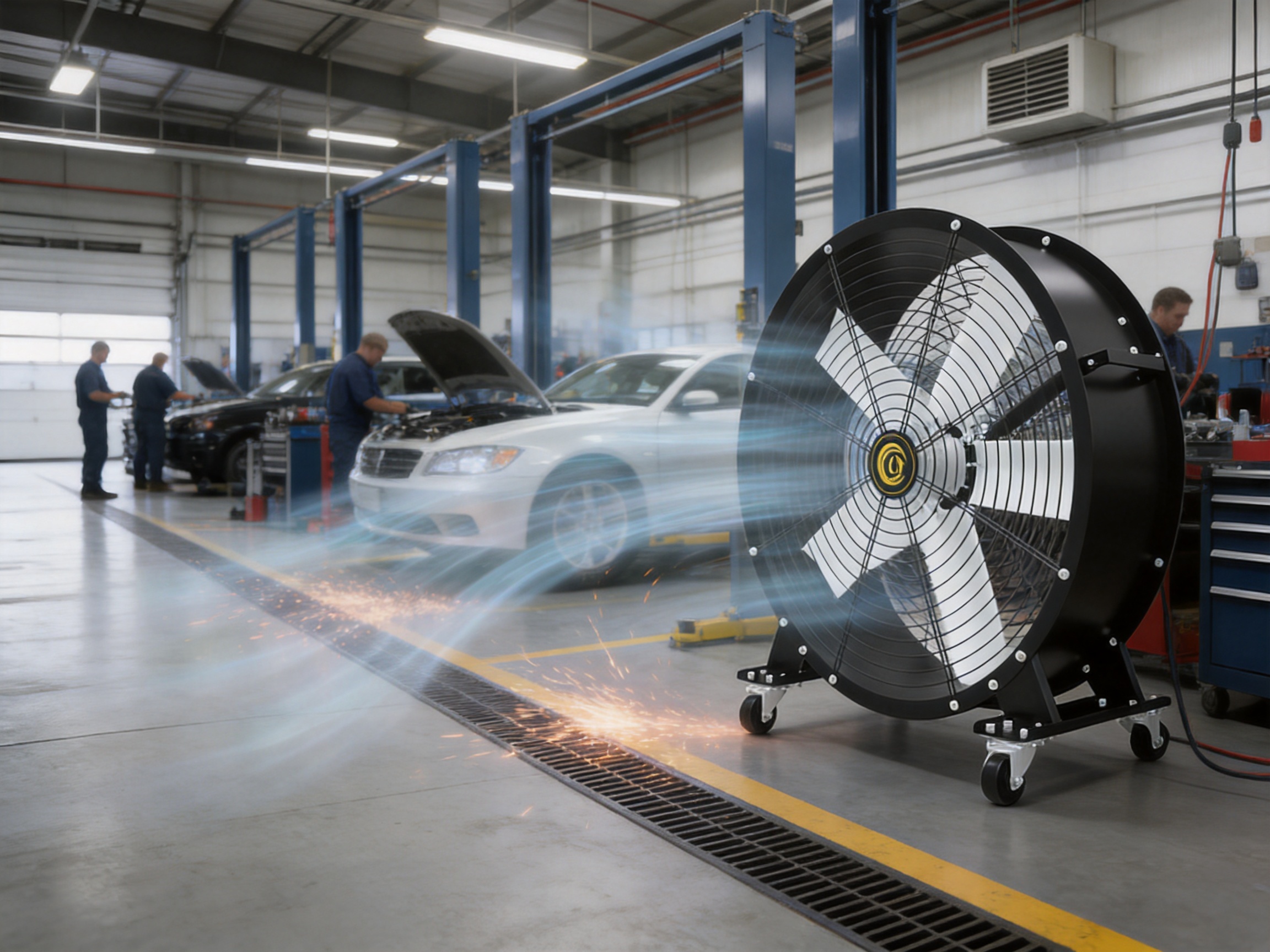
A mobile HVLS fan does not require the same structural suspension work as a ceiling-mounted fan, but it still needs proper planning. The floor must be sufficiently level and strong to support the selected model. The operating zone should provide adequate space for the frame, blades, airflow, power cable, and movement of nearby personnel or equipment.
The fan should be placed away from obstacles that could interrupt airflow or contact the blades. In warehouses, operators should consider racks, forklifts, pallets, hanging materials, and loading doors. In garages, the fan must be separated from vehicle movement, lifting equipment, welding sparks, and flammable materials. In public areas, the unit should be positioned so customers and visitors cannot easily interfere with it.
The airflow objective should be defined before placement. A fan may be used to support general circulation across a broad area, to improve comfort in a particular work zone, or to supplement an existing ventilation system. The best location depends on heat sources, openings, exhaust points, ceiling height, occupancy, and the arrangement of equipment.
The fan should not be treated as a replacement for legally required ventilation, smoke control, fume extraction, or air-conditioning systems. It moves and distributes air; it does not automatically remove hazardous gases, dust, or chemical vapors. A qualified ventilation professional should evaluate applications involving hazardous substances or regulated working conditions.
Routine maintenance helps preserve airflow performance, noise control, and operating safety. The blades and protective areas should be inspected for dust, oil, residue, or material buildup. Accumulation can affect balance and increase vibration. Cleaning procedures should follow the manufacturer’s instructions and must be completed with the power disconnected.
The frame, wheels, supports, fasteners, and adjustment components should be checked regularly. Because the fan is mobile, repeated relocation may place additional stress on wheels and structural connections. Any unusual movement, noise, vibration, or difficulty during transport should be investigated before continued operation.
Electrical cables, plugs, controllers, and connections should be inspected for wear or damage. The IP55 rating does not eliminate the need for electrical maintenance or protection from unsuitable exposure. Repairs and electrical work should be performed by qualified technicians using approved replacement parts.
The motor and control system should be kept within the specified operating environment. Ventilation around the motor and inverter should not be blocked. Operators should avoid unauthorized changes to the variable-frequency settings because incorrect parameters may affect motor performance or safety.
A maintenance schedule can be based on operating hours, environmental conditions, and the intensity of use. Facilities with high dust, humidity, or long daily operating periods may require more frequent inspection than clean commercial spaces.
Energy efficiency is one of the product’s primary commercial advantages. The high-efficiency motor and variable-frequency control system allow the user to select only the airflow that is required. A fan that operates at a reduced setting for part of the day may consume less energy than a basic system that operates continuously at full output.
Operating economics depend on several factors: local electricity prices, daily operating hours, selected model, speed setting, facility temperature, maintenance quality, and the number of fans required. Buyers should compare the expected total cost of ownership rather than focusing only on purchase price.
The mobile design can also affect project economics. A facility may avoid some structural reinforcement, ceiling installation, and relocation costs associated with fixed fans. The ability to move one fan between work zones may reduce the number of units needed for temporary or changing requirements. However, the actual number of fans should be selected through an airflow assessment rather than assumed solely from floor area.
The low noise level can provide indirect value by improving the working environment and reducing disruption. In commercial spaces, it may support customer comfort. In industrial facilities, it may help preserve communication and concentration. These benefits should be considered alongside direct energy consumption when comparing equipment options.
Purchasing from a manufacturer with direct production resources can provide advantages in technical communication, product consistency, customization, and after-sales support. A company with its own machining, cutting, welding, and testing capabilities can communicate more directly about materials, construction, controls, and performance.
Integrated production also supports project-based purchasing. A customer may need several models for different areas, matching blade colors, customized control arrangements, or documentation for an engineering project. Direct coordination can reduce misunderstandings between the specification, manufacturing process, and final delivery.
Shanghai Aipu Fans Co., Ltd. has experience in industrial fan manufacturing since 2006 and supplies products for domestic and international customers. Its stated focus is on high-quality industrial ventilation, energy-efficient products, and OEM solutions. The company’s production base and testing resources provide a foundation for serving customers that require more than a standard consumer fan.
When evaluating a supplier, buyers should request complete technical documentation, model-specific drawings, electrical data, noise test conditions, warranty terms, replacement-part availability, installation instructions, and certification records. The product information states a three-year warranty; the final warranty scope should be confirmed in the sales contract.
The first step is to evaluate the facility. Measure the available floor area, ceiling height, access routes, heat sources, occupancy, and existing ventilation. Consider whether the fan will be used for personal comfort, general circulation, temperature equalization, humidity management, or supplemental airflow.
If the fan will remain in one location, the largest suitable model may offer the desired coverage. If it must be moved frequently through doors, aisles, or between buildings, weight and dimensions become more important. The ASF-09 and ASF-12 may be easier to reposition in compact environments, while ASF-15 and ASF-20 may be preferable for larger open spaces.
Before ordering, confirm voltage, frequency, phase, power rating, controller type, plug or wiring requirements, and inverter specifications. The detailed information identifies Kewo as the inverter supplier for one configuration, but the final inverter arrangement should be confirmed for the model being purchased.
The product information provides dimensions for the model range and a separate detailed dimension for ASF-20. Since fan diameter and complete-frame dimensions can be reported differently, buyers should request a final technical drawing. This is particularly important when the fan must pass through doors, operate between storage racks, or fit into a designated working zone.
Confirm CE documentation, the applicable protection rating, operating instructions, warranty conditions, and maintenance requirements. For industrial projects, also review risk assessments, emergency-stop arrangements if applicable, and site-specific safety procedures.
HVLS means high volume, low speed. It describes a fan designed to move a large volume of air across a broad area while operating at a controlled rotational speed. The goal is wide air distribution rather than a narrow, high-speed stream.
The fan is designed as a movable unit rather than a permanently suspended ceiling fan. This allows operators to reposition it between work zones, storage areas, repair bays, event spaces, or agricultural sections as requirements change.
The product information identifies magnetic aluminum alloy, also called magnalium, as the main material. The material is intended to provide durability while reducing the overall weight of the fan.
The listed models are ASF-09, ASF-12, ASF-15, and ASF-20. They differ in dimensions, maximum speed, weight, and rated power. ASF-09 is the lightest listed model, while ASF-20 is the largest.
The listed power ratings range from 0.35 kW for ASF-09 to 0.65 kW for ASF-20. Actual consumption depends on the selected speed, operating conditions, and duration of use. The variable-frequency controller allows the user to adjust operation according to demand.
The supplied model table lists a noise level below 40 dB for each model. Actual sound may vary with speed, floor conditions, surrounding machinery, and the installation environment.
The application information includes outdoor use, but the exact suitability depends on weather exposure, electrical protection, installation conditions, and the selected configuration. IP55 protection does not mean that the fan can be submerged or exposed to every type of weather. Confirm the intended outdoor conditions with the supplier.
Yes, garages and automotive repair shops are identified as suitable applications. The fan can support general air circulation and worker comfort. It must not replace required fume extraction, and it should be kept away from hazardous vapors, sparks, vehicle paths, and unsafe electrical conditions.
Yes. The product uses variable-frequency control and supports precise wind-speed adjustment. Depending on the configuration, users can operate the fan through a remote control or wall-mounted controller.
The supplied information states a three-year warranty. Buyers should confirm what the warranty covers, including the motor, inverter, controller, frame, blades, labor, replacement parts, and shipping responsibilities.
The manufacturer provides OEM and customized product solutions. Possible options may include color, control arrangements, labeling, packaging, and project-specific configurations. All custom requirements should be reviewed and confirmed in writing before production.
Confirm the exact model, fan diameter, complete dimensions, speed range, power supply, controller type, inverter, blade count, blade color, protection rating, certification documents, warranty terms, delivery requirements, and installation instructions. The supplied information contains different ASF-20 speed and dimension references, so the final technical specification should be approved before purchase.
The 79-inch new mobile HVLS fan provides a practical solution for large areas that need flexible, quiet, and energy-conscious air movement. Its magnetic aluminum alloy construction reduces weight while supporting durability. Its high-efficiency motor and variable-frequency control allow users to match airflow to real operating needs. The mobile format provides an important advantage over permanently installed fans because it can adapt to changing layouts, seasonal demands, and temporary work zones.
The four-model range offers options for different facility sizes and handling requirements. Below-40-dB listed noise performance supports use in occupied commercial, industrial, agricultural, and sports environments. IP55 protection adds suitability for many demanding locations when the fan is installed and maintained correctly.
The manufacturer’s integrated production resources, including automated machinery, machining, cutting, welding, and testing centers, support consistent product development and OEM service. With industrial fan manufacturing experience dating from 2006, an 8,000-square-meter production base, and a focus on customized ventilation solutions, the company is positioned to serve distributors, contractors, and facility operators seeking more than a basic portable fan.
For the best result, buyers should select the model through a site-specific airflow and safety assessment. Confirm the final dimensions, electrical configuration, performance data, certification, and warranty before ordering. When properly selected and operated, the mobile HVLS fan can improve air circulation, support worker and customer comfort, and provide a flexible alternative to multiple small fans or fixed ceiling installations.
1. Product specification sheet for the 79-inch new mobile HVLS fan, including ASF-09, ASF-12, ASF-15, and ASF-20 model data.
2. Manufacturer-provided information on magnetic aluminum alloy construction, variable-frequency control, motor efficiency, applications, and OEM services.
3. Manufacturer information concerning production facilities, automated machinery, machining, cutting, welding, and testing capabilities.
4. General principles of high-volume, low-speed industrial air circulation and variable-frequency motor control.
5. General interpretation of IP55 enclosure protection and industrial equipment maintenance practices.
6. General workplace considerations for warehouse, manufacturing, agricultural, commercial, sports, garage, and exhibition-hall ventilation.
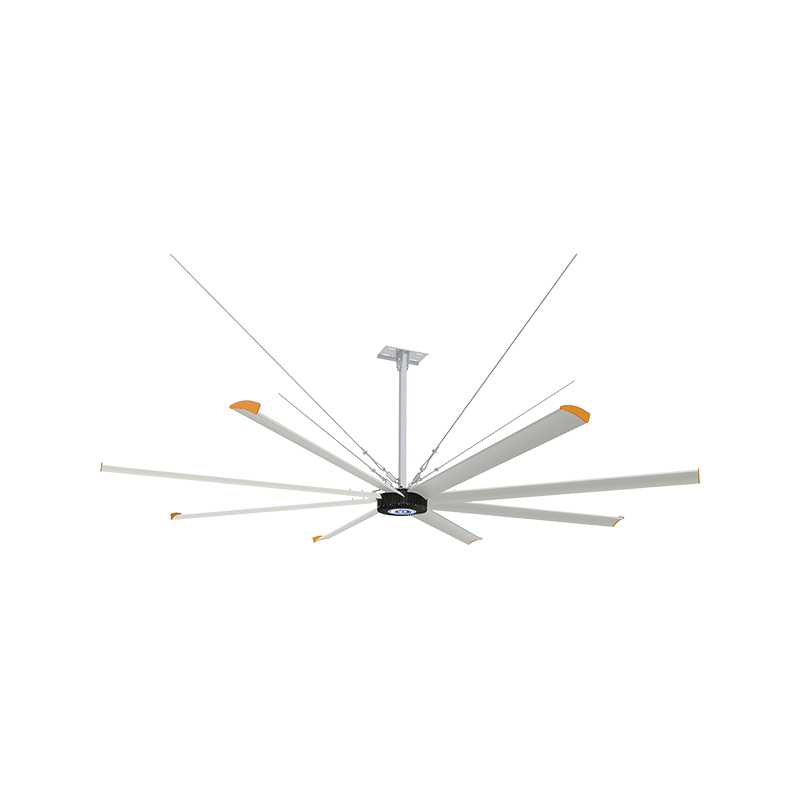
The 8-foot HVLS Large Industrial BLDC Ceiling Fan is equipped with a 0.3KW brushless DC motor, offering higher energy efficiency and lower noise levels. The lower power consumption design helps users ...
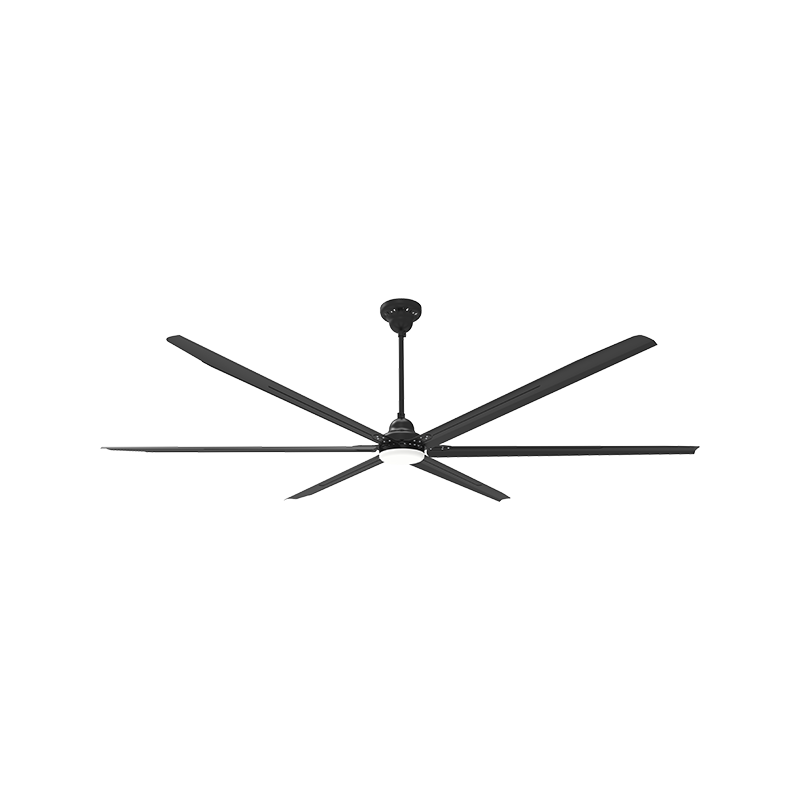
1. Core Technology: High Volume, Low SpeedNatural Breezes: Unlike the “harsh” wind from small fans, HVLS fans use massive blades rotating at low speeds to create a large-scale, three-dimensional breez...
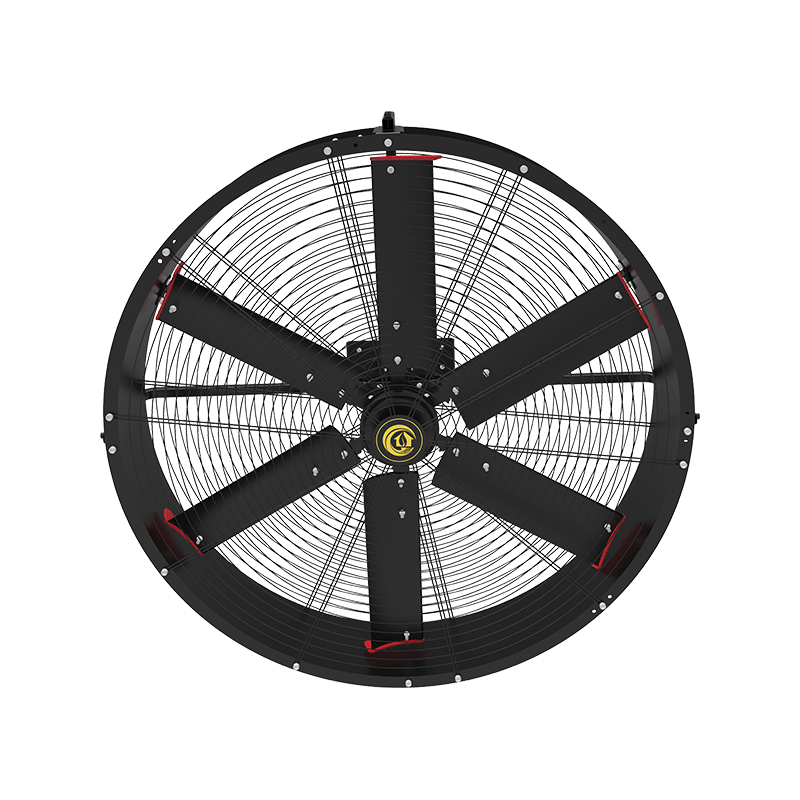
1. Extreme Airflow & Wide CoverageEquipped with massive 79-inch (2.0m) diameter aerospace-grade aluminum alloy blades. These precision-balanced blades generate a powerful, stable laminar airflow t...
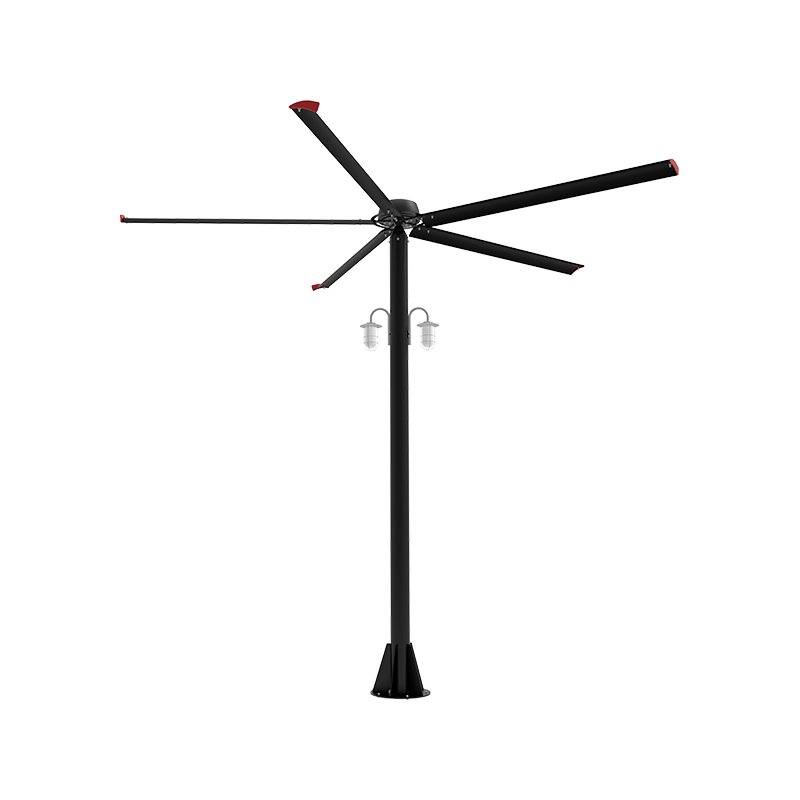
The large vertical HVLS floor-standing ventilation fan offers a variety of color options, allowing users to choose the most suitable color based on different environments and decoration needs. This c...
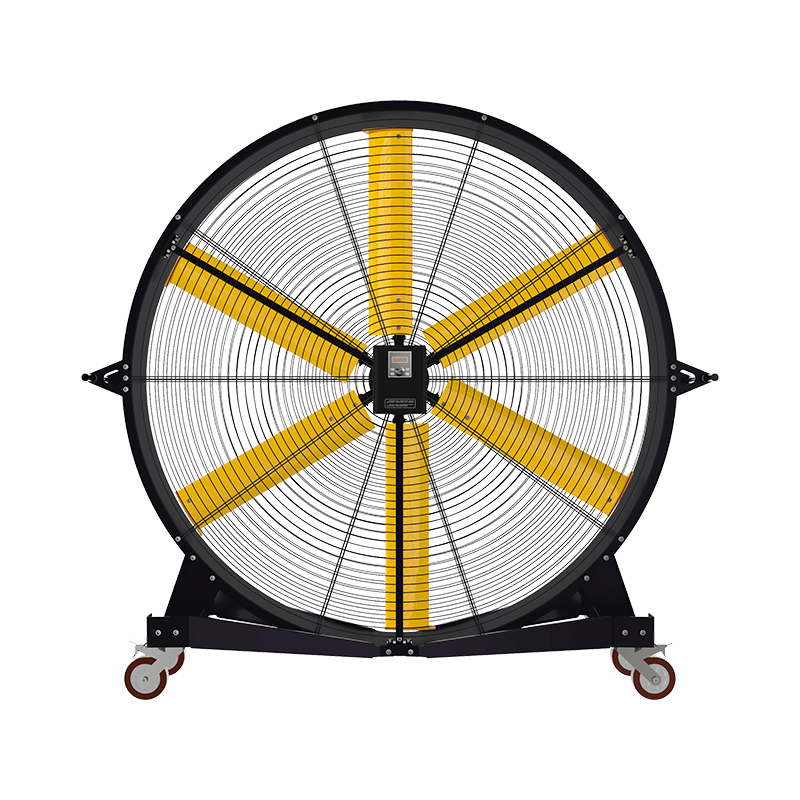
The 79-inch freestanding energy-efficient HVLS industrial fan features a robust construction designed to withstand the challenges of daily industrial use. Its impact-resistant frame ensures it can wit...
The 79-inch new mobile HVLS fan features a fan design made of magnetic aluminum alloy material, which ensures product durability while effectively reducing overall weight, making it easy to move and i...
A 6,800 m² factory floor used to be ventilated by roughly 300 small wall and pedestal fans. Six large ceiling fans now cover the same area, and in the manufacturer's own comparison that change cuts m...
READ MOREBig Fans, Low Speed, Real Results: HVLS Industrial Fans Explained When a factory floor hits 34°C, small fans only move hot air around. Large-diameter HVLS ceiling fans do the opposite: they push a t...
READ MORECommercial HVLS Fans: The Quiet Engineering Behind Large-Space Airflow A practical guide to selecting high-volume, low-speed ceiling fans for warehouses, factories, and commercial halls — with the ef...
READ MOREShanghai Aipu Fans Co., Ltd., established in Shanghai in 2006, focuses on manufacturing industrial-grade high-quality ceiling fans, relying on industry-leading motor technology and advanced manufactu...
READ MORE Custom Large Industrial Fans Manufacturers