

 English
 Español
 عربى

1. Extreme Airflow & Wide CoverageEquipped with massive 79-inch (2.0m) diameter aerospace-grade aluminum alloy blades. These precision-balanced blades generate a powerful, stable laminar airflow t...
Content
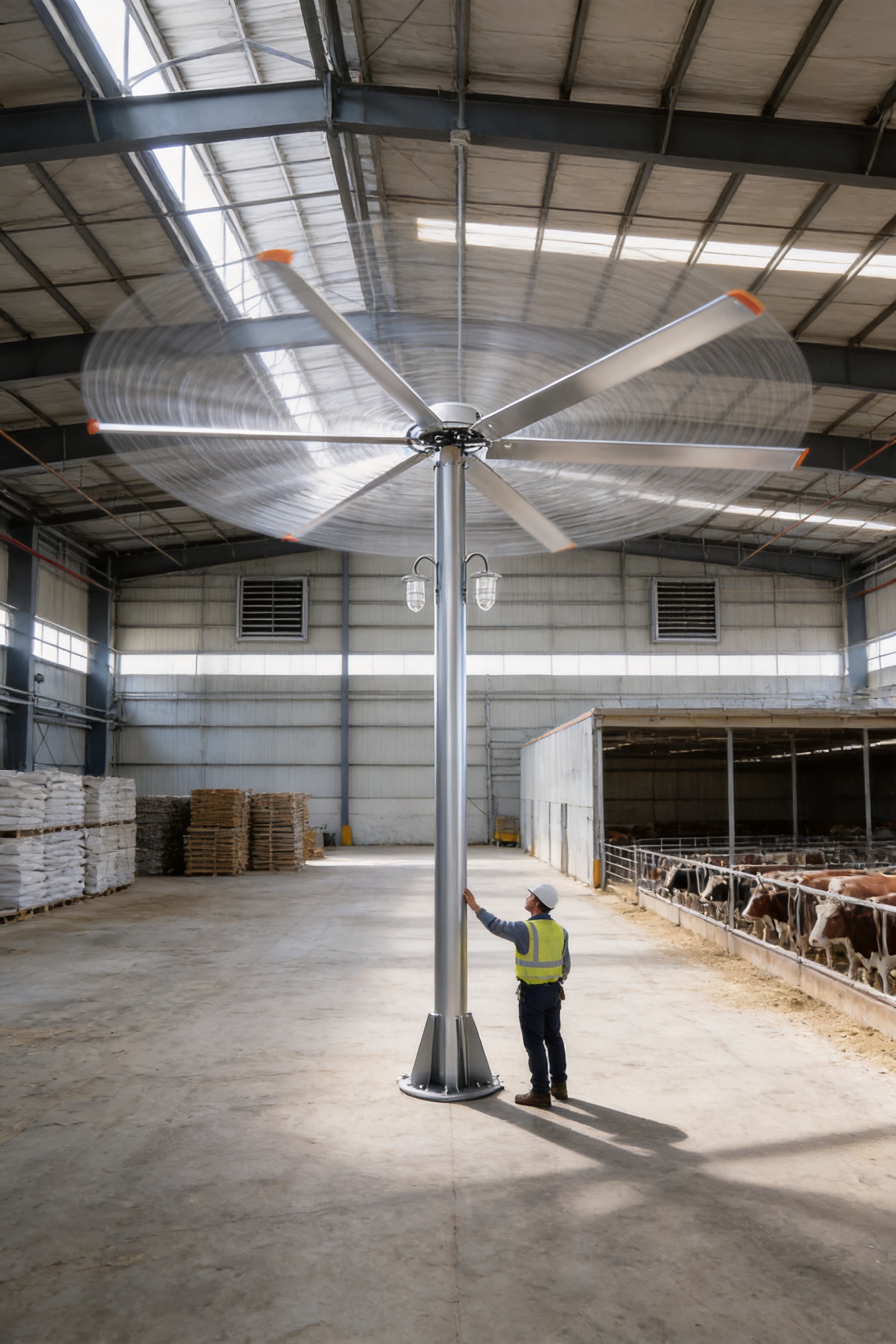
Large industrial buildings require ventilation equipment that can move substantial volumes of air without creating excessive energy consumption, noise, or maintenance demands. Warehouses, manufacturing plants, agricultural barns, exhibition halls, sports facilities, repair workshops, and food-processing areas often have large floor areas, high ceilings, heat-producing equipment, and uneven temperature distribution. Conventional high-speed fans may create strong local airflow, but they frequently consume more power, generate disruptive noise, and fail to provide consistent air movement throughout the entire space.
The aluminum alloy blade HVLS industrial vertical fan is designed to address these challenges. Combining a large-diameter propeller, low-speed operation, energy-efficient power consumption, and a stable vertical structure, this industrial fan creates broad and uniform airflow across large indoor areas. Its design is particularly suitable for applications where continuous circulation, personnel comfort, temperature regulation, and operational efficiency are important.
The featured product belongs to the Airpole Pedestal Fan category and is available in several sizes, including 2,800 mm, 3,300 mm, 3,600 mm, and 3,800 mm diameters. The highlighted ALF-36 configuration has a 3,600 mm diameter, a 350-watt motor, five or six blade options, a maximum stated speed range of 0–92 rpm, a weight of approximately 55 kg, and a total height of 3,800 mm. These specifications allow the fan to provide high-volume air movement while maintaining a comparatively low operating speed.
Air movement in a large facility is different from air movement in a residential room or a small commercial shop. A small fan can create a noticeable breeze within a limited range, but its airflow often loses effectiveness quickly as the distance increases. When multiple small fans are installed to compensate, the result may be higher electricity consumption, complicated wiring, uneven airflow, and more maintenance points.
High-volume, low-speed technology approaches the problem from another direction. Instead of forcing a narrow stream of air at high velocity, an HVLS fan uses a large-diameter blade system to move a broad column of air. The air is distributed over a wide area, helping reduce stagnant zones and improving circulation from floor level to the surrounding air volume.
This type of airflow can support several operational goals. It may help reduce the sensation of heat experienced by workers, assist the distribution of conditioned air, reduce localized humidity, improve ventilation in livestock areas, and limit temperature differences between different zones of a building. In facilities with high ceilings, large-diameter fans can also help encourage air mixing between upper and lower levels.
Low-speed operation is another important advantage. High-speed fans may create uncomfortable drafts, acoustic disturbance, and rapid mechanical wear when operated continuously. The HVLS design prioritizes broad airflow and steady circulation, allowing the fan to work for extended periods without relying on extreme rotational speed.
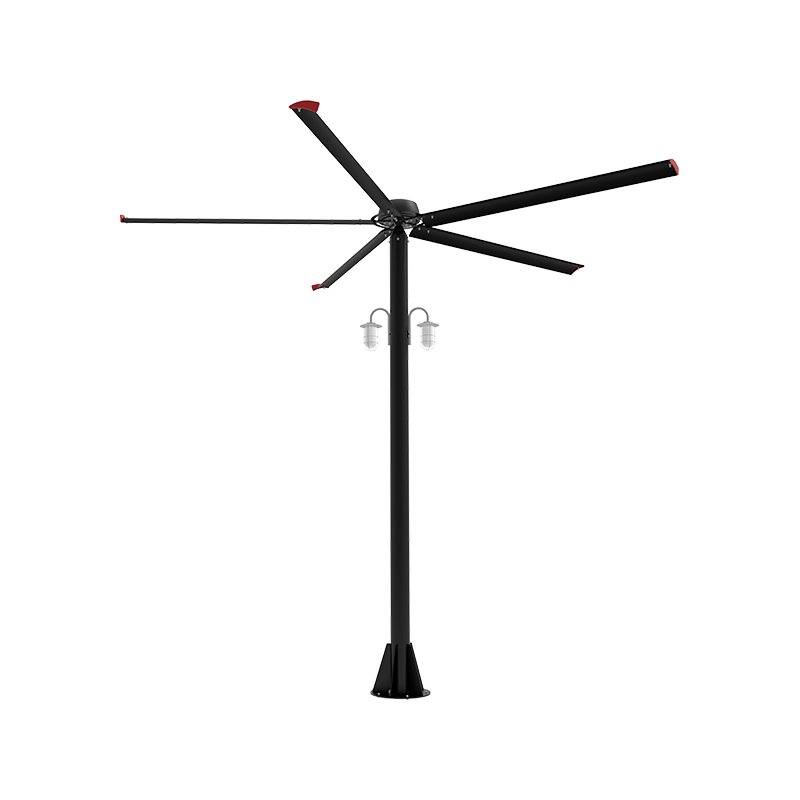
The aluminum alloy blade HVLS industrial vertical fan is engineered for large-area ventilation and air circulation. Its vertical pedestal configuration allows the fan to be positioned on the floor rather than suspended from the ceiling. This is useful in buildings where the ceiling structure is unsuitable for suspended equipment, where installation flexibility is required, or where air movement needs to be directed toward a specific working area.
The aluminum alloy blade construction offers a practical balance between strength, weight, and corrosion resistance. Aluminum is widely used in industrial airflow equipment because it can provide structural rigidity without the excessive mass associated with heavier materials. A lighter blade system can also support easier handling during assembly, inspection, and replacement.
The fan is designed with adjustable speed control. The featured product information specifies a speed range of 0–92 rpm, while the broader model table lists different rotational speeds according to model and blade configuration. This means the actual operating speed can be selected according to the space, temperature, desired airflow, and application requirements. Variable operation allows users to avoid running the fan at maximum output when moderate circulation is sufficient.
With a stated power consumption of 350 watts for the featured ALF-36 model, the fan is intended to deliver large-volume airflow with moderate energy use. The combination of a large diameter and low-speed motor makes it possible to move a substantial amount of air without the electrical demand typically associated with multiple conventional high-speed fans.
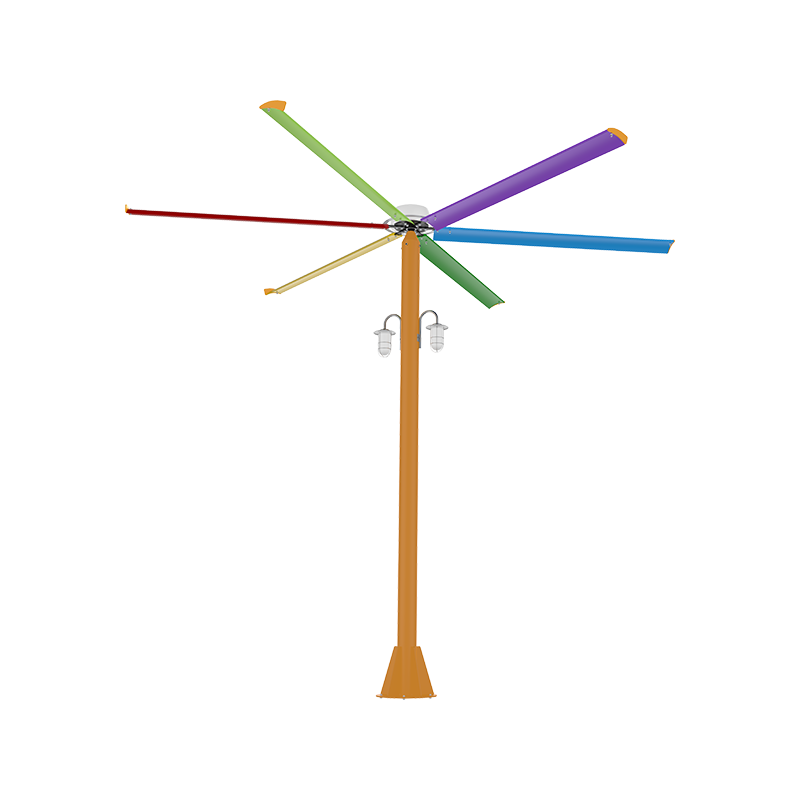
Aluminum alloy blade HVLS industrial vertical fan
The product range includes multiple diameter options to support different building sizes and airflow requirements. The following table summarizes the available configurations provided for the aluminum alloy blade HVLS industrial vertical fan.
| Specification | ALF-28 | ALF-33 | ALF-36 | ALF-38 |
|---|---|---|---|---|
| Nominal size | 9 ft | 11 ft | 12 ft | 13 ft |
| Diameter | 2,800 mm | 3,300 mm | 3,600 mm | 3,800 mm |
| Voltage | 220 V | 220 V | 220 V | 220 V |
| Frequency | 50/60 Hz | 50/60 Hz | 50/60 Hz | 50/60 Hz |
| Power | 0.30 kW | 0.35 kW | 0.35 kW | 0.40 kW |
| Blade quantity options | 5 or 6 | 5 or 6 | 5 or 6 | 5 or 6 |
| Featured speed range | 0–92 rpm for the highlighted ALF-36 configuration | |||
| Featured weight | Approximately 55 kg for the highlighted ALF-36 configuration | |||
| Height | 3,800 mm | 3,800 mm | 3,800 mm | 3,800 mm |
The model selection gives facility managers flexibility when matching the fan to the building footprint and required airflow. The ALF-28 is suitable where a somewhat smaller diameter is preferred, while the ALF-33, ALF-36, and ALF-38 models can provide broader coverage for larger open areas. Final selection should consider ceiling height, floor layout, obstacles, local environmental conditions, required air movement, and the number of fans planned for the facility.
Energy consumption is one of the most important factors in industrial ventilation. Facilities often operate fans for many hours each day, making even modest differences in power demand significant over the course of a year. The featured product uses 350 watts, or 0.35 kilowatts, in its specified ALF-36 configuration. This relatively moderate power rating supports continuous air circulation while helping control operating expenses.
The energy advantage comes from the relationship between blade diameter, rotational speed, and airflow. A large blade sweeps through a much greater area during each rotation than a small fan blade. As a result, the fan can move a large volume of air at a lower rotational speed. The purpose is not to create a narrow, forceful jet, but to establish broad air movement across the facility.
Compared with installing numerous small high-speed fans, one large industrial fan may reduce the number of motors, controllers, guards, cables, and maintenance points required. Fewer devices can simplify routine inspection and reduce the likelihood of unplanned downtime caused by individual fan failures. Actual savings will depend on the facility layout, operating schedule, existing ventilation system, and local electricity rates, but the low-power design provides a strong basis for efficient operation.
Variable speed adjustment further improves efficiency. During mild weather or low-occupancy periods, the operator can select a lower speed rather than running the fan continuously at maximum output. During hotter periods, production peaks, or high-occupancy events, the airflow can be increased. This adaptable operating pattern is more efficient than using fixed-speed equipment that provides excessive airflow when conditions do not require it.
Air circulation can also improve the performance of other environmental systems. In air-conditioned buildings, stagnant zones may remain warmer than the areas near supply outlets. Gentle mixing can help distribute conditioned air more evenly and potentially improve perceived comfort. The fan does not replace a properly designed heating, ventilation, and air-conditioning system, but it can support more uniform environmental conditions.
Uneven air distribution is a common problem in large facilities. Areas near doors, machinery, windows, storage racks, or production lines may experience different temperatures and humidity levels. Workers may feel uncomfortable in one part of the building while another area remains relatively stagnant. A large-diameter HVLS fan helps address this issue by moving air across a wider area than a conventional portable fan.
The broad airflow pattern may improve perceived comfort by increasing air movement around occupants. In warm environments, moving air can help enhance the evaporation of moisture from the skin, making workers feel cooler even when the actual room temperature changes only slightly. This can be especially valuable in warehouses, workshops, gymnasiums, and agricultural buildings where installing full-building air conditioning may be impractical or uneconomical.
Steady air circulation may also help reduce hot spots around machinery and equipment. Manufacturing processes, lighting systems, compressors, welding stations, and other sources can generate localized heat. By encouraging air movement through these areas, the fan can contribute to a more balanced working environment.
Because the fan operates at low speed, it is intended to create a more comfortable airflow than high-speed equipment that produces a harsh or concentrated draft. The adjustable control allows operators to fine-tune the effect. A lower setting can be used where occupants are stationary or where sensitive materials are present, while a higher setting may be selected for rapid air mixing or hot working conditions.
The blade material is a central component of fan performance. Aluminum alloy is valued in industrial fan construction because it combines a relatively low density with good mechanical strength. The blades must withstand repeated rotation, aerodynamic forces, vibration, and changing operating conditions. They also need to remain stable over long operating periods.
Compared with heavier blade materials, aluminum alloy can help reduce the overall mass of the rotating assembly. Lower rotating mass may support responsive speed adjustment and reduce the mechanical load placed on the motor and drive components. It can also make handling more manageable during installation or service work.
Aluminum alloy blades may provide useful resistance to corrosion in many ordinary industrial environments. This is particularly relevant in agricultural buildings, semi-open facilities, and areas where humidity levels fluctuate. However, material selection should always be evaluated against the specific atmosphere. Facilities containing aggressive chemicals, salt-laden air, or corrosive process gases may require additional technical review and protective measures.
The product information also identifies several available blade colors, including silver, yellow, red, blue, and black. Color selection can support visual coordination with a facility, equipment identification, or safety planning. In industrial environments, contrasting colors may help make equipment more visible to personnel, although all installations must still follow applicable guarding, clearance, and workplace safety requirements.
A major distinction of this product is its vertical pedestal configuration. Many large HVLS fans are designed for ceiling suspension, which can be highly effective in buildings with suitable structural support. However, not every facility can accommodate suspended equipment. Some buildings have insufficient roof strength, complex ceiling services, restricted mounting points, or operational requirements that favor floor-based equipment.
The vertical pedestal design provides an alternative installation approach. The fan can be positioned on the floor and aimed toward a work area, production line, storage zone, or open circulation area. This makes the system useful in locations where the airflow direction must be changed periodically or where temporary and semi-permanent ventilation is required.
The stated overall height is 3,800 mm. This elevated position allows the fan to distribute air above normal human head height while remaining floor-supported. The large diameter helps spread the airflow through the surrounding space. Before installation, users should confirm floor stability, required clearance, access routes, electrical supply, and the potential interaction between the fan and forklifts, cranes, vehicles, racks, or other equipment.
A stable installation is essential for safe and efficient operation. The fan weighs approximately 55 kg in the featured configuration, providing substantial mass for stability while remaining more manageable than many heavier industrial systems. The base and support structure should be installed on an appropriate surface, and the fan should not be placed where vibration, impact, or unauthorized access could compromise operation.
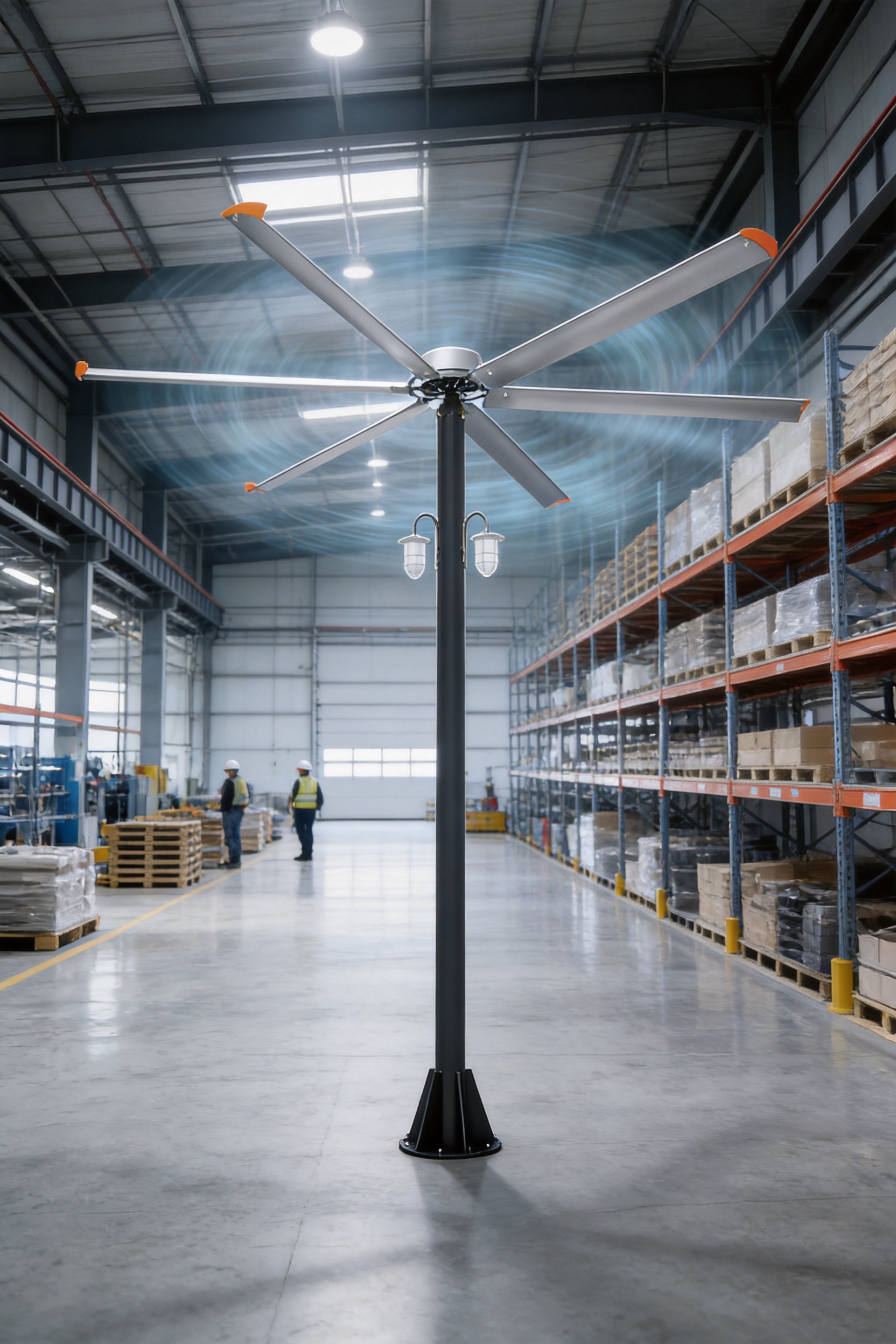
Warehouses often have high ceilings, large open floor areas, and changing levels of occupancy. Storage racks may restrict air movement, while loading doors can introduce outdoor heat and humidity. The aluminum alloy blade HVLS industrial vertical fan can help circulate air through open aisles and work zones, supporting more consistent conditions for personnel and stored goods.
In distribution centers, the fan may be positioned near packing stations, dispatch areas, or loading zones where workers remain active for long periods. Variable speed adjustment makes it possible to adapt airflow to seasonal conditions and operating schedules. The fan may also complement mechanical ventilation and air-conditioning equipment by reducing stagnant areas.
Manufacturing plants often contain heat-generating machinery, production lines, welding areas, and enclosed workstations. The fan can encourage general air movement and help reduce localized heat accumulation. It may be used as part of a broader ventilation strategy, particularly in areas where process exhaust is already provided but general comfort remains a concern.
For precision production, environmental stability can be important. Temperature differences may affect materials, equipment, and operator performance. The fan’s broad, low-speed circulation can assist with mixing without creating the highly concentrated drafts associated with smaller high-speed units.
Agricultural barns require effective air movement to manage heat, humidity, and odors. Livestock and crops can be sensitive to environmental conditions, particularly during warm seasons. The large diameter and low-speed airflow pattern may help improve circulation through barn areas while avoiding an excessively forceful stream in a localized zone.
Because agricultural environments can contain moisture, dust, and airborne particles, regular cleaning and inspection are important. Operators should evaluate the fan against the specific requirements of the barn, including washdown practices, chemical exposure, animal access, and electrical safety.
Sports facilities may experience rapid temperature changes when large groups of people are exercising. High ceilings and wide floor areas can make it difficult to maintain consistent comfort. The HVLS fan can support air circulation above courts, seating areas, training spaces, or activity zones.
Low-speed operation can be valuable in sports settings because it reduces the risk of an overly aggressive draft affecting players, spectators, or lightweight equipment. The control range allows facility managers to adapt airflow for training sessions, competitions, events, and periods of low occupancy.
Retail spaces and exhibition halls require a balance between comfort, appearance, noise control, and unobstructed movement. The floor-based design can be useful where suspended installation is not permitted or where the building layout changes regularly. The available blade colors may also support coordination with the interior environment or visual identification of equipment.
Exhibition halls may contain sensitive displays or materials that require stable temperature and humidity conditions. The fan is not a substitute for dedicated climate control, but controlled air movement can support more even distribution of conditioned air and reduce areas of stagnation.
Automotive workshops often combine large doors, vehicle movement, heat-producing equipment, exhaust gases, and variable occupancy. Air circulation is essential for comfort and general ventilation planning. The fan can help move air through service bays and improve working conditions for technicians.
Where hazardous vapors, combustion products, or chemical fumes are present, the fan should be used only as part of a suitable ventilation system designed for the specific risk. It should not be treated as a replacement for source capture, exhaust extraction, or legally required safety equipment.
Food-processing areas may require controlled humidity and temperature to help protect product quality. Broad air movement can assist with general circulation, but hygiene, cleanability, material compatibility, and contamination control must be considered carefully. The installation should follow the facility’s sanitation program and applicable food safety requirements.
Before using the fan in a sensitive processing environment, facility managers should confirm whether the selected model and installation arrangement are appropriate for the room classification, cleaning method, moisture level, and production process.
The most important advantage over conventional high-speed fans is coverage. A small high-speed fan may produce a noticeable stream of air directly in front of the blades, but the effect can diminish quickly outside that narrow path. Several units may be needed to cover a large room. A large-diameter HVLS fan is designed to distribute air over a broader area, potentially reducing the number of units required.
The second advantage is operating behavior. High-speed fans can create strong drafts, noise, and localized turbulence. This may be uncomfortable for workers and may disturb dust, lightweight packaging, papers, or sensitive displays. Low-speed operation generally supports smoother circulation and a quieter environment, although actual sound levels depend on the installation, building acoustics, motor condition, and operating speed.
The third advantage is energy management. The 350-watt featured configuration is designed to provide high-volume airflow using moderate electrical power. The adjustable speed range allows the output to be matched to the actual need instead of requiring constant maximum operation.
The fourth advantage is system simplification. Replacing a collection of small fans with fewer large industrial units may reduce wiring complexity, control points, and maintenance tasks. This can help facility managers organize inspections and keep spare parts and service procedures more consistent.
These benefits do not mean that an HVLS fan is suitable for every ventilation requirement. It is most effective when broad circulation and comfort improvement are required. Local extraction, hazardous gas removal, dust collection, smoke control, and specialized process ventilation require separate engineering solutions.
Shanghai Aipu Fans Co., Ltd. was established in Shanghai, China, in 2006 and specializes in industrial-grade fans, large ceiling fans, and ventilation solutions. The company serves industrial customers in domestic and international markets and provides customized OEM services for applications with different performance, appearance, and installation requirements.
The company operates an 8,000-square-meter production base. Its manufacturing resources include high-precision automated machinery, a machining center, a cutting center, a welding center, and a testing center. This combination supports a controlled production process from material preparation and component fabrication to assembly, inspection, and performance evaluation.
Automated and high-precision equipment can improve dimensional consistency across production batches. Consistent dimensions are important for fan blades, support structures, motor interfaces, and other components because small deviations can influence balance, vibration, noise, and service life. A structured production process also helps manufacturers repeat successful designs while maintaining quality expectations for customized orders.
The machining center supports the accurate preparation of mechanical components. Precision machining may be required for mounting interfaces, shafts, brackets, fasteners, and other load-bearing parts. Properly prepared components help ensure that the rotating assembly and supporting structure work together reliably.
The cutting center contributes to accurate material preparation, while the welding center supports the fabrication of frames, bases, supports, and structural assemblies. Welding quality is particularly important in a vertical pedestal fan because the support system must remain stable during continuous operation. Proper weld preparation, controlled procedures, and inspection can help improve structural integrity.
The testing center provides an important stage for evaluating completed products. Industrial fans should be checked for operating behavior, speed adjustment, vibration, electrical performance, and general assembly quality before shipment. Testing helps identify issues that may otherwise appear only after installation at the customer’s facility.
The company’s experience since 2006 also provides a foundation for understanding the practical needs of industrial customers. Different sites require different fan sizes, blade quantities, colors, controls, support structures, and operating configurations. Experience with industrial applications can help manufacturers develop products that are not only technically functional but also suitable for actual working environments.
Industrial ventilation projects often involve more than selecting a standard catalog item. A customer may require a particular diameter, color, power rating, control method, support arrangement, or packaging specification. The product range already includes multiple sizes and blade options, and the company also provides customized OEM services.
Customization may be useful for facilities with unusual ceiling heights, restricted floor areas, specific corporate colors, or special workflow requirements. Blade color options include silver, yellow, red, blue, and black, with other choices potentially available according to project discussions. Color can support equipment recognition, site organization, or visual integration with the customer’s facility.
OEM cooperation may also help distributors, engineering contractors, and equipment integrators provide industrial ventilation products under project-specific requirements. The appropriate customization process should begin with technical information, including building dimensions, application conditions, expected operating hours, available voltage and frequency, airflow objectives, installation constraints, and environmental exposure.
Professional product selection should not be based only on fan diameter or motor power. A qualified assessment should consider the number and position of fans, air distribution patterns, obstructions, doors, racks, machinery, occupant density, climate, and interaction with existing HVAC systems.
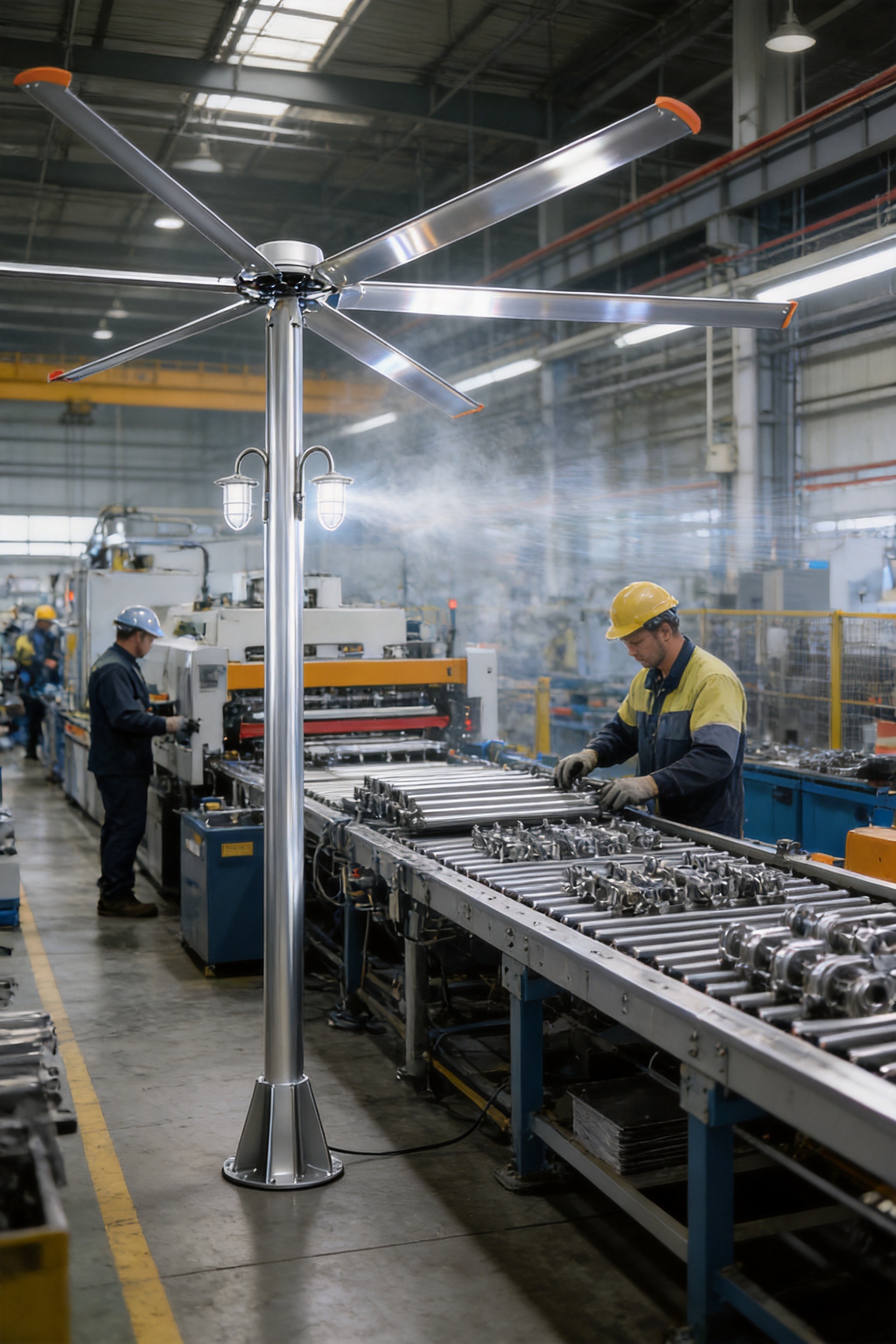
Although the vertical pedestal design simplifies installation compared with a suspended fan, careful planning remains essential. The selected location should provide a stable, level foundation capable of supporting the equipment and resisting movement during operation. The fan should be kept away from vehicle paths, forklift routes, crane movement, and areas where materials may strike the support structure.
Clearance around the blades is important. Personnel, tools, packaging, and other objects should not be able to contact the rotating assembly. If the fan is installed in an area accessible to workers or the public, suitable guards, barriers, warning signs, or controlled access measures should be considered according to local safety standards.
The electrical supply should match the specified voltage and frequency. The available models are listed for 220 V and 50/60 Hz operation. Electrical installation should be completed by qualified personnel using suitable protection, grounding, disconnect devices, and control equipment. Local regulations and the requirements of the facility’s electrical system must always be followed.
Before starting the fan, operators should check that the blades, support, fasteners, base, and electrical connections are secure. Abnormal vibration, unusual noise, unstable movement, or unexpected heating should be investigated promptly. The fan should be stopped and isolated before maintenance, cleaning, inspection, or adjustment.
Because industrial facilities may contain dust, fibers, moisture, or airborne residues, cleaning schedules should be established according to the environment. Accumulated material on the blades can affect balance and airflow. Routine inspection helps identify loose fasteners, damaged blades, wear, corrosion, and other conditions that could reduce performance or create a safety risk.
Preventive maintenance is an important part of protecting the investment in industrial ventilation equipment. A regular program can include visual inspection, cleaning, fastener checks, electrical inspection, speed-control verification, vibration observation, and review of the support structure.
Blade inspection is especially important because the blades are directly exposed to airflow forces and the surrounding environment. Operators should look for cracks, deformation, corrosion, unusual marks, or loose connections. A damaged blade should not be repaired or replaced with an unapproved component, because changes in weight or shape can affect balance.
The motor and control system should also be checked according to the manufacturer’s service recommendations. The fan should operate smoothly throughout its selected speed range. If the speed fluctuates unexpectedly, the controller, power supply, motor, and mechanical assembly may require professional evaluation.
Regular cleaning can help preserve airflow performance. Dust or residue on the blade surface may increase resistance and add weight unevenly. In food-processing, agricultural, and dusty manufacturing environments, cleaning frequency may need to be higher than in a clean commercial space.
A well-organized maintenance record can help facility managers identify performance trends. Recording inspection dates, cleaning work, unusual observations, repairs, and replacement parts makes it easier to plan service before a minor issue becomes an operational interruption.
The first selection factor is the size and layout of the facility. Larger diameters generally cover broader areas, but the best choice depends on the floor plan, obstructions, ceiling height, and desired air movement. The ALF-28, ALF-33, ALF-36, and ALF-38 models provide several diameter options from 2,800 mm to 3,800 mm.
The second factor is the operating environment. Warehouses, factories, barns, sports venues, retail spaces, and food-processing facilities may have very different requirements. Dust, humidity, cleaning chemicals, corrosive substances, temperature extremes, and access restrictions should be identified before ordering.
The third factor is the required operating schedule. A facility operating around the clock may place greater emphasis on energy efficiency, durability, noise, and maintenance access. A seasonal facility may place more emphasis on storage, mobility, corrosion protection, and rapid deployment.
The fourth factor is the available electrical supply. The listed models use 220 V and support 50/60 Hz frequency. Customers should confirm the power supply, control requirements, protective devices, and local electrical standards before installation.
The fifth factor is the desired blade configuration. The product information identifies five- and six-blade options. The appropriate configuration should be selected according to the required airflow characteristics, model availability, application conditions, and manufacturer recommendations.
An HVLS industrial vertical fan is a large-diameter fan designed to move a high volume of air at relatively low speed. The vertical model uses a floor-supported pedestal structure rather than a ceiling-suspended mounting arrangement. It is intended for broad air circulation in large industrial, commercial, agricultural, and public spaces.
The featured ALF-36 configuration is specified with a power rating of 350 watts, or 0.35 kW. Actual power consumption may vary according to operating speed, electrical conditions, control settings, and the selected model.
The highlighted product information gives a speed range of 0–92 rpm for the ALF-36 configuration. The broader model information lists different rotational speeds according to model and configuration. Customers should confirm final operating parameters when placing an order.
The featured ALF-36 model has a diameter of 3,600 mm, equivalent to approximately 12 feet. The product range also includes 2,800 mm, 3,300 mm, and 3,800 mm options.
The featured product is specified at approximately 55 kg. Weight can vary according to the selected model, blade quantity, and configuration.
The fan uses aluminum alloy blades. Listed color options include silver, yellow, red, blue, and black. Other color or appearance requirements should be confirmed with the manufacturer during project consultation.
Yes. Warehouses are one of the primary applications for large-area air circulation. The fan can help improve airflow around storage and working zones, support worker comfort, and reduce stagnant areas. The installation should account for racks, loading doors, vehicles, clearances, and electrical safety.
The fan is designed to improve air movement and perceived comfort, not to replace all heating or cooling equipment. It may complement air conditioning by helping distribute conditioned air more evenly. Facilities requiring precise temperature or humidity control should use the fan as part of a complete environmental management system.
It may be suitable for agricultural applications because broad, low-speed airflow can help manage heat and humidity. However, the operator should evaluate dust, moisture, chemical exposure, animal access, cleaning methods, and electrical requirements before installation.
Recommended maintenance generally includes cleaning, blade inspection, fastener checks, support inspection, electrical inspection, speed-control checks, and monitoring for abnormal vibration or noise. Maintenance must be performed with the fan stopped and electrically isolated.
A vertical pedestal fan can be installed where ceiling suspension is difficult, restricted, or undesirable. It can also be repositioned more easily to support a specific working area. The final choice depends on building structure, coverage requirements, available floor space, and the desired airflow pattern.
Shanghai Aipu Fans Co., Ltd. provides customized OEM services. Customization discussions may cover size, blade configuration, color, controls, structural arrangements, and project-specific requirements. Customers should provide complete technical information to support accurate product selection.
The aluminum alloy blade HVLS industrial vertical fan offers a practical solution for large spaces that require broad, steady, and energy-conscious air movement. Its large-diameter blade system, low-speed operation, adjustable control, aluminum alloy construction, and floor-supported vertical structure distinguish it from conventional high-speed fans designed for smaller or more localized applications.
The featured ALF-36 model combines a 3,600 mm diameter with a 350-watt power rating, five- or six-blade options, an approximately 55 kg weight, a 3,800 mm height, and a stated operating range of 0–92 rpm. Together, these characteristics support efficient circulation in warehouses, manufacturing plants, agricultural barns, sports facilities, exhibition halls, retail spaces, automotive workshops, and other large indoor environments.
Shanghai Aipu Fans Co., Ltd. strengthens the product offering through long-term industrial fan experience, an 8,000-square-meter production base, automated machinery, machining, cutting, welding, and testing capabilities, and customized OEM support. These resources help the company develop and manufacture industrial ventilation products intended for demanding customer applications.
Successful performance depends on correct model selection, suitable placement, safe installation, proper electrical connection, and scheduled maintenance. When these factors are addressed, the aluminum alloy blade HVLS industrial vertical fan can provide an effective combination of airflow coverage, energy efficiency, operating flexibility, and industrial practicality.
1. Product specification materials for aluminum alloy blade HVLS industrial vertical fan, including ALF-28, ALF-33, ALF-36, and ALF-38 configurations.
2. Manufacturer-provided application and feature information for large industrial fan systems.
3. Industrial ventilation planning principles for warehouses, manufacturing facilities, agricultural buildings, sports venues, and commercial spaces.
4. General engineering guidance on high-volume, low-speed airflow, fan installation, electrical safety, and preventive maintenance.
5. Company information and manufacturing capability profile for Shanghai Aipu Fans Co., Ltd., including production equipment, testing resources, OEM services, and industrial ventilation experience.
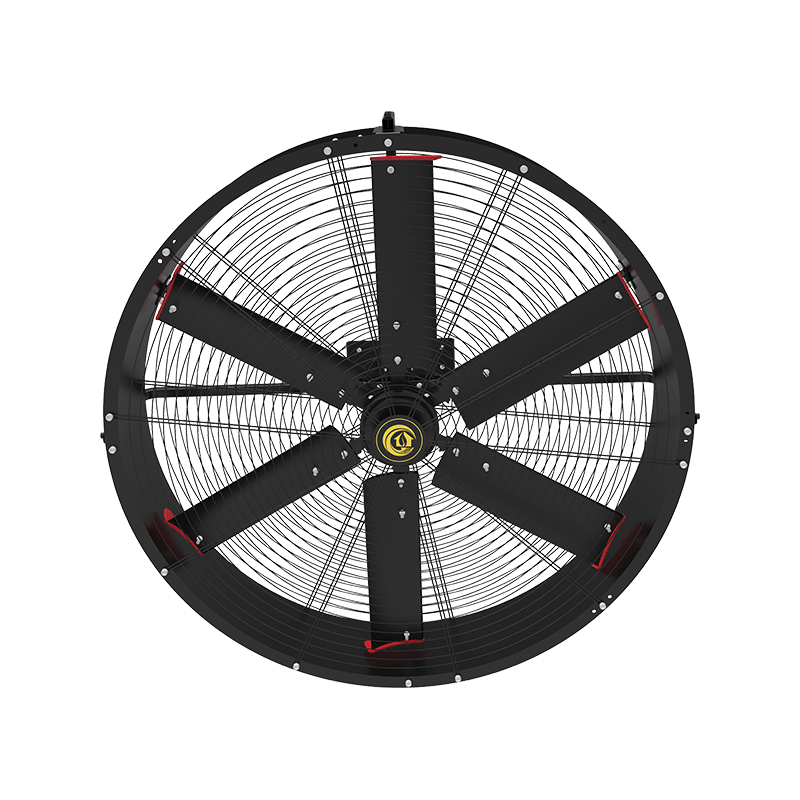
1. Extreme Airflow & Wide CoverageEquipped with massive 79-inch (2.0m) diameter aerospace-grade aluminum alloy blades. These precision-balanced blades generate a powerful, stable laminar airflow t...
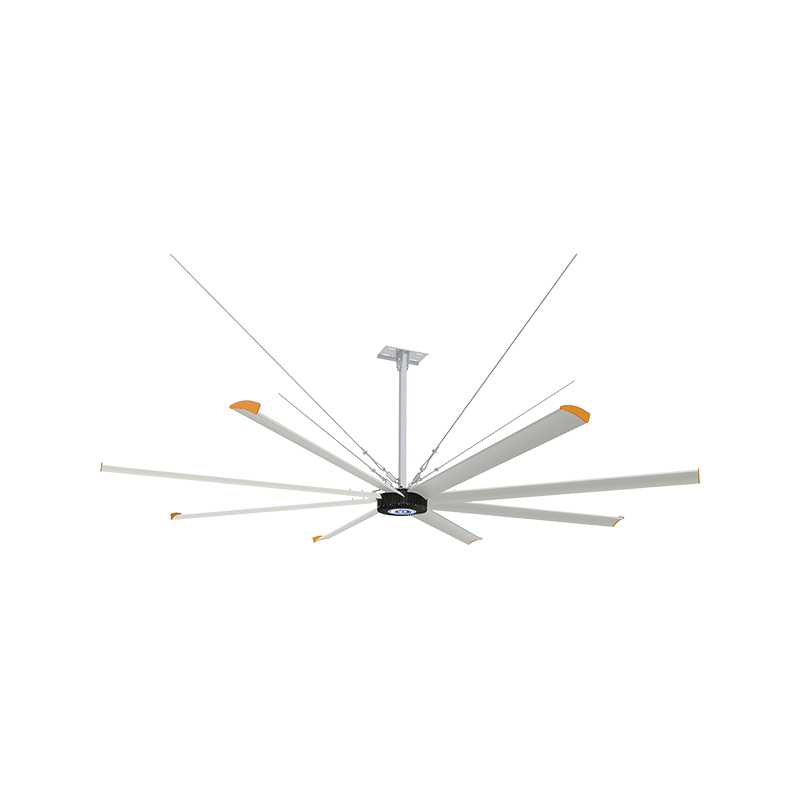
The 8-foot HVLS Large Industrial BLDC Ceiling Fan is equipped with a 0.3KW brushless DC motor, offering higher energy efficiency and lower noise levels. The lower power consumption design helps users ...

1. Core Technology: High Volume, Low SpeedNatural Breezes: Unlike the “harsh” wind from small fans, HVLS fans use massive blades rotating at low speeds to create a large-scale, three-dimensional breez...
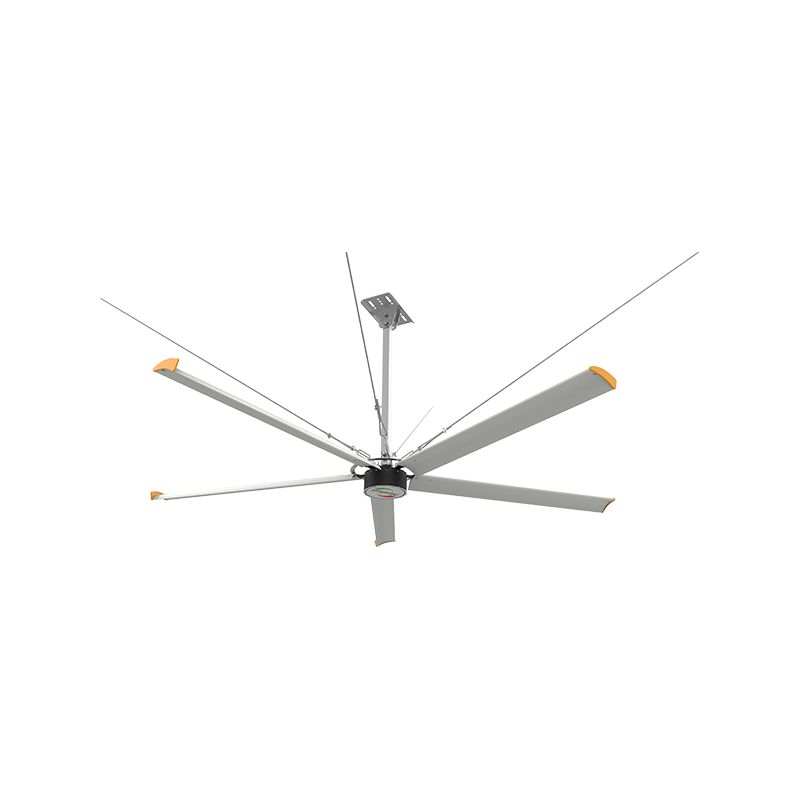
The industrial-grade aviation metal large-blade BLDC ceiling fan utilizes brushless DC motor (BLDC) technology, allowing it to provide powerful airflow with low power consumption. The ceiling fan rapi...
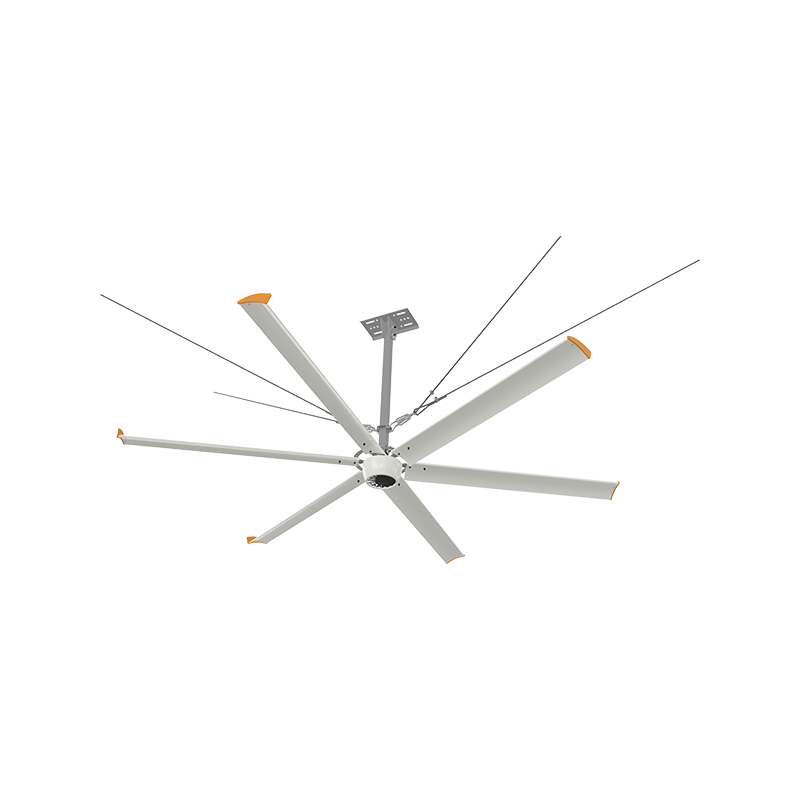
The 15-foot Even Airflow Industrial BLDC Ceiling Fan utilizes a high-efficiency BLDC motor and carefully designed blades. This ceiling fan operates with extremely low noise levels, making it suitable ...
The large vertical HVLS floor-standing ventilation fan offers a variety of color options, allowing users to choose the most suitable color based on different environments and decoration needs. This c...
A 6,800 m² factory floor used to be ventilated by roughly 300 small wall and pedestal fans. Six large ceiling fans now cover the same area, and in the manufacturer's own comparison that change cuts m...
READ MOREShanghai Aipu Fans Co., Ltd., established in Shanghai in 2006, focuses on manufacturing industrial-grade high-quality ceiling fans, relying on industry-leading motor technology and advanced manufactu...
READ MOREBig Fans, Low Speed, Real Results: HVLS Industrial Fans Explained When a factory floor hits 34°C, small fans only move hot air around. Large-diameter HVLS ceiling fans do the opposite: they push a t...
READ MOREIndustrial Ventilation Planning The Right Industrial Ceiling Fan Size Starts With the Building A practical sizing guide to diameter, ceiling height, CFM, and fan layout for warehouses, plants, and di...
READ MORE Custom Large Industrial Fans Manufacturers