

 English
 Español
 عربى

The 15-foot Even Airflow Industrial BLDC Ceiling Fan utilizes a high-efficiency BLDC motor and carefully designed blades. This ceiling fan operates with extremely low noise levels, making it suitable ...
Content
Large industrial and commercial buildings require a different approach to ventilation than ordinary offices or residential rooms. Warehouses, manufacturing plants, agricultural barns, exhibition centers, sports facilities, and retail spaces often have high ceilings, expansive floor areas, and changing heat and humidity conditions. Conventional small ceiling fans may create localized airflow, but they usually cannot distribute air evenly across a large open area. Traditional high-power ventilation systems may provide strong airflow, yet they can consume considerable energy, generate excessive noise, and require complex installation.
The 10-foot high-speed HVLS ceiling fan is designed to address these challenges through a combination of large-diameter coverage, energy-conscious motor performance, durable materials, and controlled air movement. With a 3.0-meter, or approximately 10-foot, diameter, six aluminum alloy blades, a 0.75 kW motor configuration, and a maximum operating speed of up to 106 revolutions per minute, the fan is intended for large indoor environments that require reliable and efficient circulation.
Unlike compact air circulators that concentrate airflow in a narrow direction, this HVLS ceiling fan moves a broad column of air downward and outward. The resulting air movement helps reduce stagnant zones, moderate temperature differences, improve occupant comfort, and support ventilation strategies in buildings where air must travel across a substantial floor area.
This article examines the fan’s construction, airflow performance, energy advantages, application value, manufacturing quality, installation considerations, and suitability for professional projects. It also explains how Shanghai Aipu Fans Co., Ltd. supports the product with advanced production capabilities, testing resources, customization services, and industrial ventilation experience.
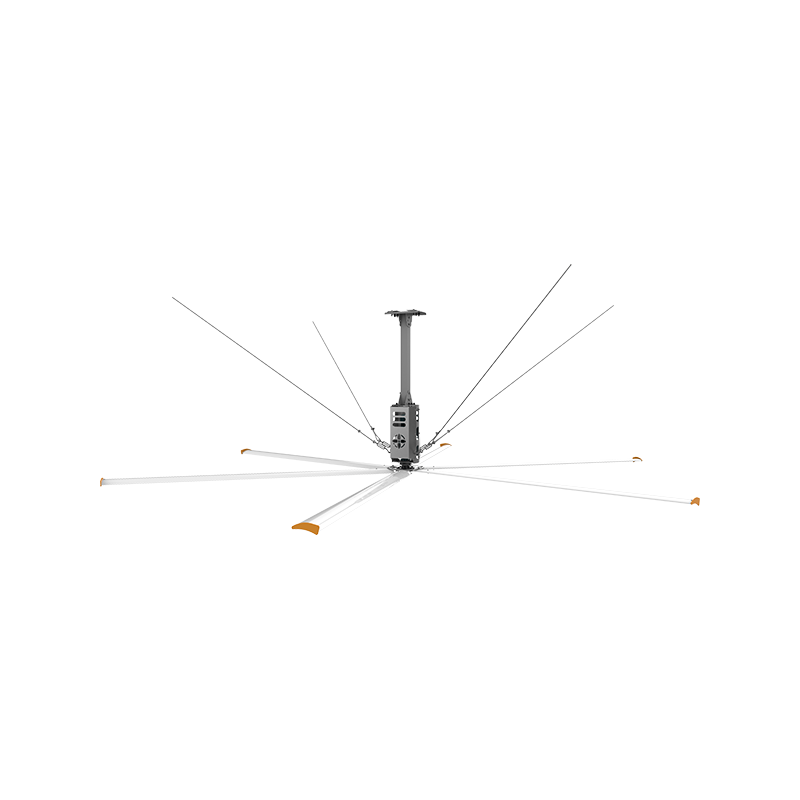
10-foot high-speed HVLS ceiling fan
HVLS means “high volume, low speed.” An HVLS ceiling fan uses large blades to move a significant volume of air at a relatively low rotational speed. Instead of relying on a small blade span and high-speed rotation, the fan creates a broad and continuous airflow pattern that covers a larger area.
The 10-foot configuration has a nominal fan diameter of 3.0 meters, making it suitable for medium-sized industrial and commercial spaces. Its six large blades are designed to generate a smooth air column while distributing air across the floor below. The large blade span allows the fan to move air efficiently without requiring the high rotational speed commonly associated with smaller axial or portable fans.
In a typical installation, air is pushed downward from the ceiling and then spreads horizontally when it reaches the floor. This movement encourages circulation throughout the room. Depending on building height, obstructions, temperature conditions, and the selected operating speed, the fan can support an effective coverage area of approximately 200 square meters.
The fan is not intended to replace every form of mechanical ventilation. It is primarily an air-circulation and comfort-management solution. It can work alongside exhaust fans, fresh-air systems, heating equipment, cooling systems, and dehumidification equipment to improve overall environmental control.
The following specifications describe the main 10-foot configuration and the wider product platform associated with the fan series. Final technical parameters may be adjusted according to voltage, frequency, motor selection, control system, and customer requirements.
| Specification | 10-Foot Configuration |
|---|---|
| Product type | High-speed HVLS ceiling fan |
| Fan diameter | 3.0 meters / approximately 10 feet |
| Number of blades | 6 |
| Blade material | Aluminum alloy |
| Rated power configuration | 0.75 kW |
| Input voltage options | 220 V, 380 V, or 415 V; other industrial ranges may be available |
| Frequency | 50 Hz or 60 Hz |
| Speed range | 0–106 RPM, depending on control and operating conditions |
| Approximate coverage area | Up to 200 square meters under suitable conditions |
| Approximate weight | 75 kg |
| Motor brand | Nord configuration |
| Packaging | Wooden cases |
| Warranty | Three years |
| Customization | OEM and ODM support |
The product information also identifies a broader family of large HVLS fans with diameters ranging from approximately 14 feet to 28 feet. These models use different combinations of blade counts, motor power, maximum speed, and air volume. This broader range allows a project designer to select a suitable fan size for a specific ceiling height, floor plan, thermal load, and airflow objective.
The primary advantage of a 10-foot HVLS fan is its ability to move air across a broad area. A larger blade span creates a wider airflow footprint than a small conventional fan. This is particularly important in buildings where workers, customers, livestock, products, or equipment are distributed over a large floor area rather than concentrated in one location.
Air movement can improve the perceived comfort of occupants by increasing evaporation at the skin. In warm working environments, even moderate air movement may make a room feel more comfortable without lowering the actual air temperature by the same amount. This can help reduce reliance on air conditioning during suitable seasons or operating conditions.
In warehouses and logistics buildings, a large fan can help reduce stagnant air pockets between storage racks and open work zones. In manufacturing facilities, it can support more consistent conditions around production lines. In agricultural buildings, it can assist with air circulation around livestock or stored materials, subject to the ventilation requirements of the specific operation.
The fan’s broad airflow pattern also supports destratification. Warm air naturally rises toward the ceiling, especially in buildings with high roof structures. Without circulation, the upper part of the building can become substantially warmer than the occupied zone. A ceiling fan helps move air downward and encourages mixing between upper and lower air layers. This may improve temperature uniformity and reduce wasted heating energy in cold seasons.
The 10-foot fan is equipped with a 0.75 kW motor configuration intended to provide useful airflow while limiting electrical consumption. The balance between motor power, blade geometry, diameter, and control system is important. A fan that consumes more energy than necessary may increase operating costs, while a fan with insufficient power may fail to deliver useful coverage.
Compared with multiple small high-speed fans, one large HVLS fan can simplify airflow planning. Instead of creating several independent air streams with overlapping turbulence, the large fan produces a more unified circulation pattern. The total installed power of a properly designed HVLS system may therefore be lower than that of numerous smaller units serving the same general area. Actual energy savings depend on building design, fan quantity, operating schedule, ambient temperature, and the performance of other ventilation equipment.
Variable-speed operation is another important advantage. The stated speed range of 0–106 RPM allows operators to adjust airflow according to occupancy, season, production activity, and comfort requirements. The fan does not need to operate at full speed continuously. Lower-speed operation may be suitable for mild conditions, while higher-speed operation may be selected during periods of elevated heat or greater occupancy.
Adjustable operation also helps facility managers avoid the common problem of over-ventilation. A fixed-speed fan may produce more airflow than necessary during part-load conditions. A controllable HVLS fan can be integrated into an operating plan that responds to temperature, humidity, occupancy, or production schedules.
The fan uses six large blades made from aluminum alloy. This material is widely used in industrial fan construction because it provides a useful balance of low weight, rigidity, corrosion resistance, and manufacturing flexibility. Reducing rotating weight can help limit the mechanical load on the motor and supporting structure, while adequate blade stiffness helps maintain a stable aerodynamic profile.
Aluminum alloy blades are also well suited to large-span designs. A blade must remain dimensionally stable during continuous rotation and should resist deformation caused by vibration, temperature changes, and normal operating loads. Properly engineered blade geometry supports consistent air delivery across the fan’s operating range.
The six-blade arrangement contributes to balanced airflow and smooth operation. Blade number is only one factor in performance; pitch angle, chord width, leading-edge shape, blade curvature, rotational speed, and motor control also influence output. The combined design is intended to provide a steady air stream rather than a sharp, irregular blast.
For facilities exposed to dust, moisture, cleaning chemicals, or corrosive conditions, the selection of blade finish and protective treatment should be discussed during the specification stage. The correct surface treatment, cleaning method, and maintenance schedule can help preserve blade condition over the service life of the fan.
Although HVLS fans are traditionally associated with low rotational speed, modern designs may offer a wider operating range than older large industrial fans. The 10-foot model combines a large blade span with a maximum speed of up to 106 RPM. This allows the fan to respond more quickly when a facility requires increased air movement.
The higher available speed can be valuable in buildings with changing environmental conditions. For example, a retail space may require gentle air circulation during normal operation but stronger airflow during peak occupancy. A workshop may need more movement near heat-producing equipment. A warehouse may operate at lower speed during storage hours and increase airflow when loading doors remain open.
High-speed capability should not be confused with uncontrolled operation. The fan should be commissioned according to ceiling height, structural support, clearance requirements, and the airflow needs of the space. A professional controller allows operators to select a suitable speed while minimizing unnecessary mechanical stress and energy use.
Because the fan moves a large volume of air, the perceived airflow at floor level may remain useful even when the blades rotate more slowly than those of a small portable fan. This is one of the defining differences between large-diameter air movement and conventional high-speed spot ventilation.
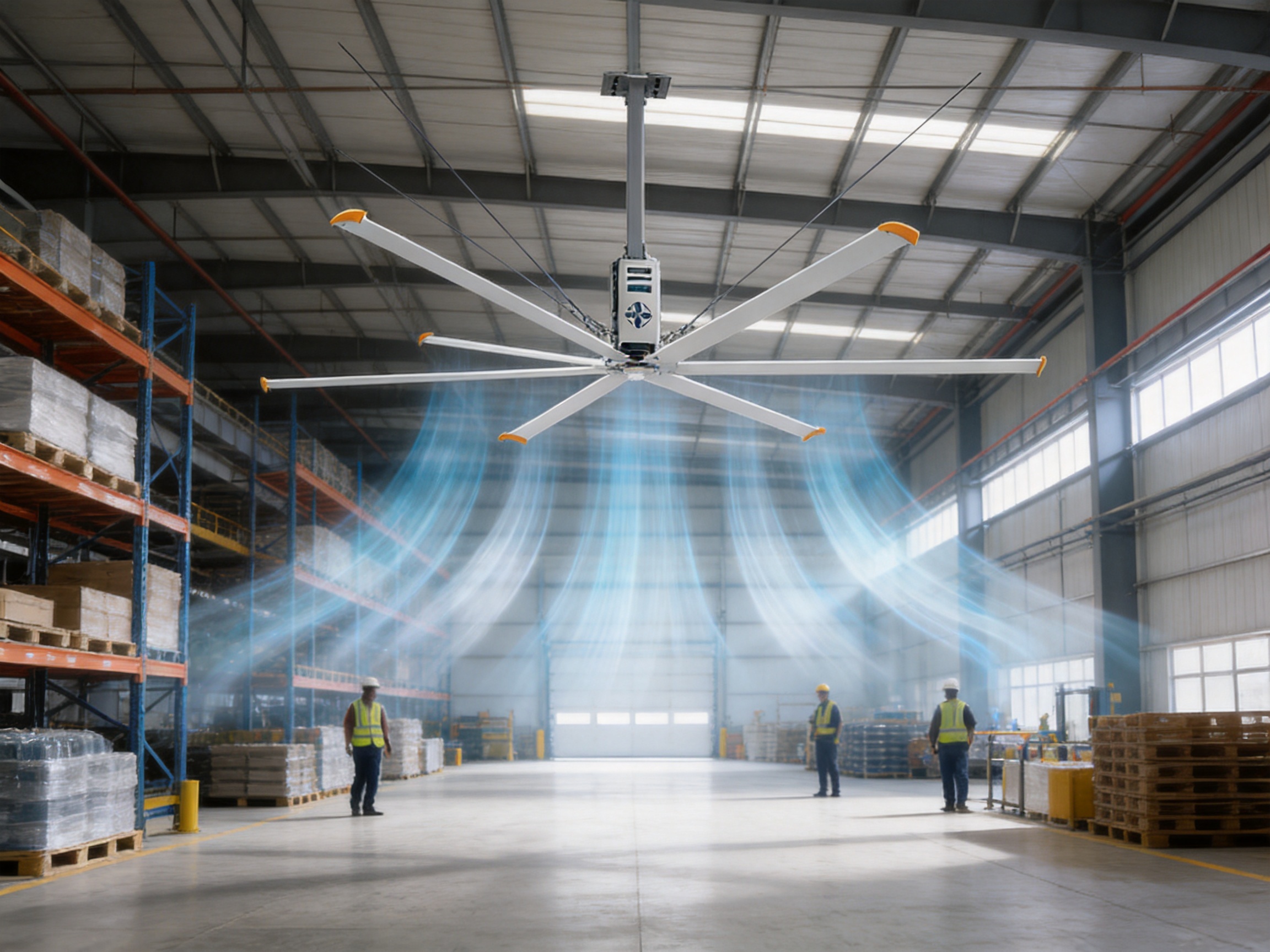
A conventional wall fan or pedestal fan generally projects air in one direction. Its effective comfort zone is limited by blade size, mounting position, and obstacles. The 10-foot HVLS fan distributes air downward and outward from a central overhead location, allowing one unit to influence a much wider portion of the floor.
Using one appropriately sized ceiling fan can reduce the number of individual fan units, electrical connections, wall penetrations, control points, and maintenance locations. Fewer devices may simplify cleaning, inspection, spare-parts management, and operator training.
Large open buildings often contain temperature layers. The fan’s downward circulation helps mix air between the ceiling and occupied zone. This can improve comfort and support heating efficiency during colder periods by returning warm air from the roof area toward the working level.
Ceiling installation keeps the floor clear for vehicles, inventory, machinery, retail displays, seating, and production equipment. This is especially useful in warehouses and workshops where floor-mounted equipment can create trip hazards or interfere with material handling.
The variable-speed design enables facility managers to adjust airflow rather than operating the fan at a single fixed output. This supports seasonal control, occupancy-based operation, and integration with broader building-management strategies.
Small high-speed fans can create uncomfortable drafts in one area while leaving other parts of a building stagnant. A large fan is designed to create a more evenly distributed circulation pattern. Proper selection and commissioning remain essential, but the basic airflow approach is better suited to open environments.
Multiple small fans may appear attractive because each unit is relatively inexpensive and easy to purchase. However, a large installation can create hidden costs. Every fan requires electrical service, mounting hardware, controls, inspection, and eventual replacement. Several small air streams may also conflict with one another or become blocked by shelving, partitions, machinery, and stored goods.
A 10-foot HVLS fan provides a centralized alternative. Its large airflow footprint can reduce the number of devices required for general circulation. The result is a cleaner ceiling and floor layout, fewer potential failure points, and a more consistent approach to air movement.
The correct comparison should include total ownership cost rather than purchase price alone. Project owners should consider energy consumption, installation labor, control systems, cleaning, bearing or motor maintenance, downtime, replacement parts, and the operational value of improved comfort. In many large facilities, these long-term factors are more important than the initial cost of an individual fan.
There are situations where small fans remain appropriate. Tight rooms, enclosed workstations, localized heat sources, or spaces with complicated partitions may require targeted ventilation. The 10-foot HVLS fan is most effective in open or semi-open environments where a broad circulation pattern can develop.
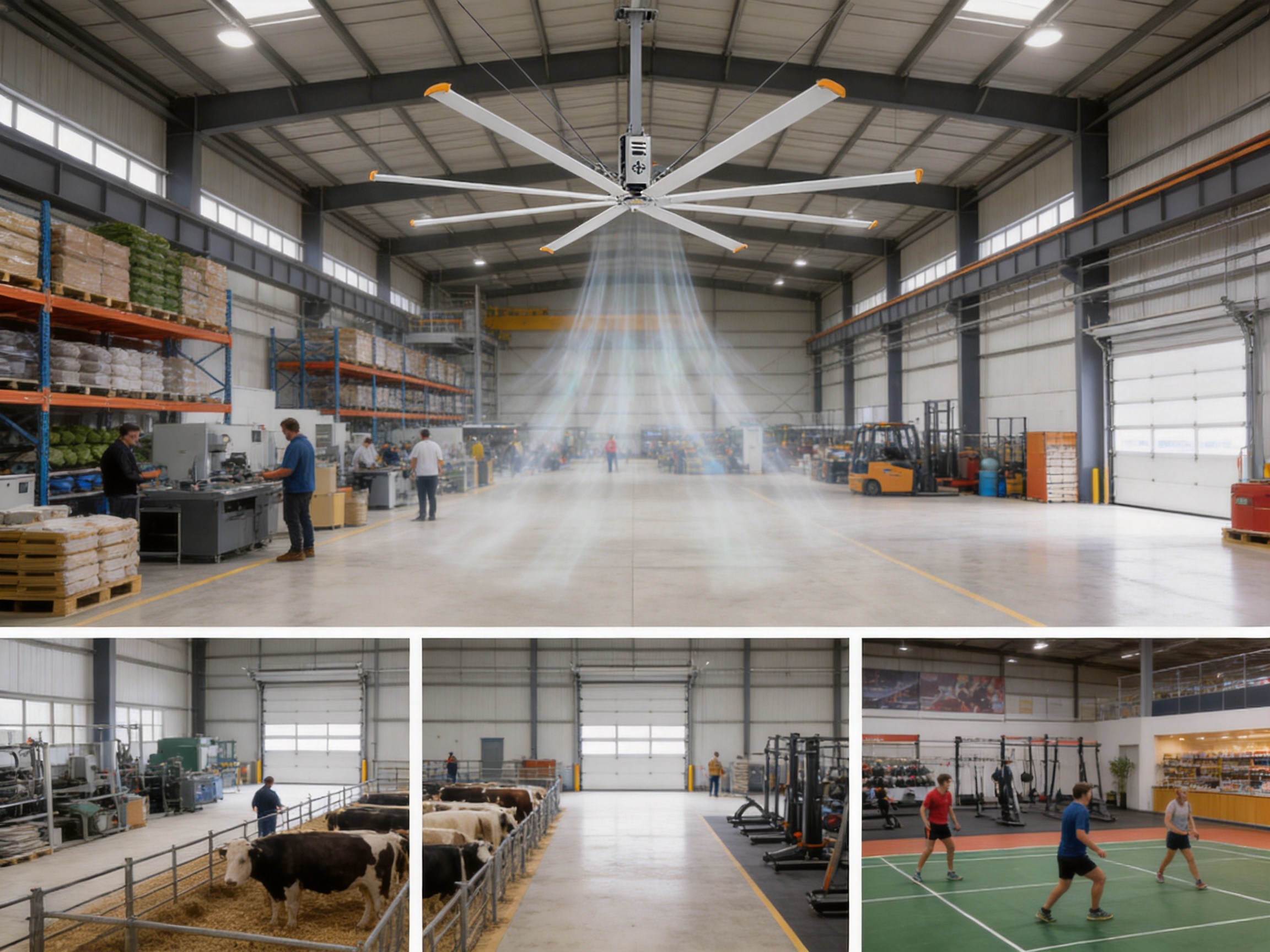
Warehouses often have high roof structures, large loading doors, extensive storage racks, and varying occupancy levels. Air can become stagnant in aisles, packing zones, staging areas, and spaces between the roof and stored goods. A ceiling-mounted HVLS fan helps maintain general movement throughout these areas.
During warm weather, airflow can improve worker comfort during picking, packing, sorting, and loading operations. During colder months, the fan can help destratify heated air. This may reduce temperature variation between the roof zone and the occupied zone, although the fan should be operated at an appropriate low speed to avoid creating discomfort.
Warehouse operators should consider rack height, sprinkler locations, lighting fixtures, crane paths, fire-safety clearances, and forklift activity before installation. The fan should be located and supported so that it does not interfere with storage systems or building services.
Manufacturing facilities may contain heat-generating machinery, welding areas, assembly lines, packaging equipment, and large numbers of employees. Local exhaust systems may be needed to remove contaminants at the source, but general air circulation remains important for comfort and temperature management.
The 10-foot fan can help move air through open production areas and reduce stagnant zones around equipment. Its ability to operate at adjustable speeds allows the airflow pattern to be adapted to different processes. In a facility with sensitive production steps, air movement should be evaluated carefully to avoid disturbing lightweight materials, powders, films, or precision operations.
HVLS circulation should complement, not replace, code-required extraction and filtration systems. Where fumes, dust, vapors, or hazardous gases are generated, the appropriate industrial hygiene controls must remain the primary solution.
Agricultural buildings require careful management of temperature, humidity, odors, and air quality. Large fans can support air circulation in barns, animal housing, crop facilities, and storage structures. Improved movement may help reduce stagnant pockets and assist with general environmental management.
Every agricultural application must be evaluated according to animal type, stocking density, building layout, seasonal conditions, and local welfare requirements. Air velocity that is suitable for one type of livestock may not be appropriate for another. Moisture, dust, ammonia, and cleaning chemicals can also influence equipment selection and maintenance procedures.
The aluminum alloy blade construction offers a practical foundation for industrial use, but the installation environment should be reviewed before ordering. Protective finishes, corrosion considerations, electrical protection, and cleaning access should be included in the project specification.
Retail stores, wholesale clubs, exhibition halls, and event venues often combine high ceilings with large open floor plans. Air-conditioning systems may provide temperature control, yet air distribution can still be uneven, particularly near entrances, display structures, or crowded areas.
A ceiling fan can improve perceived comfort without occupying valuable selling or exhibition space. Adjustable speed makes it possible to use gentle circulation during normal business hours and increase airflow during crowded events or seasonal heat.
Exhibition halls may also benefit from more uniform temperature and humidity distribution. However, sensitive exhibits, hanging displays, lightweight graphics, and suspended structures must be considered during design. The fan location and operating speed should be coordinated with the event layout.
Physical activity increases body heat and raises the need for effective air movement. In gyms, training centers, indoor courts, and sports arenas, the 10-foot HVLS fan can support comfort by circulating air across occupied areas.
The fan can be integrated with heating, cooling, and fresh-air systems to help distribute conditioned air. Operators should select settings that provide comfort without creating excessive airflow across sensitive sports activities. Locations above spectator zones, warm-up areas, or general circulation spaces may be particularly suitable.
Structural review is essential in sports facilities because ceilings may include lighting rigs, acoustic panels, scoreboards, retractable equipment, and suspended nets. The fan’s mounting system and safety clearances must be coordinated with all overhead equipment.
Shanghai Aipu Fans Co., Ltd. was established in Shanghai, China, in 2006 and specializes in industrial-grade ceiling fans and ventilation solutions. Its experience in this field supports the development of products for warehouses, factories, commercial spaces, agricultural buildings, and other demanding environments.
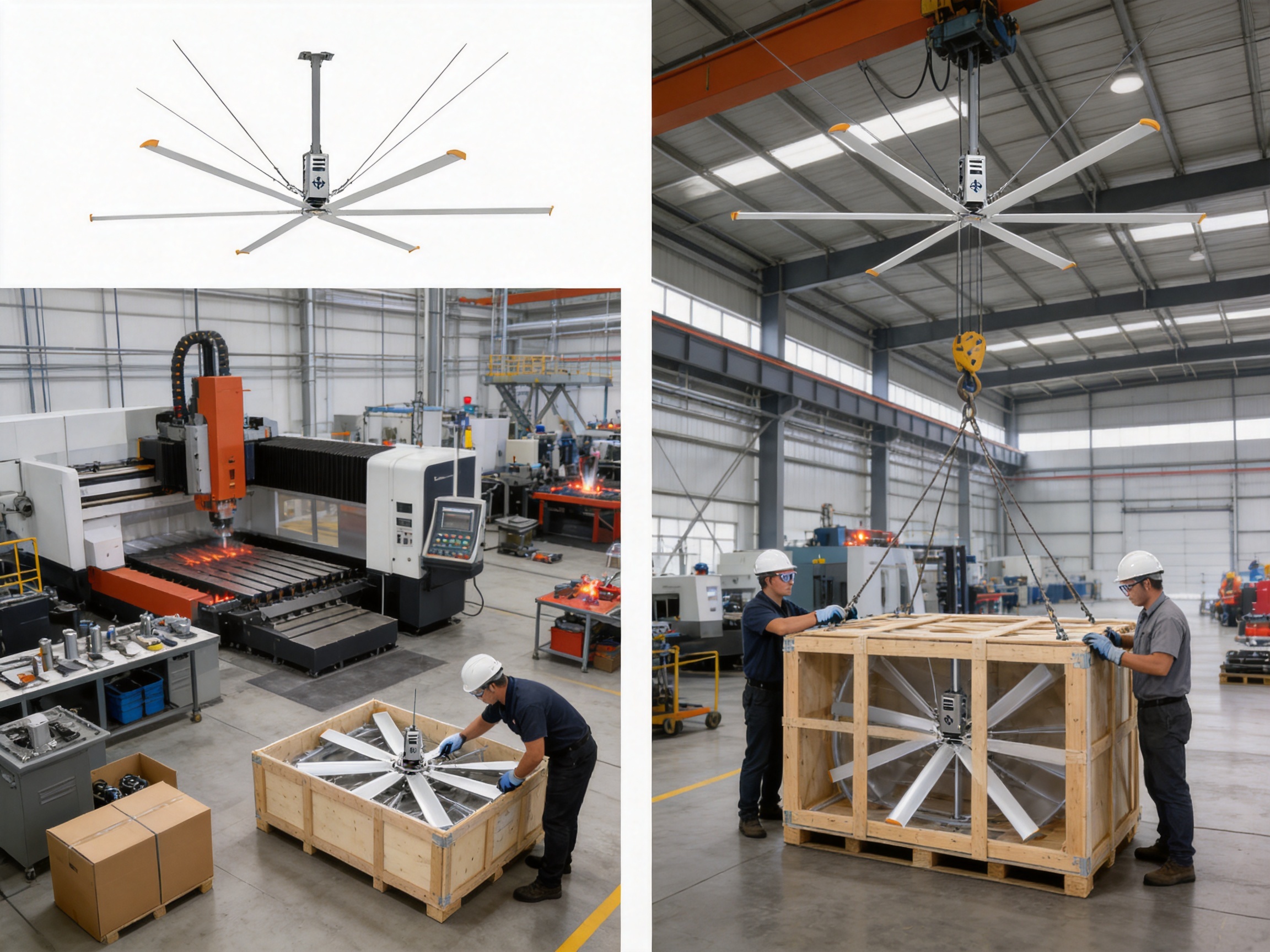
The company operates an 8,000-square-meter production base equipped with automated machinery and dedicated technical areas. These include a machining center, cutting center, welding center, and testing center. The presence of specialized production departments allows key manufacturing processes to be managed systematically instead of relying entirely on fragmented external operations.
For industrial fans, manufacturing consistency is critical. Blade dimensions, mounting points, motor alignment, structural connections, and rotating balance all influence performance and safety. Controlled cutting and machining processes help maintain repeatability, while welding capabilities support the fabrication of robust structural components and brackets.
A dedicated testing center is also important. Industrial fans must be evaluated for operating behavior, electrical performance, vibration, noise, speed response, and general reliability. Testing does not eliminate the need for correct installation, but it helps identify manufacturing issues before products are shipped to customers.
High-precision automated machinery can improve repeatability and reduce variation between production batches. For a large fan, consistent blade geometry and component positioning are particularly important because even small differences can affect balance or airflow.
Automation also supports production efficiency. It can help the manufacturer manage larger orders, maintain consistent processing times, and reduce dependence on manual operations for repetitive tasks. Skilled personnel remain essential for process control, inspection, assembly, and final verification.
Machining centers are used to produce components that require accurate dimensions, holes, interfaces, or mounting surfaces. Correct machining supports motor installation, shaft alignment, structural connections, and serviceability.
Cutting centers allow raw materials and structural parts to be prepared according to controlled specifications. Accurate cutting is especially important when producing multiple blades or repeated structural components. Consistent dimensions contribute to balanced assembly and predictable installation.
The welded frame and support components must withstand static loads, rotating forces, vibration, and long-term environmental exposure. A dedicated welding center supports better process organization and inspection. Weld quality, joint design, penetration, finishing, and corrosion protection should all be considered as part of the manufacturing process.
Testing provides an opportunity to verify that assembled products operate as intended before delivery. A professional testing program may include checks of motor response, rotational stability, speed control, electrical connections, abnormal noise, vibration, and general assembly quality.
For customers ordering OEM or ODM products, testing is particularly valuable because customized dimensions, controls, finishes, and voltage requirements may introduce additional technical variables. Factory verification helps ensure that the final configuration corresponds with the agreed project specification.
Different buildings require different fan sizes, colors, control systems, electrical inputs, mounting arrangements, and documentation. The manufacturer provides OEM and ODM support to accommodate project-specific requirements.
OEM services may be suitable for customers who already have a defined product specification, brand requirement, or distribution program. ODM support can assist customers who need help developing a fan configuration for a particular application, market, or building type.
Customization may involve blade design, motor selection, voltage, frequency, control interface, packaging, labels, documentation, or installation accessories. The final options should be confirmed through technical drawings and a formal quotation. Factors such as ceiling height, structural load capacity, environmental conditions, required coverage, and local electrical standards should be assessed before production begins.
Project customers should provide accurate information about the building and intended use. Useful details include floor dimensions, ceiling construction, height, obstructions, target comfort conditions, existing ventilation equipment, power supply, operating schedule, and installation location. Better input allows the manufacturer to recommend a more appropriate configuration.
An HVLS ceiling fan must be mounted to a suitable structural support. The fan should not be attached solely to a weak ceiling panel, decorative surface, or non-structural suspended ceiling. The supporting structure must be reviewed by a qualified professional according to the fan weight, dynamic forces, safety requirements, and local building standards.
Clearance is another essential consideration. The fan must maintain suitable distance from walls, beams, lights, sprinklers, cranes, storage racks, signs, and other suspended equipment. The exact clearance depends on the building and installation method, so it should be confirmed using approved technical drawings.
Electrical installation should be performed by qualified personnel. The input voltage, frequency, protection devices, grounding, isolation switch, controller, and cable routing must be compatible with the fan specification. The stated product options include 220 V, 380 V, and 415 V configurations, but the correct version must be selected for the local power supply.
After installation, the fan should be inspected for secure fasteners, correct blade attachment, alignment, electrical safety, control response, and abnormal vibration. Initial operation should begin at a low setting before gradually increasing speed while personnel observe the fan and surrounding structure.
Regular maintenance helps preserve airflow performance and operating reliability. Inspection intervals should be based on operating hours, environmental conditions, dust levels, humidity, vibration, and the manufacturer’s recommendations.
Maintenance personnel should inspect blade surfaces, blade fasteners, motor connections, mounting hardware, safety cables, structural supports, and controller behavior. Any unusual noise, oscillation, vibration, odor, overheating, or speed fluctuation should be investigated promptly.
Dust and residue should be removed using methods appropriate for the blade finish and the facility environment. Aggressive chemicals, abrasive tools, or excessive water may damage protective coatings or electrical components. Cleaning procedures should be documented, especially in food processing, agricultural, and high-dust environments.
The three-year warranty provides additional support for eligible product issues, subject to the manufacturer’s warranty terms and correct installation requirements. Customers should retain purchase records, installation information, inspection reports, and maintenance documentation to support future service requests.
Large rotating equipment must be treated as a safety-critical installation. Only trained personnel should install, inspect, repair, or modify the fan. Power should be isolated before service work begins, and appropriate lockout procedures should be followed.
Operators should prevent unauthorized persons from adjusting control parameters or entering restricted maintenance areas. If the fan is installed above a production line, pedestrian area, or public space, safety devices and structural inspections should be included in the facility’s routine safety program.
The fan should never be operated if blades, supports, fasteners, or electrical components appear damaged. A temporary shutdown is preferable to continued operation under uncertain conditions. Any replacement part should match the approved specification and be installed according to the manufacturer’s instructions.
Fan diameter is only one part of a complete ventilation design. Project planners should also evaluate the building’s total floor area, ceiling height, thermal load, occupancy, air-conditioning system, obstructions, and desired air velocity.
The 10-foot model is a practical choice for applications requiring broad circulation in a medium-sized area. Larger buildings may need multiple 10-foot fans or a larger model from the same product family. The broader range includes configurations from approximately 14 feet to 28 feet, with different blade counts, motor powers, speeds, and air-volume ratings.
Fan quantity should be determined using a layout rather than a simple area division. Columns, racks, partitions, machinery, lighting, and roof structure can influence airflow. A professional layout should identify where air can descend and spread without being blocked or directed into sensitive work zones.
It is also important to distinguish between circulation and ventilation. Circulation moves existing air within the building. Ventilation introduces fresh air and removes stale or contaminated air. Many facilities require both functions. The HVLS fan should therefore be considered as one part of a coordinated indoor environmental system.
During warm seasons, the fan can operate at a higher setting to increase air movement around occupants. The resulting evaporative cooling effect may improve comfort, especially when combined with appropriate fresh-air exchange and shading.
During colder seasons, the fan can be operated at a lower speed to mix warm air that has collected near the ceiling. This destratification effect may help distribute heat more evenly and reduce the temperature difference between the roof zone and occupied area. The goal is not necessarily to create a strong draft but to encourage gentle mixing.
In transitional seasons, the adjustable speed range allows the facility to operate the fan only when needed. This can reduce unnecessary energy consumption and help maintain comfortable conditions as outdoor temperatures change.
An industrial ceiling fan is expected to operate for long periods, often in dusty, humid, or demanding environments. Small manufacturing defects can become significant problems when components are subjected to continuous rotation and structural loads.
Quality begins with material selection and continues through cutting, machining, welding, assembly, balancing, electrical testing, packaging, and after-sales support. A manufacturer with dedicated production and testing resources is better positioned to control these stages and respond to customer requirements.
Shanghai Aipu Fans Co., Ltd. combines industrial fan experience with an 8,000-square-meter production base, specialized machinery, multiple manufacturing centers, and international sales experience. Its products are supplied to customers in different markets, while its technical approach emphasizes energy efficiency, reliability, customization, and practical industrial ventilation solutions.
The use of wooden-case packaging provides additional protection during transport. Large fan components must be protected from impact, moisture, deformation, and handling damage while in transit. Proper packaging is particularly important for export orders and long-distance logistics.
HVLS means high volume, low speed. An HVLS fan uses large blades to move a substantial volume of air across a broad area without relying on the very high rotational speed of a small portable fan.
The main product configuration has a diameter of 3.0 meters, or approximately 10 feet. The manufacturer also offers a broader range of industrial HVLS fan sizes for larger or differently configured spaces.
The product information identifies a 0.75 kW motor configuration. Actual electrical consumption depends on the selected operating speed, voltage, frequency, controller, load, and operating conditions.
The 10-foot configuration uses six aluminum alloy blades. The wider product family includes models with different blade counts depending on fan diameter and design requirements.
The stated coverage area is approximately 200 square meters under suitable installation and operating conditions. Actual coverage depends on ceiling height, building layout, obstructions, desired air movement, and other ventilation equipment.
Yes. The stated speed range is 0–106 RPM, depending on the selected configuration and controller. Variable-speed operation allows the fan to respond to seasonal conditions, occupancy, production schedules, and comfort requirements.
Suitable applications include warehouses, factories, manufacturing plants, agricultural barns, retail spaces, exhibition halls, gyms, indoor sports arenas, automotive repair shops, food processing facilities, and other large open buildings.
No. The HVLS fan primarily circulates air inside a building. It does not automatically remove contaminants or provide fresh-air exchange. Facilities requiring pollutant control, odor removal, or code-compliant ventilation should use appropriate exhaust, filtration, and fresh-air systems in combination with the fan.
The listed options include 220 V, 380 V, and 415 V, with frequency options of 50 Hz or 60 Hz. The correct configuration should be confirmed according to the project’s electrical supply and local standards.
Yes. OEM and ODM support is available. Customers can discuss requirements involving product configuration, electrical specifications, controls, packaging, labels, and other project-related details.
The listed warranty period is three years. Warranty coverage is subject to the manufacturer’s terms, approved installation, correct operation, and applicable service conditions.
The fan should be installed by qualified professionals on a suitable structural support. The installation must account for fan weight, dynamic forces, clearances, electrical protection, safety devices, and local building requirements.
Aluminum alloy offers low weight, useful strength, corrosion resistance, and dimensional stability. These properties are suitable for large rotating blades, although the appropriate surface protection and maintenance plan should be selected for the operating environment.
Useful information includes building dimensions, ceiling height, floor plan, structural conditions, intended application, local voltage and frequency, desired coverage, environmental conditions, operating schedule, and any OEM or ODM requirements.
The 10-foot high-speed HVLS ceiling fan provides a practical method for moving air across large industrial and commercial spaces. Its 3.0-meter diameter, six aluminum alloy blades, 0.75 kW motor configuration, adjustable speed range, and approximate 200-square-meter coverage make it suitable for warehouses, factories, agricultural buildings, retail facilities, gyms, exhibition halls, and other open environments.
Its main advantages include broad airflow distribution, flexible speed control, efficient use of floor space, improved temperature uniformity, and the potential to reduce dependence on multiple small fans. The fan can support both warm-season comfort and cold-season destratification when operated according to the building’s requirements.
Product performance is supported by the manufacturer’s industrial experience, 8,000-square-meter production base, automated machinery, machining center, cutting center, welding center, testing center, OEM and ODM capabilities, and international service experience. These resources help provide a structured path from product design and component processing to assembly, testing, packaging, and customer support.
For the best result, the fan should be selected as part of a complete airflow plan. Structural support, electrical compatibility, building layout, safety clearances, maintenance access, and the relationship between circulation and fresh-air ventilation should all be reviewed before installation. When correctly specified and professionally installed, the 10-foot HVLS fan can become a dependable component of an efficient large-space ventilation strategy.
1. American Society of Heating, Refrigerating and Air-Conditioning Engineers. Handbook of Heating, Ventilating, and Air-Conditioning Principles and Applications.
2. Air Movement and Control Association International. Industrial and Commercial Fan Performance and Testing Principles.
3. International Organization for Standardization. Guidance on Mechanical Vibration, Rotating Equipment, and Fan Performance Evaluation.
4. Occupational safety guidance for the installation, operation, inspection, and maintenance of industrial rotating equipment.
5. Manufacturer-provided technical information for the 10-foot high-speed HVLS ceiling fan and associated industrial fan product family.
6. Manufacturer-provided company information concerning industrial fan production, automated machinery, machining, cutting, welding, testing, packaging, OEM services, and ODM services.
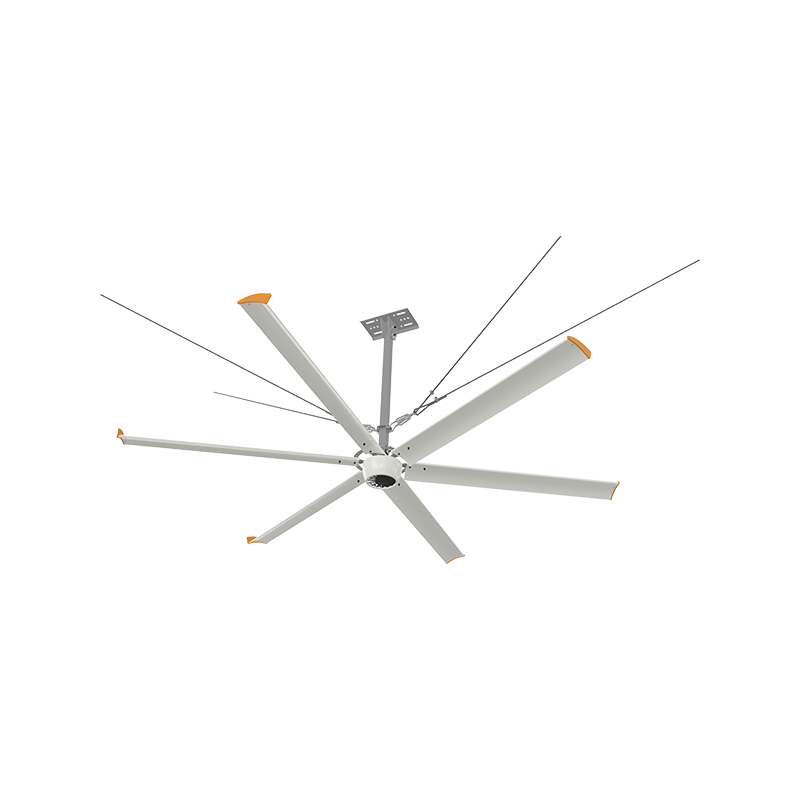
The 15-foot Even Airflow Industrial BLDC Ceiling Fan utilizes a high-efficiency BLDC motor and carefully designed blades. This ceiling fan operates with extremely low noise levels, making it suitable ...
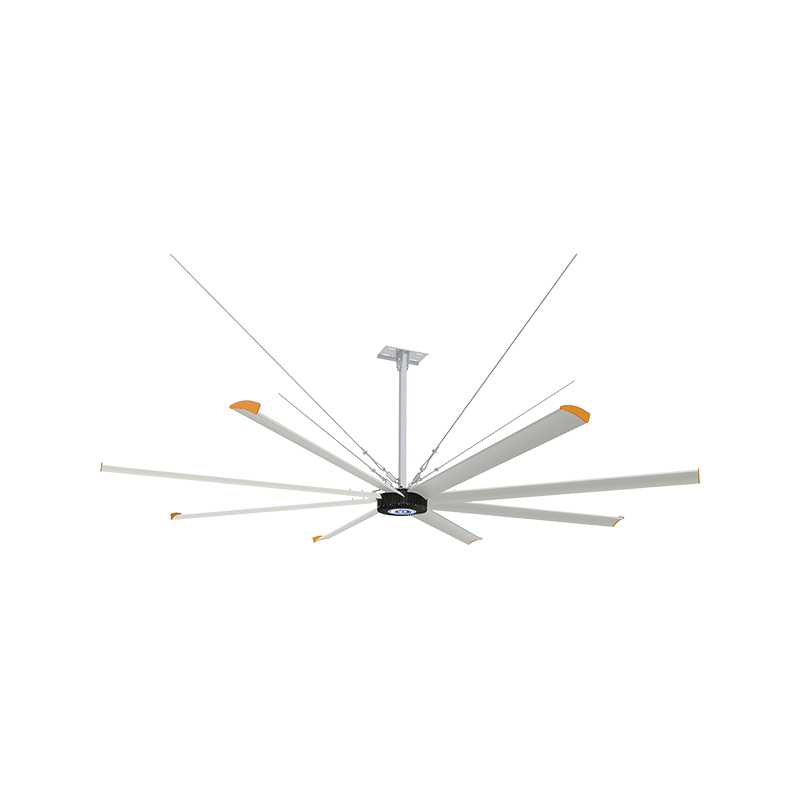
The 8-foot HVLS Large Industrial BLDC Ceiling Fan is equipped with a 0.3KW brushless DC motor, offering higher energy efficiency and lower noise levels. The lower power consumption design helps users ...
This 10-foot high-speed HVLS ceiling fan is equipped with a 0.75 kW motor, suitable for most industrial, commercial, and agricultural environments. Compared to traditional high-power fans, the 0.75 kW...
The 10-foot DC motor-driven HVLS (High Volume Low Speed) industrial and commercial ceiling fan utilizes a low-speed, high-airflow operating principle, achieving uniform airflow over a large area and a...
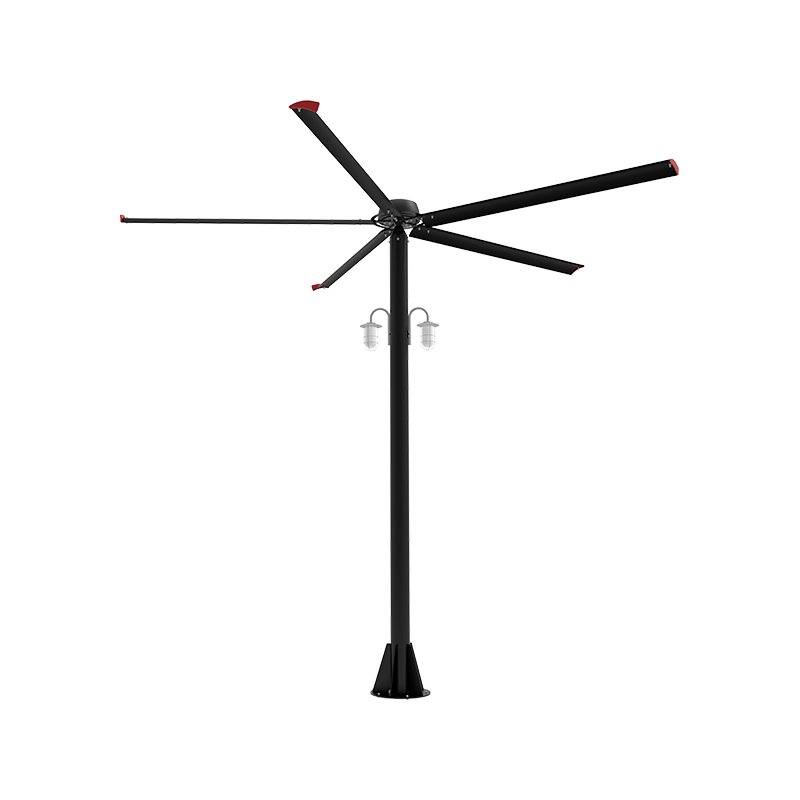
The large vertical HVLS floor-standing ventilation fan offers a variety of color options, allowing users to choose the most suitable color based on different environments and decoration needs. This c...
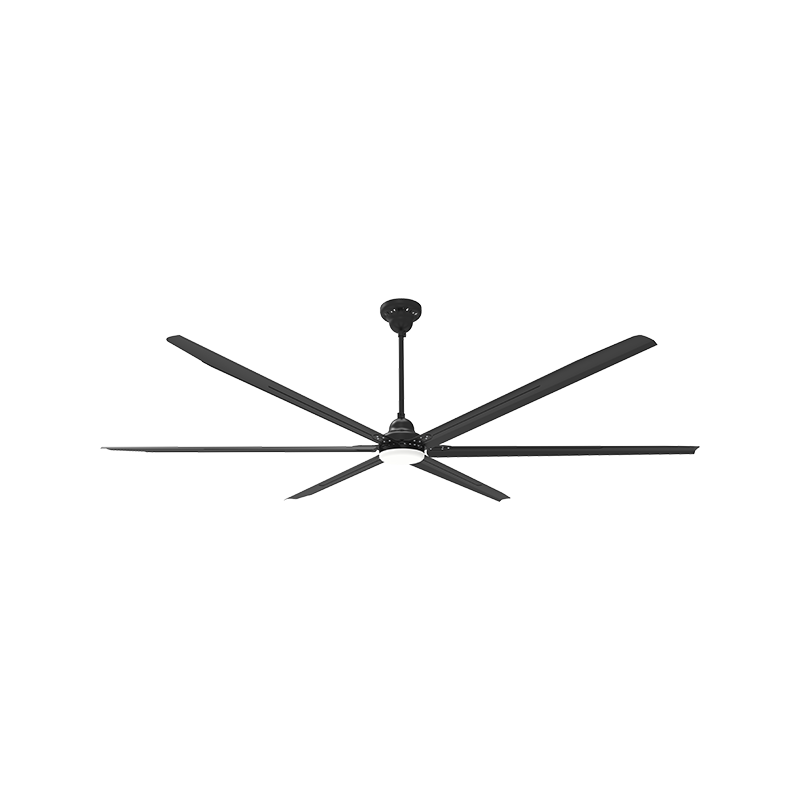
1. Core Technology: High Volume, Low SpeedNatural Breezes: Unlike the “harsh” wind from small fans, HVLS fans use massive blades rotating at low speeds to create a large-scale, three-dimensional breez...
A 6,800 m² factory floor used to be ventilated by roughly 300 small wall and pedestal fans. Six large ceiling fans now cover the same area, and in the manufacturer's own comparison that change cuts m...
READ MORESpecifying industrial air movement The HVLS Ceiling Fan Isn’t a Big Ceiling Fan. Sizing, motor selection, and mounting height have to work together before a large industrial space can feel genuinely...
READ MORECommercial HVLS Fans: The Quiet Engineering Behind Large-Space Airflow A practical guide to selecting high-volume, low-speed ceiling fans for warehouses, factories, and commercial halls — with the ef...
READ MORELarge-space air movement Big Commercial Fans: How to Size, Mount and Power Them One 24 ft ceiling fan can replace forty pedestal units, but only when span, mounting height and motor match the buildin...
READ MORE Custom Large Industrial Fans Manufacturers